
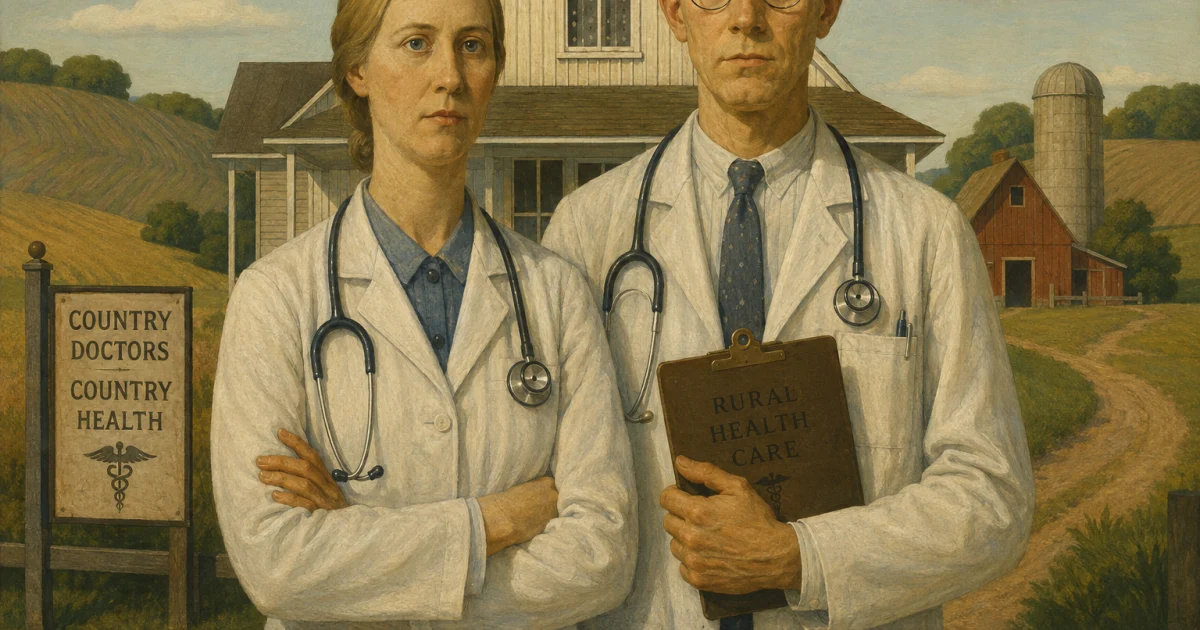
Rural America faces a critical and escalating shortage of physicians, a crisis poised to intensify as a wave of experienced doctors nears retirement with insufficient replacements in the pipeline. Emerging research is shedding crucial light on this complex issue, revealing that the location of a physician’s undergraduate medical education plays a surprisingly minor role in their decision to practice in underserved rural areas. Instead, the findings underscore the profound influence of a physician’s upbringing and, most significantly, the location where they complete their graduate medical education – their residency and fellowship training.
n
The stark reality is that vast swathes of rural America are transforming into healthcare deserts, leaving millions of residents with limited access to essential medical services. This phenomenon is not confined to primary care; significant deficits exist across numerous specialties, including general surgery, psychiatry, obstetrics and gynecology, oncology, and cardiology. As the nation grapples with this growing disparity, understanding the factors that draw and retain physicians in rural settings has become a paramount concern for public health officials, policymakers, and rural communities alike.
n
The Growing Chasm: Understanding the Rural Physician Shortage
n
The demographic landscape of rural America paints a concerning picture. While approximately 15% to 20% of the United States population resides in rural counties, these areas are served by a disproportionately smaller percentage of actively practicing physicians – ranging from 9% to 11%. This disparity is even more pronounced in specialized fields. For instance, rural regions often have half the number of general surgeons, a third of the psychiatrists, and nearly half the obstetrician-gynecologists compared to their urban counterparts.
n
This scarcity creates a cascade of negative consequences. Residents in rural areas often face extended travel times for routine and specialized medical care, a burden that can be particularly acute for those with chronic conditions or during medical emergencies. The absence of local specialists can lead to delayed diagnoses, suboptimal treatment outcomes, and increased reliance on emergency services, which are themselves often strained in rural settings.
n
The physician shortage is further exacerbated by an aging rural physician workforce. A significant portion of actively practicing rural physicians are nearing or are in the age range where retirement becomes a consideration. With only a small fraction of new medical school graduates choosing rural practice, the pipeline for replacement physicians is critically underdeveloped. This demographic shift threatens to widen the existing gap, pushing already underserved communities further into healthcare insecurity.
n
The problem is also a complex interplay of interconnected factors. For example, the viability of certain medical practices is directly tied to the presence of supporting infrastructure and personnel. An obstetrician may find it challenging to practice without readily available surgical backup from a general surgeon. Similarly, the ability to perform complex abdominal surgeries is contingent on having a skilled surgical team and appropriate post-operative care facilities. The absence of these critical elements can create a self-perpetuating cycle of decline in rural healthcare services.
n
Addressing the Gap: Initiatives in Medical Education
n
In an effort to combat the growing physician shortage, numerous new medical schools have been established in recent decades. However, the geographical distribution of these institutions has done little to alleviate the rural deficit. A mere 13% of these new medical schools are situated in rural, non-metropolitan communities. Many of these rural-based programs are not standalone institutions but rather regional campuses of larger, urban-based medical schools. This model often involves sending students to regional hubs for their clinical clerkships, a workaround necessitated by the lack of comprehensive hospital infrastructure in truly rural settings. Such infrastructure is vital for providing students with the diverse clinical experiences, including intensive care unit (ICU) and subspecialty rotations, essential for a well-rounded medical education.
n
To further target the rural physician shortage, some medical schools have implemented specific rural training tracks. These programs often prioritize admitting students with rural backgrounds, offer specialized coursework focused on rural primary care, and facilitate longitudinal clerkships in rural settings. The aim is to immerse students in the realities of rural practice and foster a connection to these underserved communities.
n
The Unveiling Truth: Training Location Reigns Supreme
n
Recent research, published in JAMA Network Open, offers compelling insights into the factors that most influence a physician’s decision to practice in rural areas. The study, which analyzed data from the Association of American Medical Colleges (AAMC), examined physician origin, their experiences during medical school (undergraduate medical education or UME), and their graduate medical education (GME), including residency and fellowship training.
n
The findings provide a clear hierarchy of influence:
n
- n
- n
Rural Upbringing: Physicians who grew up in rural areas demonstrated a statistically significant association with increased rural practice time, showing a roughly 27% increase. This suggests that personal familiarity and connection to rural life can be a motivating factor.
n
- n
Medical School Location (UME): Surprisingly, the location of a physician’s undergraduate medical education had a minimal direct impact on their likelihood of practicing in a rural setting, accounting for only about a 1% association. This indicates that simply attending a medical school located in a rural area does not guarantee that graduates will choose to practice there.
n
- n
Residency and Fellowship Training (GME): The most powerful predictor of rural practice was the location of graduate medical education. Physicians who completed their residency and fellowship training in rural GME programs showed a substantial 42% increase in subsequent rural practice. This highlights the critical role of hands-on clinical experience in a rural environment during the formative stages of a physician’s career.
n
n
n
n
n
The study further revealed that approximately 80% of trainees who complete their GME in urban areas tend to remain within those broader geographical regions. While the retention rate for rural GME trainees is slightly lower, the data strongly suggests that rural training tracks are a highly effective mechanism for attracting physicians, both those with rural origins and those from urban backgrounds, into underserved rural healthcare markets.
n
The Implications: Charting a Course for Rural Healthcare
n
The research offers a pragmatic and actionable answer to the age-old question of how to keep physicians practicing in rural communities. While establishing rural medical schools is a laudable goal, the evidence points overwhelmingly to the critical importance of developing and expanding robust rural residency and fellowship programs. These programs provide invaluable exposure to the unique challenges and rewards of rural medicine, allowing aspiring physicians to experience firsthand the practice environment and develop the skills necessary to thrive in such settings.
n
However, the location of training alone cannot be the sole solution. Rural practice is fundamentally different from its urban counterpart. It necessitates a different professional and personal ecosystem, characterized by fewer specialists and hospitals, longer distances to refer patients, and a greater reliance on a smaller, more integrated healthcare team. These differences can be perceived as either significant drawbacks or attractive opportunities, depending on an individual physician’s preferences and priorities.
n
Therefore, a multifaceted approach is required to address the rural physician shortage effectively. This involves a "matching problem" – identifying and nurturing individuals who are genuinely drawn to the lifestyle and practice of rural medicine. Rural training tracks serve as a crucial conduit for this, providing the necessary exposure and allowing for the identification of those for whom rural practice is a good fit.
n
Concurrently, rural healthcare systems and communities must actively work to enhance the appeal and sustainability of rural practice. This could involve strengthening clinical support structures, fostering robust professional networks among rural practitioners, implementing more workable schedules that promote work-life balance, and investing in other improvements that mitigate the inherent tradeoffs of practicing far from major metropolitan medical centers.
In essence, retaining physicians in rural areas requires a concerted effort to either cultivate more physicians who are predisposed to embracing rural life and its medical practice, or to actively transform rural healthcare environments into places where physicians are more inclined to choose and remain. The future of rural healthcare hinges on our ability to implement these strategic interventions, ensuring that all Americans, regardless of their geographical location, have access to the quality medical care they deserve.
Sources:
- Rural Background, Training Exposure, and Rural Practice Location Among US Physicians. JAMA Network Open DOI: 10.1001/jamanetworkopen.2026.25481

