
New Study Reveals a Paradoxical Exodus from Privatized Medicare as Illness Strikes, Raising Questions for Future Healthcare Models
n
Introduction
n
Medicare Advantage (MA), the privatized arm of the federal health insurance program for seniors, has rapidly gained traction, now covering over half of eligible beneficiaries. Its allure is undeniable: enhanced benefits like dental and vision, integrated prescription drug coverage, and crucially, out-of-pocket maximums, all presented as a more comprehensive package than traditional Medicare. However, a groundbreaking new study published in JAMA Health Forum illuminates a stark economic paradox: while MA appears a compelling choice for healthy individuals, its appeal can dramatically diminish for those who fall ill. This study not only sheds light on the migration patterns of increasingly sick patients from MA back to traditional Medicare but also carries profound implications for the broader debate surrounding healthcare reform, including the aspirational concept of Medicare for All. The findings suggest that fundamental trade-offs inherent in healthcare systems, regardless of their structure, cannot be easily wished away.
n
The Allure of Medicare Advantage: A Siren Song for the Healthy
n
In the United States, Medicare is a cornerstone of healthcare security for millions of individuals aged 65 and older, as well as those with certain disabilities. For decades, the traditional fee-for-service model, often supplemented by private Medigap plans and separate prescription drug coverage (Part D), served as the primary pathway. However, the landscape has been significantly reshaped by the rise of Medicare Advantage plans, offered by private insurance companies and approved by Medicare.
n
The appeal of MA is multifaceted and, for many, deeply practical. These plans frequently bundle various benefits that traditional Medicare does not, such as routine dental, vision, and hearing care, often at no additional premium beyond the standard Medicare Part B premium. Furthermore, MA plans are mandated to include an out-of-pocket maximum, providing a critical financial safety net against catastrophic medical expenses – a feature absent in traditional Medicare, where beneficiaries can face unlimited costs if they don’t have supplemental insurance. The integration of prescription drug coverage (Part D) into a single plan also simplifies administration for beneficiaries.
n
These advantages have translated into substantial growth. As of early 2024, approximately 54% of all eligible Medicare beneficiaries are enrolled in an MA plan. This surge is driven by a perception of greater value and comprehensive coverage, making MA plans a seemingly "win-win" proposition for beneficiaries seeking to maximize their benefits while managing their healthcare costs.
n
However, the very mechanisms that make MA attractive to a healthy population can become significant hurdles when illness strikes. The "cost" of these enhanced benefits and financial protections is often embedded in other aspects of the plan: more restrictive networks of hospitals and providers, the administrative burden of prior authorization for certain treatments, and greater overall administrative friction. While taxpayers, not beneficiaries, bear the higher per-member costs associated with MA plans due to risk-adjusted payments to insurers, the beneficiary experiences the direct impact of these utilization controls.
n
The Turning Tide: A New Study Exposes the Exodus of the Sick
n
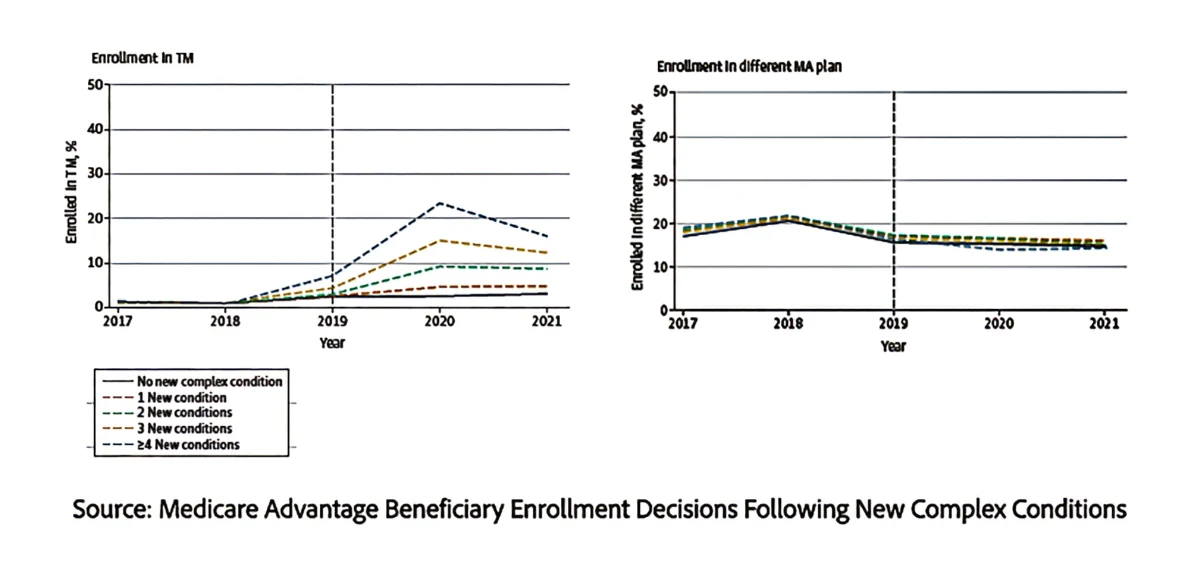
The JAMA Health Forum study, titled "Medicare Advantage Beneficiary Enrollment Decisions Following New Complex Conditions," offers a critical, data-driven examination of what happens when the health status of MA enrollees changes. The research meticulously tracked a substantial cohort of approximately one million MA beneficiaries from 2016 through 2019. Crucially, this cohort was established with a baseline of individuals who, at the outset of the study, had no pre-existing medical issues. This design allowed researchers to isolate the impact of developing new health conditions on enrollment decisions.
n
The study’s findings reveal a clear and compelling trend: as beneficiaries experience a decline in health and develop new medical conditions, a significant portion opt to disenroll from their Medicare Advantage plans and transition back to traditional Medicare. This migration is not a minor shift; it is a direct response to the evolving needs of patients whose healthcare requirements become more complex.
n
The study’s methodology involved dividing the million-strong cohort into two groups: approximately 200,000 individuals who developed one or more new medical conditions during the study period, and a control group of about 800,000 who remained healthy. Among those who developed health issues, the severity varied: 80% developed a single new condition, 14% experienced two new conditions, and the remainder faced three or four complex new diagnoses.

n
The results are stark. The researchers found that as the complexity of beneficiaries’ health needs increased, so did their likelihood of leaving Medicare Advantage. This shift is particularly pronounced when beneficiaries have access to a viable pathway for supplemental coverage, such as a Medigap policy, which can ease the transition and mitigate potential financial risks associated with leaving an MA plan.
n
Key Findings: The Trade-off Between Benefits and Access
n
The study’s core revelation is the shifting calculus beneficiaries undertake as their health deteriorates. While MA’s promise of out-of-pocket maximums and bundled benefits is attractive to those who are well, the limitations on access—such as restricted provider networks and the requirement for prior authorization for certain procedures—become increasingly problematic for those with chronic or complex conditions.
n
Specifically, the research indicates that:
n
- n
- Illness Drives Disenrollment: Beneficiaries who developed new, complex medical conditions were significantly more likely to leave Medicare Advantage than their healthy counterparts. This suggests that the perceived benefits of MA diminish as the need for extensive, ongoing, and potentially specialized medical care rises.
- Access Becomes Paramount: For those facing serious health challenges, the ability to access a wide range of doctors and hospitals, and to receive prompt approval for necessary treatments, often outweighs the financial protections offered by MA. Traditional Medicare, with its broader provider acceptance and fewer utilization management hurdles, becomes a more appealing option in these circumstances.
- Medigap Facilitates the Exit: The availability of Medigap policies plays a crucial role in enabling this transition. Medigap plans work alongside traditional Medicare to cover the "gaps" in Original Medicare, such as deductibles and coinsurance. When beneficiaries can secure Medigap coverage, the financial disincentive to leave MA is reduced, making the switch to traditional Medicare more feasible. Without such supplemental coverage, some may feel financially trapped in their MA plans, even if they are no longer the optimal choice for their health needs.
- Limited Movement Between MA Plans: Interestingly, the study also observed that while movement from MA to traditional Medicare was significant among the sick, there was less movement between different MA plans. This suggests that once a beneficiary experiences a significant health event, the fundamental structure of managed care, with its inherent access limitations, becomes the primary concern, rather than minor differences between competing MA offerings.
n
n
n
n
n
The Economic Underpinnings: Adverse Selection and Moral Hazard
n
The findings of this study can be understood through two fundamental economic lenses: adverse selection and moral hazard, both of which are central to the functioning of any insurance market, including healthcare.
n
Adverse Selection and the Beneficiary’s Calculation
n
Adverse selection occurs when individuals with a higher-than-average risk of needing healthcare services are more likely to choose or remain in certain insurance plans. In the context of MA, this dynamic plays out in two distinct ways:
n
- n
- n
Beneficiary-Driven Adverse Selection: As highlighted by the study, MA plans are often most attractive to beneficiaries who are relatively healthy. For these individuals, the comprehensive benefits and out-of-pocket caps provided by MA can easily justify the potential limitations on provider choice or the need for prior authorizations. However, as a beneficiary’s health deteriorates, their perception of risk changes. They become more acutely aware of their future need for care and may begin to value unrestricted access to a broad network of providers and swift treatment approvals more highly. This leads to what is known as dynamic adverse selection, where individuals’ enrollment decisions change over time based on their evolving health status. Without the ability to easily transition to traditional Medicare with supplemental coverage, some may remain in MA not because it’s their preferred option, but because leaving has become financially prohibitive due to the difficulty of obtaining Medigap coverage once they are ill.
n
-
Plan-Driven Adverse Selection (or Favorable Selection for MA): When sicker, higher-cost beneficiaries leave MA for traditional Medicare, the remaining MA population tends to be healthier and less costly. This scenario benefits the MA plans, as they retain a less expensive enrollee pool. Conversely, traditional Medicare, particularly when combined with Medigap, becomes the destination for these higher-cost individuals, leading to adverse selection into traditional Medicare. The study does not suggest that MA plans deliberately push sick beneficiaries out. However, the inherent features of managed care—utilization controls like prior authorization and network restrictions—which are less consequential for healthy members, become increasingly burdensome for those requiring extensive medical attention. These same mechanisms can thus contribute to lower spending among those who remain in MA while simultaneously making the plans less attractive to those who are likely to incur the highest costs.
Moral Hazard: Incentives and Behavior
Moral hazard refers to the phenomenon where individuals, once insured, may alter their behavior because they do not bear the full financial consequences of their decisions. In healthcare, this can manifest in two opposing ways depending on the insurance structure:
-
Traditional Medicare and Moral Hazard: Traditional Medicare, when paired with Medigap, significantly lowers the marginal cost of additional healthcare services for the beneficiary. This can incentivize greater utilization of services, as the direct out-of-pocket expense for each doctor’s visit, test, or procedure is minimal. This exposure to potentially higher utilization is a fundamental characteristic of the traditional Medicare model.
-
Medicare Advantage and Utilization Control: Medicare Advantage plans, by contrast, operate on a capitated payment system, meaning they receive a fixed payment per enrollee, regardless of the services used. This structure creates a powerful financial incentive for MA plans to control utilization. They achieve this through mechanisms such as limiting provider networks, requiring prior authorization for certain treatments, and implementing care management programs. While these tools can be effective in discouraging unnecessary or low-value care, they can also create barriers to accessing necessary and costly treatments, particularly for beneficiaries with complex health needs.

The paradox, as the study implies, lies in the fact that traditional Medicare’s risk of moral hazard is managed by making care more accessible, while MA’s attempt to control utilization through managed-care restrictions becomes most impactful precisely when beneficiaries are sick and need care the most. This inherent tension drives the observed movement from MA back to traditional Medicare.
Implications for the Future of Healthcare: The Unavoidable Trade-offs
The findings of the JAMA Health Forum study carry significant weight for the ongoing discourse surrounding healthcare policy in the United States, particularly as it relates to the concept of "Medicare for All."
The Fundamental Healthcare Problem
Both Medicare Advantage and traditional Medicare, in their own ways, grapple with a core dilemma inherent in healthcare systems: determining who decides how much care is consumed, who provides that care, and who ultimately bears the financial responsibility.
-
Traditional Medicare: This model largely defers these decisions to patients and their physicians, accepting a higher degree of exposure to utilization and the potential for moral hazard. The emphasis is on patient choice and physician autonomy.
-
Medicare Advantage: This model shifts more of that decision-making power to private insurers. In exchange for potentially greater control over spending and utilization, MA plans employ networks, prior authorization, and other managed-care tools. The emphasis is on cost containment and efficiency, sometimes at the expense of immediate access.
Medicare for All and the Persistence of Scarcity
The aspirational goal of Medicare for All—a single, government-run health insurance program that covers every American—is often framed as a solution to the complexities and inequities of the current system. Proponents argue it would eliminate administrative waste, ensure universal coverage, and reduce costs through bulk purchasing power.
However, the lessons learned from the Medicare Advantage paradox suggest that such a system would not magically eliminate the fundamental trade-offs that define healthcare. While expanding coverage to encompass who is insured is a critical step, it cannot eliminate the underlying realities of:
- Scarcity: Healthcare resources, including specialized personnel, advanced medical technology, and time, are finite. No matter how the system is structured, there will always be limits on what can be provided.
- Moral Hazard: The incentive for increased utilization when costs are externalized will persist, regardless of whether the insurer is a private company or the government.
- The Need for Utilization Control: Even in a universal system, there will be a need to manage the demand for services to ensure sustainability and to prioritize care that is medically necessary and cost-effective.
The harder questions, which Medicare for All would still have to confront, are precisely those that the MA study highlights:
- How much healthcare can society realistically afford and sustain?
- Who decides which treatments and interventions are considered "worth paying for"?
- Ultimately, who has the authority to say "no" to a particular course of treatment, and based on what criteria?
The Medicare Advantage experience demonstrates that attempts to manage these trade-offs through private market mechanisms can create new challenges, particularly for the most vulnerable. While a single-payer system might address some of the administrative complexities and inequities, it would still necessitate difficult decisions about resource allocation, access, and the balance between individual choice and collective responsibility. The study serves as a potent reminder that the promise of universal healthcare does not erase the fundamental economic and ethical dilemmas inherent in providing medical care. Understanding these dynamics is not merely an academic exercise; it is essential for designing healthcare systems that are both equitable and sustainable for all.

