
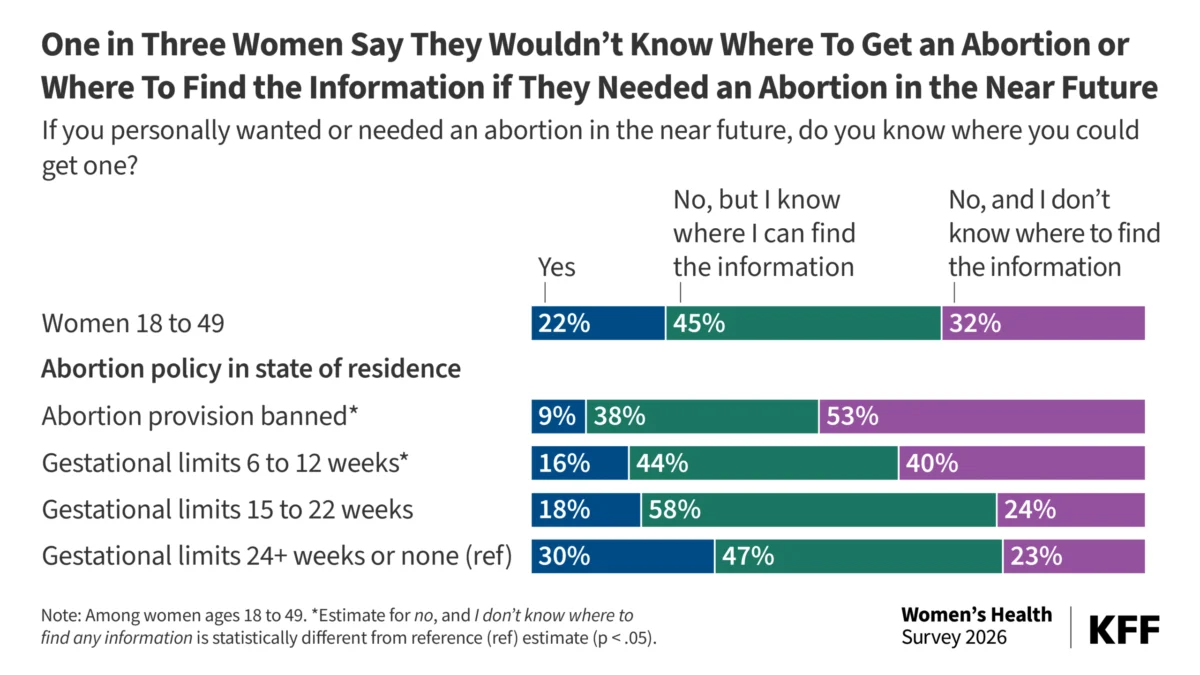
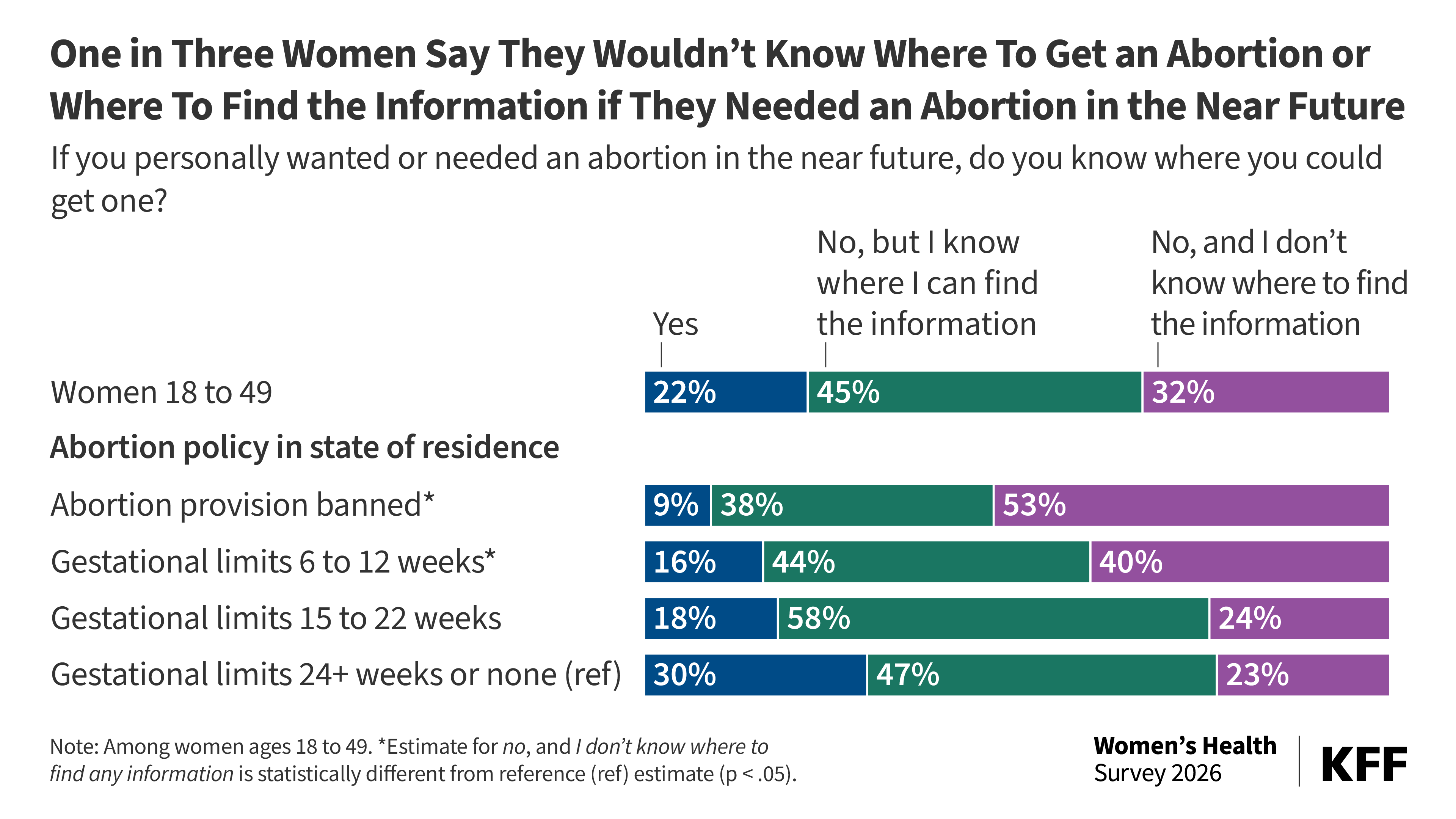
WASHINGTON, D.C. — Four years after the United States Supreme Court overturned the constitutional right to abortion, a profound and widening "information gap" is leaving millions of women across the country in a state of medical and legal uncertainty. According to the newly released 2026 KFF Women’s Health Survey, more than half of reproductive-age women living in states with abortion bans now report they would not know how to access abortion services or find reliable information if they needed it.
n
The report, which comes during a pivotal midterm election year, paints a stark picture of a nation divided not just by law, but by access to basic health literacy. As state-level restrictions have solidified since the 2022 Dobbs v. Jackson decision, the difficulty of navigating the healthcare landscape has intensified, even as alternative methods like telehealth and medication abortion have become more technically available.
n
Main Facts: A Surging Deficit of Knowledge
n
The most striking finding of the KFF survey is the rapid erosion of knowledge regarding reproductive healthcare. In states where abortion provision is banned, 53% of women of reproductive age (18-49) say they would not know where to go or how to find information about obtaining an abortion. This represents a significant 10-point increase from 2024, when 43% reported similar confusion.
n
This trend is not confined to states with total bans. In states with "gestational limits" (laws that restrict abortion between 6 and 12 weeks of pregnancy), 40% of women express a lack of knowledge regarding access. Nationally, the number of women who are unsure of where to turn has climbed to 32%, up from 26% just two years ago.
n
The data suggests that rather than becoming more accustomed to the post-Roe landscape, women are becoming increasingly disconnected from the evolving legal and medical realities of their states. This "information desert" is particularly acute among younger women and those in marginalized communities who may lack the resources to navigate complex out-of-state referral networks.
n
Chronology: From the Fall of Roe to the 2026 Landscape
n
To understand the current crisis, one must look at the sequence of legal and social shifts that have occurred over the last four years:
n
2022: The Seismic Shift
n
In June 2022, the Supreme Court’s decision in Dobbs v. Jackson Women’s Health Organization ended nearly 50 years of federally protected abortion rights. "Trigger laws" immediately went into effect across several states, creating a chaotic environment where clinics closed overnight and legal battles began over the definition of "medical emergencies."
n
2023-2024: The Rise of the Patchwork
n
Following the initial shock, 2023 and 2024 saw a stabilization of state laws. Blue states implemented "shield laws" to protect providers who ship medication to ban states, while red states tightened restrictions, targeting not just the procedure but also the dissemination of information. By 2024, KFF data showed that 43% of women in ban states were already struggling to find information.
n
2025-2026: The Hardening of the Information Gap
n
By early 2026, the survey indicates that the "chilling effect" of these laws has reached a new peak. Despite the proliferation of online resources, the threat of legal repercussions and the closure of local clinics have created a vacuum. The 2026 survey, fielded between March 11 and April 14, reveals that the cumulative weight of four years of restrictive legislation has successfully obscured the remaining avenues for care for a majority of women in affected regions.
n
Supporting Data: The Medication Abortion Paradox
n
One of the most significant developments in reproductive healthcare over the last decade has been the rise of medication abortion—a two-pill regimen of mifepristone and misoprostol. While this method now accounts for the majority of abortions in the U.S., the KFF survey highlights a massive disconnect between the technology’s availability and the public’s awareness of it.
n
The Awareness Gap
n
While 68% of reproductive-age women have heard of medication abortion pills, a much smaller fraction understands how to legally or practically obtain them.
n
- n
- National Awareness: Only 18% of women nationally know that medication abortion can be obtained via telehealth or online pharmacies.
- Ban State Awareness: In states where abortion is prohibited, that number plummets to a mere 8%.
- The Unsure Majority: A staggering 71% of women are either entirely unsure of how to get the pills or have never heard of them at all.
n
n
n
n
Barriers to Access
n
The survey also tracked the personal impact of these restrictions. Approximately 12% of reproductive-age women (1 in 8) say they personally know someone—including themselves—who has faced significant hurdles in accessing abortion care due to state restrictions. This is an increase from 8% in 2024.
n
The most common difficulties cited by these women include:
n
- n
- Travel Logistics: The necessity of traveling hundreds of miles to the nearest legal clinic.
- Information Scarcity: Not knowing which states are legal or which clinics are reputable.
- Financial Constraints: The inability to cover the costs of the procedure, travel, lodging, and childcare.
n
n
Official Responses and the Legal Context
The findings have sparked immediate reactions from healthcare advocates and legal experts, who argue that the lack of information is a deliberate byproduct of state policy.
Healthcare Advocates
Public health officials warn that the information gap is a "secondary health crisis." Dr. Alicia Richards, a maternal health specialist not involved in the study, noted: "When women don’t know where to go for reproductive care, they delay seeking help. This leads to later-term procedures which, while safe, carry more complexity, or it forces women to carry pregnancies to term against their will, often in states with the highest maternal mortality rates."
Legal and Political Climate
In many states with bans, legislators have introduced or passed "medical gerrymandering" and "information suppression" bills. These laws often aim to prevent state funds from being used for any referral services or to categorize the mailing of abortion pills as a felony.
Conversely, the Biden-Harris administration and various advocacy groups have attempted to bolster federal websites and hotlines to provide accurate data. However, the KFF survey suggests these federal efforts are struggling to compete with the localized "chilling effect" created by state-level enforcement and the shuttering of local Planned Parenthood offices that previously served as primary information hubs.
Implications: Safety, Policy, and the 2026 Midterms
The implications of the 2026 KFF survey extend far beyond the immediate need for abortion services; they touch on the broader safety of pregnancy and the future of the American political landscape.
Maternal Safety Concerns
A majority of women (59%) now express concern that abortion bans may affect the safety of their future pregnancies or the safety of those close to them. This fear is rooted in reports of women being denied care for miscarriages or ectopic pregnancies due to doctors’ fears of prosecution.
Interestingly, this concern is not universal. The survey found that majorities across most demographic groups share this anxiety, with two notable exceptions: Republican women and women living in rural areas. This highlights a deep partisan and geographic divide in how the risks of the post-Roe era are perceived.
The Midterm Influence
As the 2024 and 2026 election cycles have shown, reproductive rights remain a potent "kitchen table" issue. The KFF report title, "Health in Midterms," suggests that the confusion and fear documented in the survey will likely be a driving force at the ballot box. Candidates in swing states are increasingly forced to address not just the legality of abortion, but the collapse of the reproductive healthcare infrastructure.
The Long-term "Chilling Effect"
The 10-point jump in confusion among women in ban states between 2024 and 2026 suggests that the situation is worsening, not stabilizing. As more clinics close and more "shield" or "bounty" laws are debated, the "chilling effect" on speech and medical advice is deepening. This creates a cycle where even legal options (like traveling out of state or using telehealth) are obscured by a cloud of perceived illegality.
Conclusion
The 2026 KFF Women’s Health Survey serves as a data-driven indictment of the current state of reproductive health literacy in the United States. Four years after the fall of Roe, the "right to know" has become as contested as the "right to choose."
With 53% of women in ban states left in the dark and only 8% aware of the digital avenues for medication, the United States is facing a future where medical care is determined not just by your zip code, but by your ability to navigate a labyrinth of misinformation and fear. As the 2026 midterms approach, these findings will likely serve as a critical benchmark for the ongoing national debate over bodily autonomy and the fundamental right to healthcare information.
About the Survey: The 2026 KFF Women’s Health Survey was conducted between March 11 and April 14, 2026. It utilized a nationally representative sample of 3,538 women between the ages of 18 and 49. The survey is part of a multi-year series tracking the impacts of the Dobbs decision on women’s health and access to care.

