
By [Your Name/News Bureau]nUpdated October 9, 2026
n
The Medicare Advantage (MA) market, long characterized by explosive growth and an ever-expanding buffet of choices for American seniors, is entering a period of significant volatility and strategic recalibration. As the 2027 plan year approaches, a comprehensive analysis of federal data reveals a market in flux—one where the "average" beneficiary still enjoys robust options, but where the geographic and corporate divide is widening.
n
While the average Medicare beneficiary can choose from 28 Medicare Advantage prescription drug (MA-PD) plans in 2027, this surface-level stability masks a deeper trend of market contraction. From major insurers exiting hundreds of counties to a net loss of participating firms, the 2027 landscape suggests that the era of unfettered expansion may be giving way to a more disciplined, and perhaps more restrictive, era of private Medicare.
n
n
I. Main Facts: A Market of Contrasts
n
The 2027 Medicare Advantage market is defined by several key metrics that highlight a shift away from the peak competition seen in the mid-2020s. According to the Centers for Medicare & Medicaid Services (CMS) landscape data, the primary takeaways for the upcoming year include:

n
- n
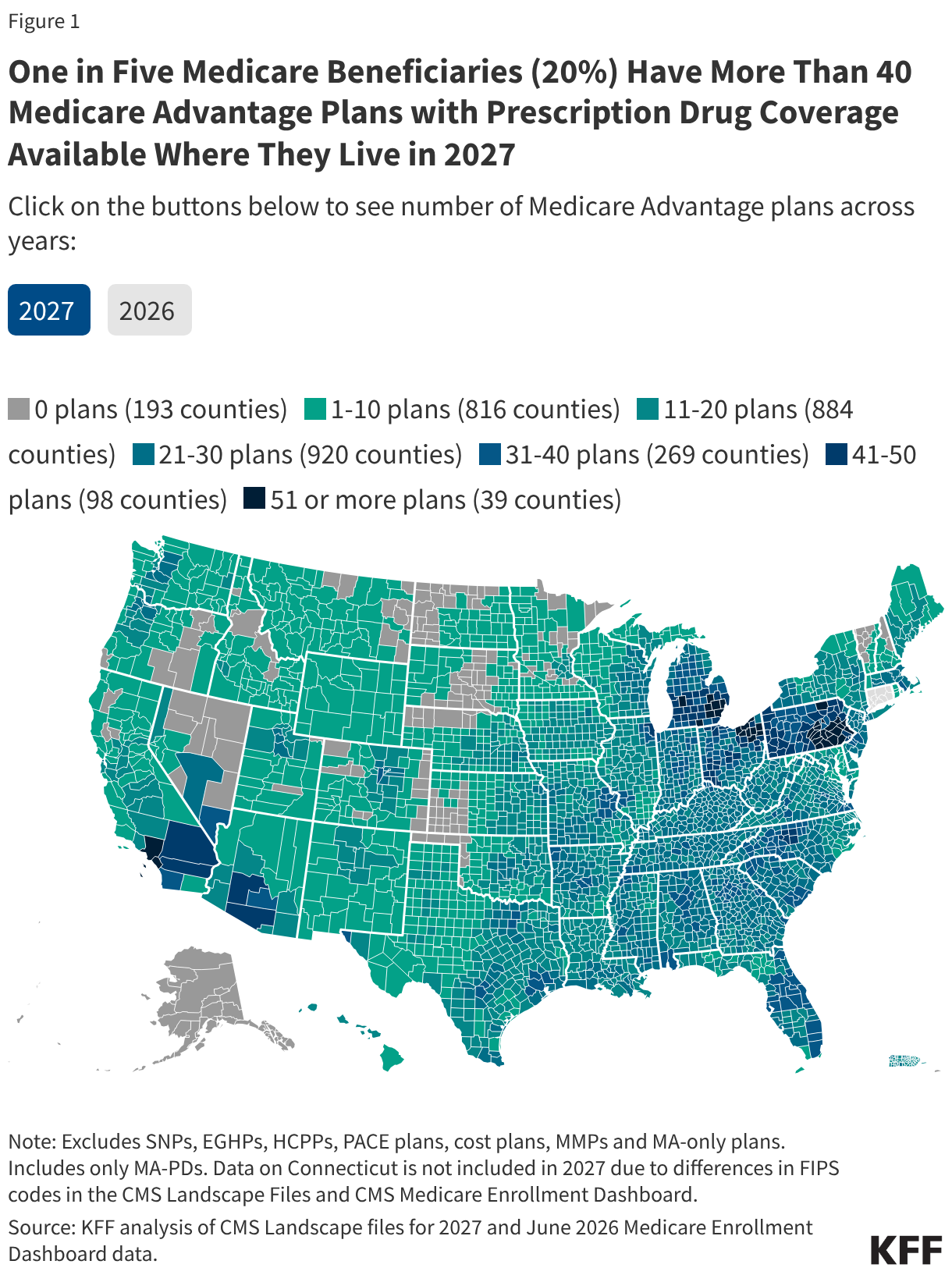
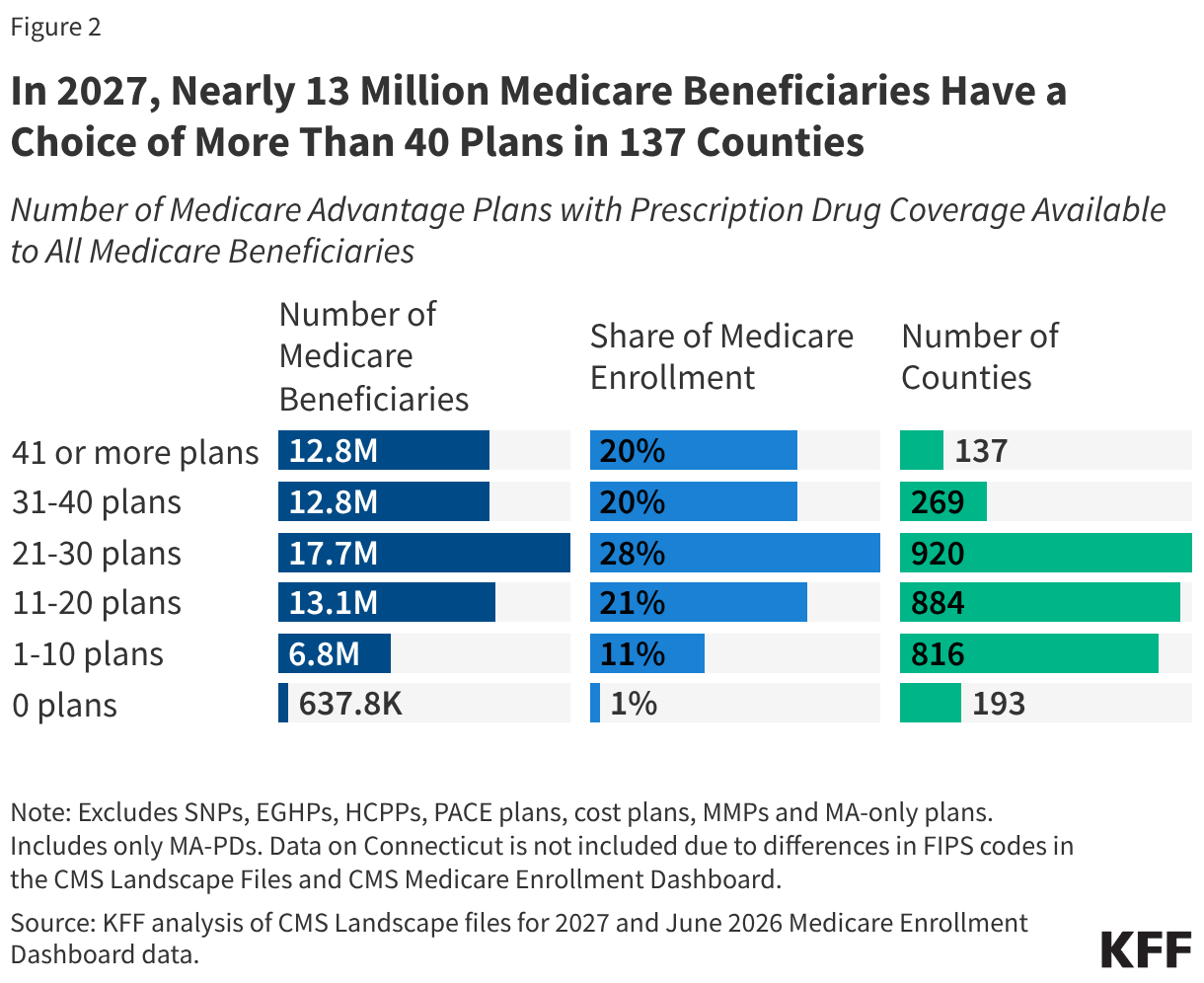
- Reduced High-Choice Availability: Only 20% of Medicare beneficiaries will have access to more than 40 MA-PD plans in 2027, a notable decline from 27% in 2026. This represents a shift of nearly 3.6 million people moving out of the "ultra-high choice" category.
- Growing "Deserts" of Coverage: The number of counties with zero MA-PD options for general enrollment has surged by 57%, rising from 123 counties in 2026 to 193 in 2027.
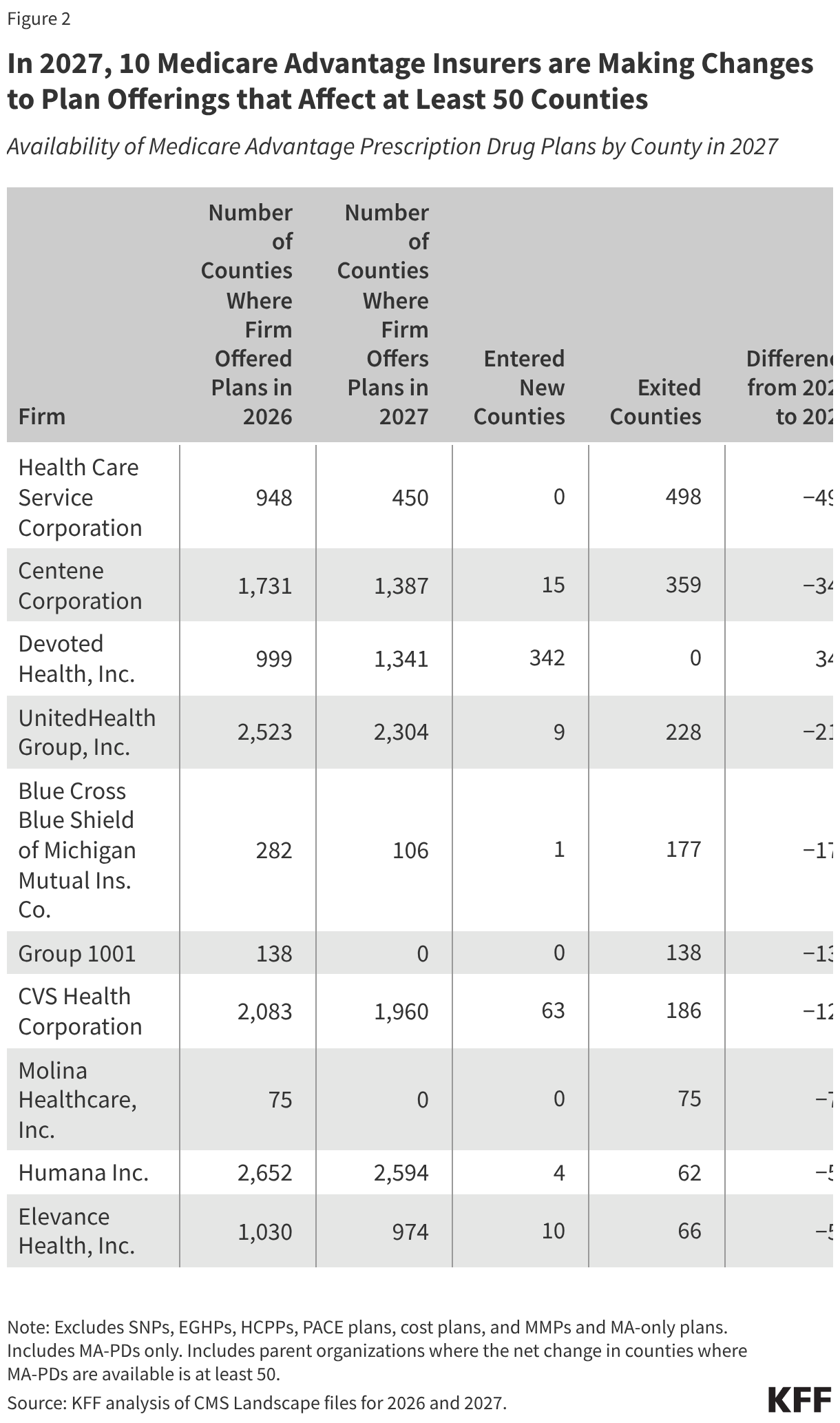
- Insurer Footprint Contraction: The two largest players in the industry, UnitedHealth Group and Humana, are exiting far more counties than they are entering. UnitedHealth is withdrawing from 228 counties, while Humana is exiting 62.
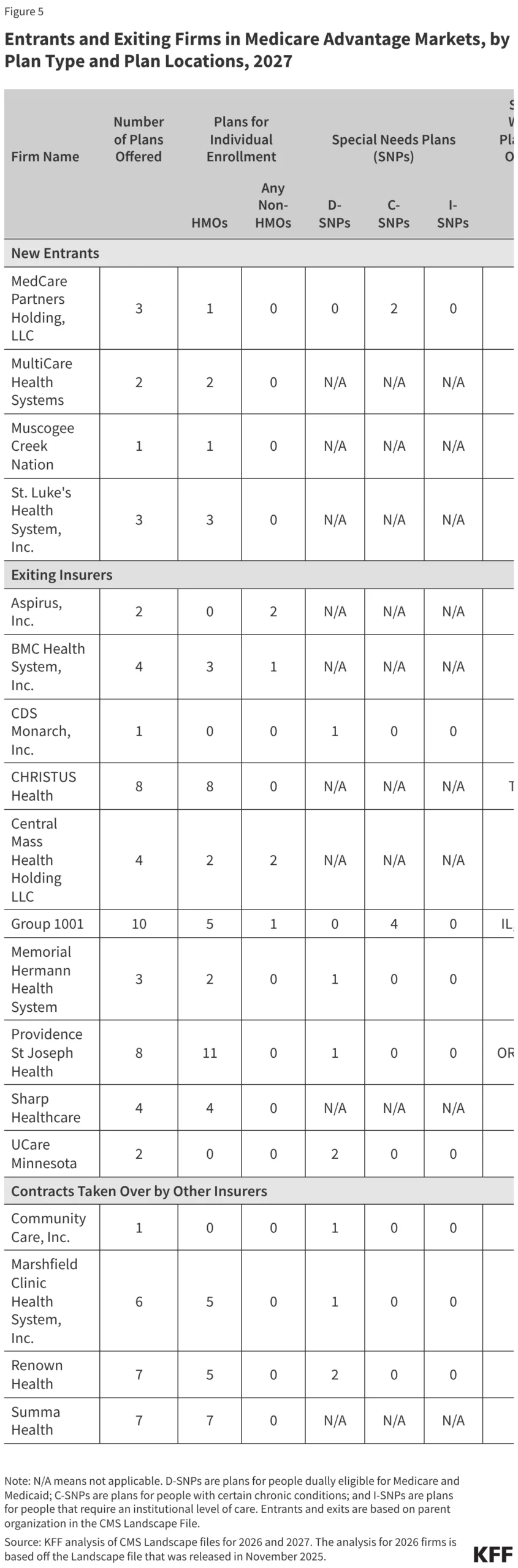
- Net Loss of Firms: The market is seeing a "brain drain" of sorts; ten firms are exiting the Medicare Advantage market entirely, while only four new firms are entering.
- Strategic Pivots: Several insurers, including Molina Healthcare and Presbyterian Healthcare Services, are abandoning general enrollment plans to focus exclusively on Special Needs Plans (SNPs), which target specific high-need populations.
n
n
n
n
n
n
n
II. Chronology: From Expansion to Consolidation (2026–2027)
n
To understand the 2027 landscape, one must look at the trajectory of the market over the last 24 months. In 2025 and 2026, the Medicare Advantage market reached what many analysts consider its "saturation point." During this time, beneficiaries in metropolitan hubs like Los Angeles or Lancaster, Pennsylvania, saw plan counts soar into the 60s and 70s.
n
However, the transition into 2027 marks a chronological pivot point:
n
- n
- Mid-2025 to Early 2026: Insurers began signaling "cost pressures" during quarterly earnings calls, citing higher-than-expected utilization of medical services and changes to the CMS star-rating system, which affects bonus payments.
- Late 2026 (The Current Analysis): The CMS landscape files for 2027 confirm the industry’s response to these pressures. The data shows a deliberate "trimming of the fat." Rather than blanket nationwide expansion, firms are now conducting surgical exits from underperforming or high-cost rural counties.
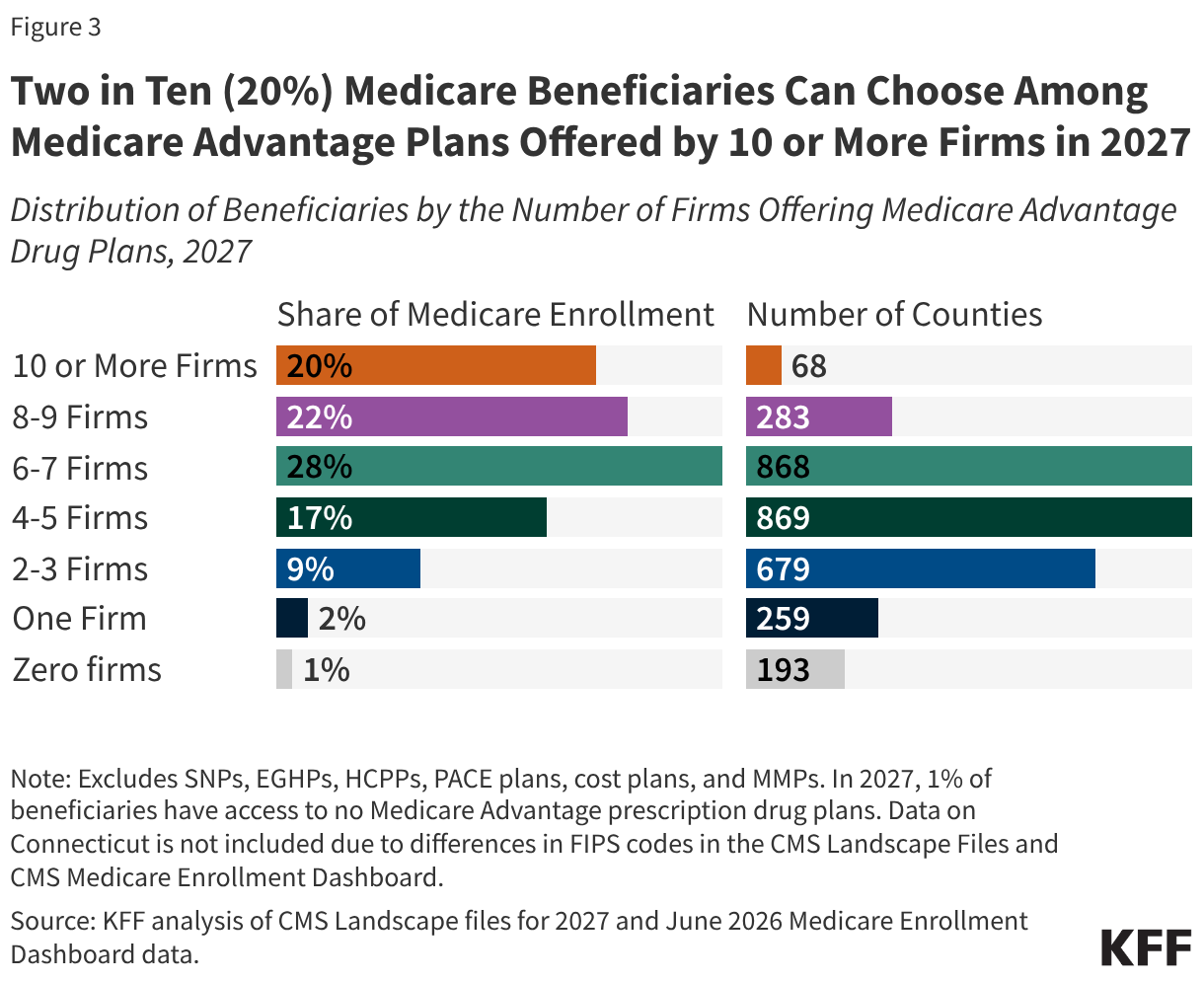
- The 2027 Enrollment Period: Beneficiaries entering the market this fall will find a landscape that is roughly 12.5% less "crowded" at the firm level, with the average number of firms available per beneficiary dropping from eight to seven.
n
n
n
n
n
III. Supporting Data: Geographic and Corporate Deep Dive
n
The disparities in the 2027 market are most visible when examining the data at the county and firm levels.
n
The Geographic Divide
n
The "choice" available to a senior remains largely a matter of ZIP code. In 2027, Lancaster, Pennsylvania, holds the title for the most competitive market in the nation, offering 66 different MA-PD plans. Conversely, the entire state of Alaska remains a "general enrollment desert," with zero MA-PD plans available to its 110,000 beneficiaries.
n
The data reveals a concerning trend for rural America. In 2027, 259 counties will have only a single firm offering an MA-PD plan, up from 180 counties in 2026. This represents nearly 2% of the total Medicare population who now live in "monopoly" markets for private Medicare coverage.
n
Insurer Exodus and Expansion
The most striking data point in the 2027 analysis is the massive reduction in the footprint of the Health Care Service Corporation (HCSC). The firm is exiting 498 counties—the largest reduction in the market—while entering zero new ones. Centene follows a similar path, exiting 359 counties.
| Insurer | Counties Exited | Counties Entered | Net Change |
|---|---|---|---|
| HCSC | 498 | 0 | -498 |
| Centene | 359 | 15 | -344 |
| UnitedHealth Group | 228 | 9 | -219 |
| CVS Health (Aetna) | 186 | 63 | -123 |
| Devoted Health | 0 | 342 | +342 |
Devoted Health stands out as the primary outlier, aggressively expanding its footprint into 342 new counties. This suggests that while "Legacy" insurers are retrenching, newer, tech-focused "insurtech" firms may still see growth opportunities in the current rate environment.
The Rise of Co-Branding
To maintain market share without increasing traditional marketing spend, several firms are turning to retail partnerships. In 2027, we see an increase in co-branded plans:
- SCAN Group is partnering with Costco (California/Nevada) and Walmart (Arizona/Texas).
- Alignment Health continues its partnership with Instacart, offering grocery benefits to those with chronic conditions.
- Humana maintains its long-standing tie-in with USAA, targeting the veteran demographic.
IV. Official Responses and Industry Sentiment
While CMS provides the data, the insurers provide the "why." The reasons cited for the 10 firm exits and the hundreds of county withdrawals point toward a tightening regulatory and economic vise.
Memorial Hermann Health Plan and Central Mass Health (Mass Advantage) both officially cited "changing Medicare landscapes" and "regulatory uncertainty" as the primary drivers for their departure from the market. This refers to a series of CMS policy shifts, including a lower-than-anticipated base payment rate increase for 2025/2026 and a more rigorous "Risk Adjustment Data Validation" (RADV) audit process designed to claw back overpayments.
Industry analysts suggest that the "Big Two"—UnitedHealth and Humana—are prioritizing profit margins over sheer enrollment volume for 2027. By exiting 290 counties combined, these firms are signaling to shareholders that they will no longer chase market share in regions where medical loss ratios (the percentage of premiums spent on care) are too high.
In contrast, firms like Community Care, Inc. and Marshfield Clinic did not "vanish" but were absorbed through mergers (with entities like General Catalyst), suggesting that consolidation is becoming the preferred survival strategy for mid-sized regional plans.
V. Implications: What This Means for the Future of Medicare
The 2027 data serves as a harbinger for a more stratified Medicare Advantage market. The implications for beneficiaries and policymakers are profound.
1. The Rural-Urban Choice Gap
The fact that 638,000 beneficiaries now live in counties with no MA-PD options—a 60% increase in one year—suggests that the private market is struggling to serve low-density populations. If this trend continues, Traditional Medicare (Fee-for-Service) will once again become the only viable option for rural seniors, potentially creating a "two-tier" system where urban seniors enjoy extra benefits (like dental and vision) that rural seniors cannot access.
2. The Narrowing of the "Big Two" Dominance
Even though UnitedHealth and Humana are exiting counties, they still control 46% of the total market. Their decision to retrench could lead to less price competition in the counties they remain in. With fewer firms to compete against, these giants may have less incentive to offer the "zero-premium" plans that have been the hallmark of Medicare Advantage for the past decade.
3. The "SNP-ification" of the Market
The move by firms like Molina to focus exclusively on Special Needs Plans (SNPs) suggests that the general enrollment market is becoming too commoditized. By focusing on SNPs (which serve those eligible for both Medicare and Medicaid, or those with chronic conditions), insurers can access different payment tiers and more specialized care management models. For the average "healthy" senior, this means their choice of insurers for a standard plan is shrinking.
4. Consumer Confusion and "Plan Switching"
With 13 million people seeing their choice of plans drop from over 40 to a lower bracket, and hundreds of thousands losing their plans entirely due to county exits, the 2027 Open Enrollment period is likely to be one of the most chaotic in recent history. Beneficiaries who have been on "autopilot" with their coverage for years may find their plan no longer exists, forcing them into a complex decision-making process.
Conclusion
The 2027 Medicare Advantage landscape is a testament to the "Dynamic" label often applied to it. However, "dynamic" is often a euphemism for "unstable." As insurers navigate a landscape of higher costs and stricter federal oversight, the 2027 data suggests that the "Golden Age" of endless Medicare Advantage choices may be sunsetting, replaced by a more calculated, consolidated, and geographically uneven marketplace. For the 67 million Americans on Medicare, the message for 2027 is clear: pay close attention to the map, because your options are changing faster than ever.

