The United States government has reaffirmed its position as the preeminent donor in the international health landscape, currently supporting comprehensive global health programs in more than 80 countries as of Fiscal Year 2024. This expansive reach is achieved through a sophisticated architecture of bilateral agreements, regional strategic initiatives, and substantial contributions to multilateral organizations. The U.S. approach to global health is characterized by a multi-sectoral strategy where programs in partner nations often address several critical health areas simultaneously, ranging from infectious disease control to reproductive health and systemic health security.
According to the latest data tracking U.S. bilateral global health programs, the federal government’s activities are categorized into several key pillars: the President’s Emergency Plan for AIDS Relief (PEPFAR), Tuberculosis (TB) control, the President’s Malaria Initiative (PMI), Family Planning and Reproductive Health (FP/RH), Maternal and Child Health (MCH), Nutrition, and the increasingly vital sector of Global Health Security. This integrated framework allows for a tailored response to the specific epidemiological profiles and healthcare infrastructure needs of each partner nation.
The Pillars of U.S. Global Health Engagement
The cornerstone of the U.S. global health portfolio remains the President’s Emergency Plan for AIDS Relief (PEPFAR). Launched in 2003, PEPFAR represents the largest commitment by any nation to address a single disease in history. In FY 2024, PEPFAR continues to operate as a transformative force, providing life-saving antiretroviral treatment to millions and supporting orphans and vulnerable children affected by the HIV/AIDS epidemic. The program has evolved from an emergency response to a sustainability-focused initiative, working to strengthen local health systems so that partner countries can eventually manage their own HIV responses.
Parallel to HIV efforts, the President’s Malaria Initiative (PMI) serves as a critical component of the U.S. strategy to reduce all-cause mortality among children under five. PMI focuses on the scale-up of proven interventions, such as insecticide-treated bed nets, indoor residual spraying, and the distribution of artemisinin-based combination therapies. As malaria remains a leading cause of death and poverty in Sub-Saharan Africa and parts of Southeast Asia, the FY 2024 data indicates a sustained geographic focus on these high-burden regions.
The U.S. also maintains a robust commitment to combating Tuberculosis, the world’s leading infectious killer prior to the COVID-19 pandemic. U.S. TB programs work in coordination with the World Health Organization’s (WHO) "End TB Strategy," focusing on early diagnosis, treatment of drug-resistant strains, and the integration of TB/HIV services. By leveraging technological advancements in rapid diagnostics, the U.S. aims to close the gap between estimated cases and those actually notified and treated.
In the realms of Maternal and Child Health (MCH) and Nutrition, U.S. programs prioritize the "first 1,000 days" of life—the period from pregnancy to a child’s second birthday. These initiatives provide essential services including immunization, prenatal care, and nutritional supplements to prevent stunting and wasting. The focus on Family Planning and Reproductive Health (FP/RH) complements these efforts by promoting voluntary birth spacing, which significantly improves maternal survival rates and economic outcomes for families.
The Rise of Global Health Security
A significant shift in the FY 2024 landscape is the elevated prominence of Global Health Security (GHS). In the wake of the COVID-19 pandemic, the U.S. has intensified its efforts to prevent, detect, and respond to infectious disease threats at their source. This involves strengthening laboratory networks, improving real-time surveillance, and training a "detective" workforce of epidemiologists in partner countries.
The GHS agenda is not merely a reactive measure but a proactive investment in international stability. By helping countries comply with International Health Regulations (IHR), the U.S. reduces the likelihood of local outbreaks evolving into global pandemics. This sector has seen increased budgetary attention and a wider geographic spread in the 2024 tracker, reflecting the bipartisan consensus on the importance of biosecurity.
Historical Context and Evolution
The trajectory of U.S. global health policy has moved from fragmented, disease-specific interventions in the mid-20th century to the highly integrated, data-driven models seen today. The establishment of USAID in 1961 marked the beginning of formal bilateral health assistance, but the early 2000s saw a paradigm shift with the creation of PEPFAR and PMI under the Bush administration.
Over the last two decades, these programs have survived multiple changes in domestic administration, reflecting a rare area of political continuity in Washington. The Obama administration introduced the Global Health Initiative (GHI) to foster better integration between programs, while the Trump administration maintained high levels of funding for PEPFAR and Malaria despite broader foreign aid cuts. The Biden-Harris administration has further refined this by emphasizing the link between climate change and health, as well as the necessity of global health equity.
Regional Distribution and Strategic Focus
The FY 2024 data reveals a strategic concentration of resources in Sub-Saharan Africa, which receives the largest share of bilateral health funding. This is due to the high prevalence of HIV, malaria, and maternal mortality in the region. However, the "80+ countries" mentioned in the tracker also include significant investments in South and Central Asia, Southeast Asia, and the Western Hemisphere.
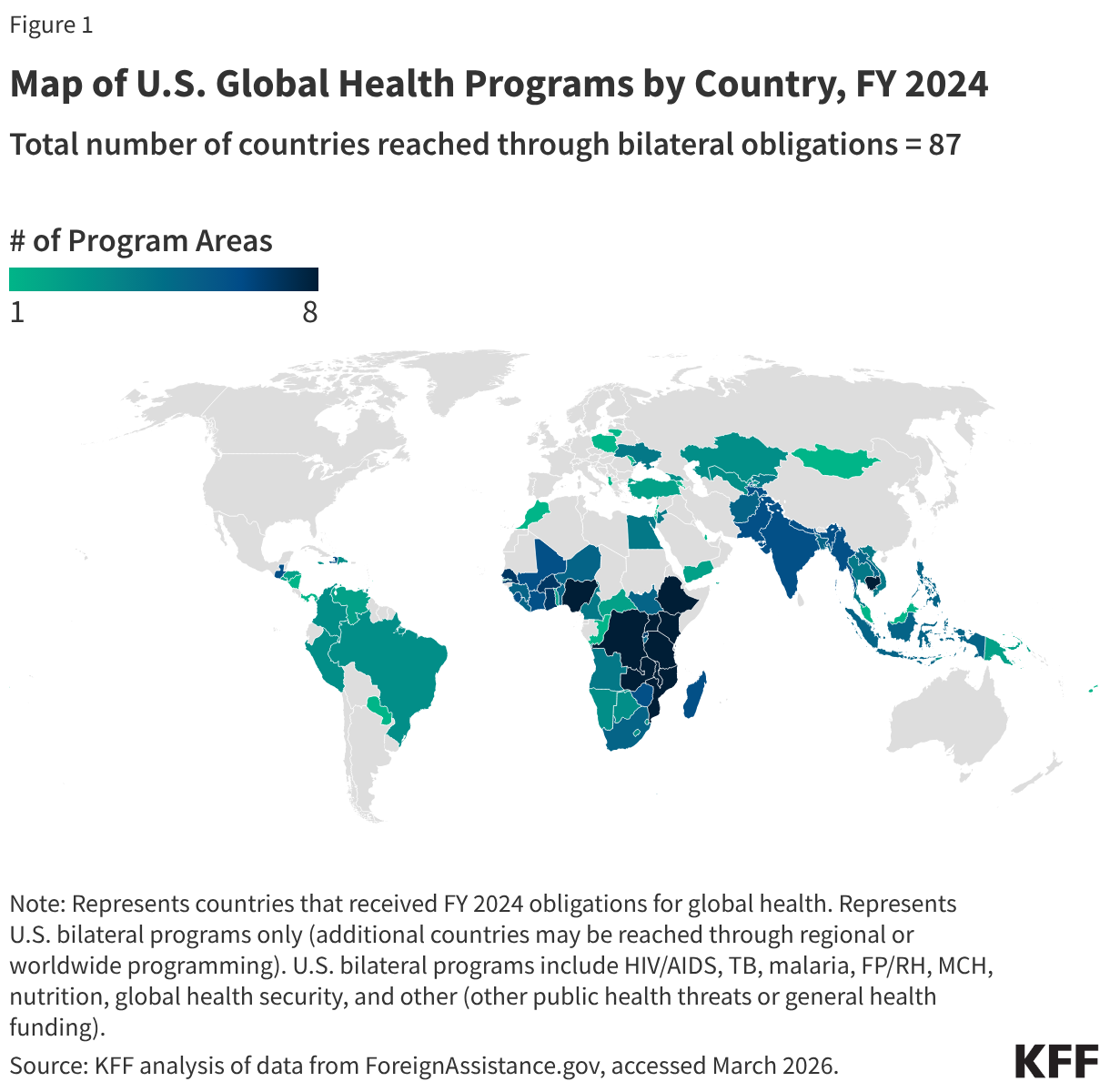
In Asia, programs often focus on TB control and Global Health Security, given the region’s role as a potential hotspot for zoonotic diseases. In Latin America and the Caribbean, U.S. health assistance frequently addresses MCH and infectious disease outbreaks, such as Zika or Dengue, which have direct implications for regional migration and economic stability.
The regional efforts are supplemented by U.S. contributions to multilateral organizations. By funding the Global Fund to Fight AIDS, Tuberculosis and Malaria, Gavi, the Vaccine Alliance, and the World Health Organization, the U.S. extends its influence even to countries where it does not maintain a direct bilateral presence. This "hybrid" model of engagement ensures that U.S. health expertise and resources have a global reach.
Data-Driven Implementation and Accountability
A hallmark of the U.S. global health strategy is its reliance on rigorous data and transparency. The FY 2024 tracker is part of a broader effort to provide the public, policymakers, and partner nations with a clear view of where and how funds are being utilized. This level of transparency is intended to foster accountability and allow for the optimization of programs based on real-world outcomes.
The KFF (Kaiser Family Foundation) tracker for U.S. global health country-level funding serves as a vital companion to the program tracker, offering a granular look at the financial commitments that power these initiatives. By monitoring both the programmatic footprint and the fiscal allocations, analysts can assess the efficiency of U.S. interventions and identify gaps in coverage.
Statements and Perspectives
While official government statements from USAID and the State Department emphasize the humanitarian and moral imperatives of global health assistance, national security experts often highlight the strategic benefits. Healthy populations are more economically productive and less prone to the civil unrest that can stem from healthcare collapses or uncontrolled epidemics.
International partners have generally lauded the U.S. for its consistent leadership. Dr. Tedros Adhanom Ghebreyesus, Director-General of the WHO, has frequently noted that U.S. bilateral support is foundational to global progress in health. However, some advocacy groups continue to call for even greater focus on "localization"—the process of shifting funding and decision-making power from U.S.-based NGOs to local organizations within the partner countries themselves. The FY 2024 strategy reflects an ongoing shift toward this localized approach, aiming to build long-term institutional capacity.

Broader Impact and Future Implications
The implications of the U.S. global health footprint extend far beyond the immediate health outcomes. By stabilizing health systems, the U.S. fosters stronger bilateral ties and enhances its "soft power" on the world stage. In many partner nations, U.S. health programs are the most visible and positively perceived aspect of American foreign policy.
Looking forward, the U.S. faces the challenge of maintaining these gains in an era of fiscal constraint and competing geopolitical priorities. The emergence of antimicrobial resistance (AMR) and the health impacts of climate change—such as the expanding range of vector-borne diseases—will likely require the U.S. to adapt its global health framework once again.
The FY 2024 data serves as a baseline for these future adjustments. As the U.S. continues to support health programs in over 80 countries, the focus will likely remain on integrating various health areas to maximize impact. The transition from donor-led programs to partner-led systems remains the ultimate goal, ensuring that the progress made in HIV, malaria, and maternal health becomes a permanent fixture of the global landscape.
In conclusion, the United States’ commitment to global health in FY 2024 represents a sophisticated blend of humanitarian aid, strategic investment, and scientific leadership. Through its multi-layered approach of bilateral, regional, and multilateral engagement, the U.S. continues to play a pivotal role in shaping the health and security of the global community. The current tracker provides a comprehensive map of this engagement, reflecting a legacy of decades of investment and a roadmap for the challenges of the future.