As the United States approaches the critical midterm election cycle of 2026, a new comprehensive study from KFF (formerly the Kaiser Family Foundation) reveals a deeply divided electorate regarding the nation’s health care priorities. According to the KFF Health Tracking Poll conducted in late June, rising health care costs have solidified their position as the primary concern for a majority of voters, yet a significant and growing segment of the Republican base is increasingly focused on the issue of fraud within government-sponsored health programs. The findings underscore a complex political landscape where concerns over personal financial stability collide with ideological debates over government oversight and program integrity.
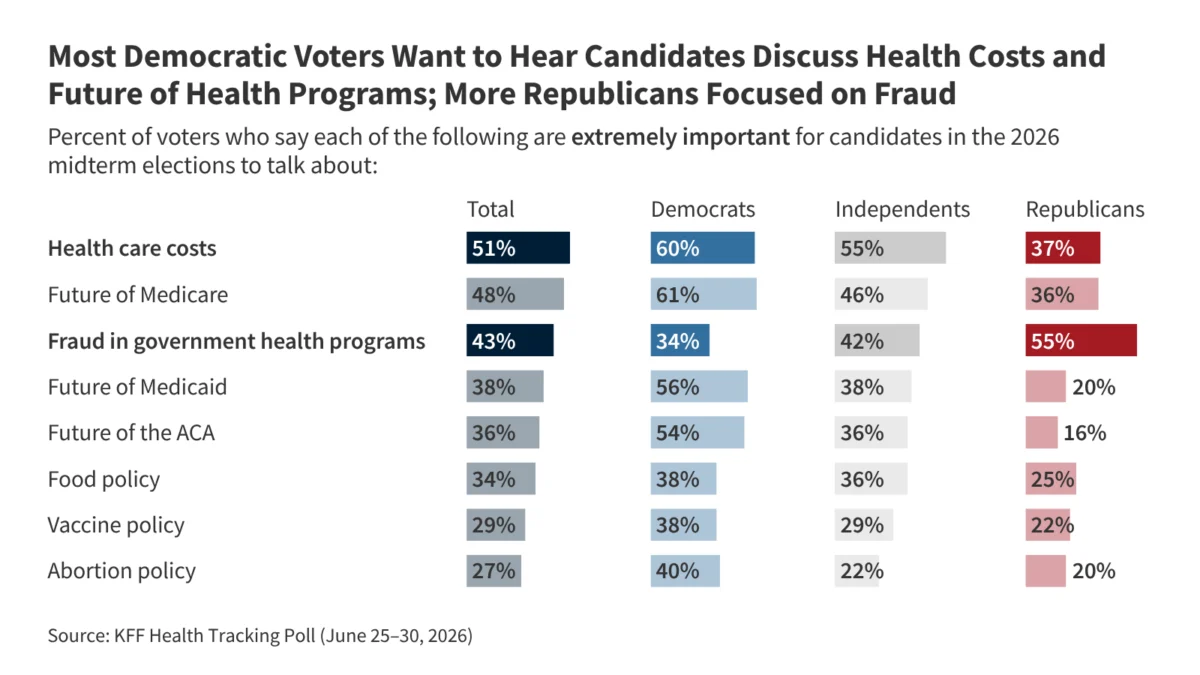
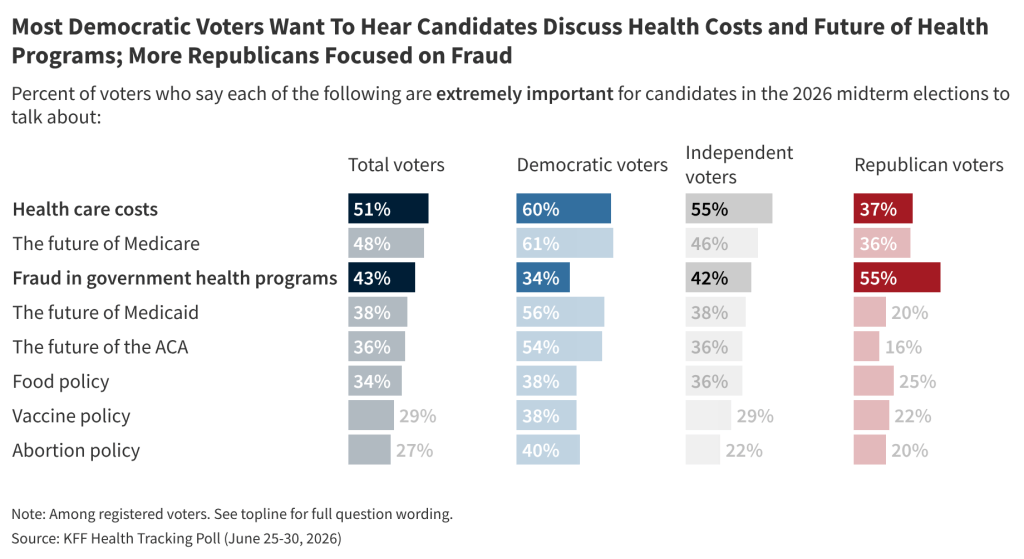
The poll, which surveyed a nationally representative sample of 1,321 adults, including 1,055 registered voters, indicates that 51% of all voters consider health care costs an "extremely important" topic for candidates to address. This sentiment is particularly pronounced among Democratic (60%) and independent (55%) voters. Conversely, the Trump administration’s consistent messaging regarding "waste, fraud, and abuse" appears to have resonated deeply with the Republican electorate. More than half of Republican voters (55%) now identify the investigation and prevention of fraud in government health programs as a top-tier campaign issue.
A Divergence of Priorities: Costs vs. Oversight
The emphasis on costs reflects a broader economic anxiety. Over the past several years, American households have grappled with fluctuating inflation and the expiration of pandemic-era subsidies. While the administration has pointed to its efforts to curb fraud as a method of fiscal responsibility, many voters remain focused on the immediate burden of premiums, deductibles, and prescription drug prices.
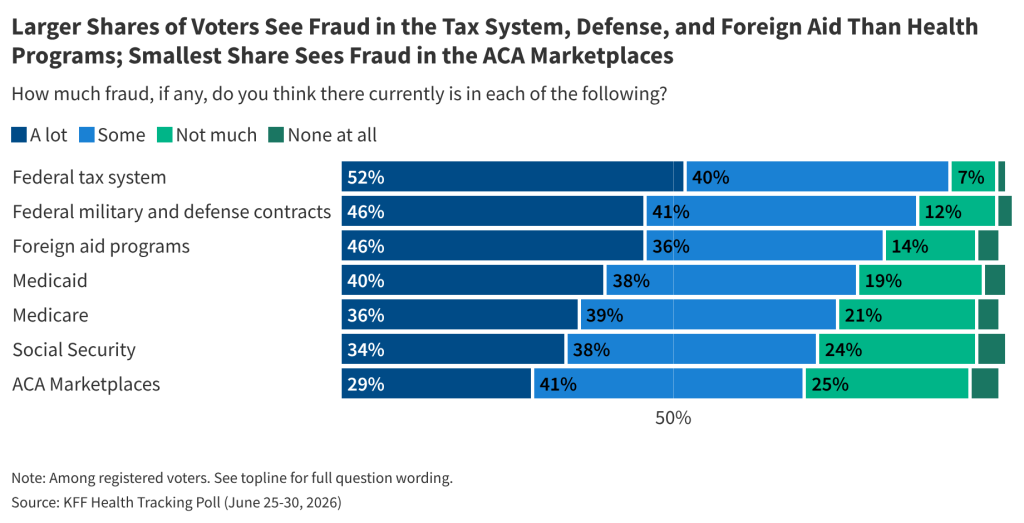
The KFF data suggests that the partisan divide is not just about what is important, but how voters perceive the health care system’s vulnerabilities. While the administration has focused heavily on the Affordable Care Act (ACA) Marketplaces and Medicaid as hubs of potential illicit activity, the general public views other areas of government as being more prone to corruption. Approximately 52% of voters believe there is "a lot" of fraud in the federal tax system, while 46% say the same of military and defense contracts and foreign aid programs. In contrast, only 40% perceive significant fraud in Medicaid, 36% in Medicare, and a mere 29% in the ACA Marketplaces.
The Partisan Perception of the Affordable Care Act
Despite the lower overall perception of fraud in the ACA Marketplaces, a sharp partisan split exists. Nearly half of Republican voters (47%) believe there is a substantial amount of fraud occurring within the ACA exchanges. This perception aligns with recent statements from the Trump administration, which has attributed a noticeable decline in ACA enrollment to aggressive anti-fraud measures rather than the expiration of enhanced tax credits.
The enhanced tax credits, originally implemented to make coverage more affordable for middle- and low-income enrollees, were a cornerstone of recent health policy. Their expiration has led to significantly higher out-of-pocket costs for many Marketplace participants. Policy analysts suggest that the administration’s focus on "fraud" serves as a dual-purpose political narrative: it justifies the reduction in enrollees as a "cleaning up" of the system while de-emphasizing the role that reduced subsidies have played in making insurance less accessible.
Who is Responsible for Health Care Fraud?
One area of relative consensus among the electorate is the source of health care fraud. Across the political spectrum, voters are more likely to blame providers—such as doctors, hospitals, and pharmacies—rather than the individual patients or beneficiaries. Roughly half of Democrats, Republicans, and independents agree that providers bear the primary responsibility for fraudulent claims and billing irregularities.
Only a small minority (ranging from 10% to 30% depending on the party) believe that patients are the primary culprits. This finding is significant because it suggests that aggressive "eligibility checks" or policies that target individual beneficiaries may not align with the public’s intuition about where the actual problems lie. Despite this, about 30% of voters remain unsure of who is responsible, indicating a gap in public knowledge that political campaigns often seek to fill with targeted messaging.
Chronology of Federal Anti-Fraud Actions and Medicaid Deferrals
To understand the current voter sentiment, it is essential to look at the timeline of actions taken by the administration leading up to the 2026 midterms:
- Late 2024 – Early 2025: The administration announces a "National Integrity Initiative," aimed at auditing state-run Medicaid programs.
- Mid-2025: Federal authorities begin targeting specific "high-risk" states, many of which are led by Democratic governors. Actions include the decertification of several state fraud control units.
- Late 2025: The Department of Health and Human Services (HHS) begins deferring federal Medicaid payments to states, citing insufficient documentation or suspected "improper payments."
- Early 2026: Reports emerge of eligible low-income individuals losing coverage as states, facing budget shortfalls from deferred federal funds, tighten enrollment procedures.
- June 2026: The KFF Health Tracking Poll captures the public’s reaction to these cumulative measures, showing a nation divided on the intent and impact of these policies.
The Medicaid Conflict: Access vs. Integrity
The administration’s strategy of deferring Medicaid payments has become a flashpoint for political debate. The poll reveals that 71% of voters believe that ensuring beneficiaries have access to care should be a higher priority than eliminating every instance of fraud. This includes 89% of Democrats and 81% of independents.
Republican voters, however, are almost perfectly split on this trade-off. Forty-seven percent believe that preventing fraud should be the priority even if it inadvertently harms access for eligible individuals, while 52% prioritize access. This internal Republican tension suggests that while the "fraud" narrative is powerful, a significant portion of the GOP base remains concerned about the "collateral damage" of aggressive oversight, particularly as it relates to vulnerable populations.
The potential for eligible people to lose health care is a concern shared by a vast majority of the public. Seventy-seven percent of voters—including 61% of Republicans—express fear that delaying federal payments to states will cause low-income citizens to lose their health services.
Political Motivations and State Impact
A central criticism of the administration’s anti-fraud efforts is that they appear to be politically motivated. Nearly two-thirds of all voters (64%) believe that the focus on Medicaid deferrals is driven by politics rather than a genuine desire to protect the program. This sentiment is highest among Democrats (89%) and independents (70%). Conversely, 69% of Republicans defend the actions as a necessary step to safeguard the financial health of Medicaid.
The targeting of Democratic-led states has led to a "war of words" between state capitals and Washington. Governors in affected states have argued that the federal government is using administrative tools to bypass the legislative process, effectively "starving" programs they could not repeal through Congress. They contend that the administrative burden of these new "fraud" checks is designed to create a "bottleneck" that forces people off the rolls.
Analysis of Broader Implications
The results of the KFF poll suggest several critical implications for the upcoming midterm elections and the future of U.S. health policy:
1. The "Cost" Narrative Remains Dominant: Despite the administration’s efforts to shift the conversation toward fraud, the daily reality of medical bills remains the most potent issue for the majority of the electorate. Candidates who focus solely on oversight without addressing affordability may find themselves out of step with independent voters.
2. The Erosion of Trust in Federal Oversight: With 64% of voters viewing anti-fraud measures as politically motivated, there is a risk that legitimate efforts to improve program integrity will be dismissed as partisan theater. This erosion of trust could make it more difficult for future administrations to implement necessary audits or reforms.
3. State-Federal Relations: The use of Medicaid payment deferrals as a policy lever marks a significant shift in the federal-state partnership. If this becomes a standard tool for federal administrations to exert pressure on states with differing political alignments, the stability of the social safety net could be permanently compromised.
4. The Vulnerability of the ACA: The high perception of fraud among Republicans regarding the ACA suggests that the program remains a primary target for dismantling. By framing the issue as one of "integrity" rather than "repeal," the administration may be attempting to build a broader coalition for significant changes to the law.
Conclusion
As the 2026 midterm campaigns intensify, health care is once again at the forefront of the American political consciousness. The KFF Health Tracking Poll paints a picture of a country where the definition of "program integrity" depends largely on one’s partisan affiliation. While Democrats and independents demand solutions for the high cost of living and medical care, Republicans are increasingly galvanized by the prospect of rooting out government waste.
The ultimate impact of these competing priorities will likely be decided at the ballot box. Whether voters prioritize the protection of access to care or the aggressive pursuit of fraud prevention will determine the trajectory of Medicaid, Medicare, and the Affordable Care Act for years to come. In the interim, the tension between these two goals remains a defining feature of the American health care debate, with millions of beneficiaries caught in the middle of the ideological divide.