
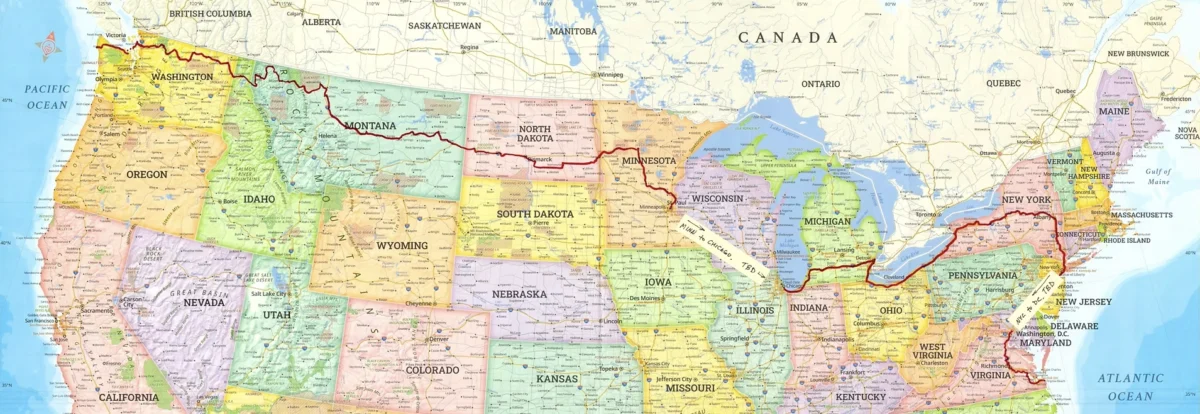
VIRGINIA BEACH, VA — For most, a cross-country journey involves a flight of a few hours or perhaps a week-long road trip. For Pat McAleer, it is a three-month, 5,000-mile test of human endurance, mechanical reliability, and philanthropic spirit. Pedaling solo from the rugged coastline of Washington State toward the Atlantic shores of Virginia, McAleer is fueled by more than just electrolytes and sheer will; he is driven by a fifteen-year promise to his daughter and millions of others living with Type 1 Diabetes (T1D).
n
The initiative, titled "Ride Pat Ride," represents a massive undertaking in the world of independent advocacy. Since its commencement in mid-July, the campaign has captured the attention of the diabetes community, raising significant funds for Breakthrough T1D (formerly JDRF) while highlighting the daily grit required to manage a chronic autoimmune condition.
n
The Core Mission: A Father’s Promise
n
The genesis of this transcontinental trek dates back to 2009. At just ten years old, McAleer’s daughter, Mary Kate, was diagnosed with Type 1 Diabetes. The diagnosis fundamentally altered the trajectory of the McAleer family’s life. Unlike Type 2 diabetes, T1D is an autoimmune disease in which the pancreas produces little to no insulin—a hormone required to allow sugar to enter cells to produce energy. There is currently no cure, and management requires 24/7 monitoring, insulin injections, and a constant balancing act to avoid life-threatening highs and lows.
n
"Since then, my wife Molly and I have been 100 percent committed to improving the lives of people with T1D," Pat McAleer stated. This commitment has evolved from local advocacy to a monumental physical challenge. "I wanted to take on a challenge that’s both physically difficult and that would offer an opportunity for me to fundraise in a way that is uniquely my own. Riding my bike across the United States for three months felt like the right way to push myself while supporting an important cause."
n
Chronology of the Journey: From the Pacific to the High Prairies
n
The Rocky Start (July 15 – July 20)
n
The journey officially began on July 15 at the Pacific Ocean in La Push, Washington. In a symbolic gesture common among transcontinental cyclists, McAleer dipped his rear wheel into the Pacific, intending to dip the front wheel into the Atlantic three months later.
n
However, the "odyssey" nearly ended before it truly began. Just six miles into the ride, a stray stick on the road caught in McAleer’s drivetrain, tearing the derailleur—the mechanism that shifts gears—completely off the frame. With the bike rendered inoperable, McAleer was forced to hitchhike to Forks, WA, and eventually take a bus to Port Angeles to secure repairs.

n
Conquering the Cascades and Wildfires (Late July)
n
Once back on the road, the physical demands intensified. By Day 5, McAleer was ascending the North Cascades, tackling the 5,477-foot Washington Pass. The ascent was only the beginning of his environmental hurdles. As he moved eastward, he was met with the harrowing reality of Western wildfires.
n
Navigating through thick smoke and falling ash, McAleer was forced to don a respirator mask while pedaling through Sherman Pass (5,575 feet). The imagery of a cyclist in a respirator serves as a poignant metaphor for the resilience required by those living with T1D, who must often navigate their own "internal storms" and environmental obstacles to maintain their health.
n
The Continental Divide and the Montana Flats (August)
n
Moving through the Idaho panhandle and into Montana, McAleer crossed the Continental Divide—the hydrological "backbone" of the Americas. After navigating the steep, technical terrain of Glacier National Park and the Rocky Mountains, he transitioned into the high prairies of central and eastern Montana.
n
Throughout this segment, McAleer has operated entirely self-sufficiently. His bicycle serves as his home, carrying a full camping kit, repair tools, spare parts, clothing, and a solar-powered bike computer. The weight of the gear adds a significant layer of difficulty to the thousands of feet of vertical climbing he faces daily.
n
Supporting Data: Fundraising and Logistics
n
The "Ride Pat Ride" campaign is as much a financial success as it is an athletic one. As of late August, McAleer has raised nearly $150,000 toward his primary goal of $250,000.
n
A critical component of this fundraiser is its efficiency. Pat and his wife, Molly, are personally financing 100% of the trip’s expenses—including gear, food, transportation, and maintenance. This ensures that every dollar donated by the public goes directly to Breakthrough T1D to fund research into disease-modifying therapies, beta-cell replacement, and, ultimately, a cure.

n
The Route Ahead
n
McAleer is following the Adventure Cycling Association’s "Northern Tier Route." His itinerary for the coming weeks includes:
n
- n
- The Midwest: Traversing North Dakota, Minnesota, Wisconsin, Illinois, Indiana, and Michigan.
- The Northeast: Crossing Ohio and Pennsylvania before arriving in Buffalo, New York.
- The Home Stretch: Following the Erie Canal to Albany, then heading south to New York City.
- The Finale: Moving through Washington, D.C., and Fredericksburg, Maryland, before concluding at the Cavalier Hotel in Virginia Beach.
n
n
n
n
n
Official Responses and Collaborative Efforts
n
The impact of McAleer’s ride has resonated at the highest levels of the T1D advocacy community. During his stop in New York City, McAleer is scheduled to meet with Breakthrough T1D CEO Aaron J. Kowalski, Ph.D.
n
Kowalski, the first person with T1D to lead the organization, has been a vocal proponent of community-led fundraising. The meeting in NYC will focus on the progress of current research and the importance of "DIY" (Do-It-Yourself) fundraising in the modern non-profit landscape.
n
McAleer’s journey was facilitated by "Breakthrough T1D Your Way," a platform designed to empower individuals to create custom campaigns. Whether it is a cross-country ride, a bake sale, or a local marathon, the platform provides the infrastructure for grassroots advocates to turn personal passions into research capital.
"I hope to personally connect and perhaps ride with others—particularly those impacted by T1D," McAleer said in a recent update. "If you live along my route, please reach out. I’d love to ride together or just join up for a coffee break, a meal, or a cold beer."
Implications for the T1D Community and Future Research
Pat McAleer’s 5,000-mile journey is a microcosm of the T1D experience: it requires meticulous planning, the ability to troubleshoot sudden "mechanical" failures, and the endurance to keep moving when the environment becomes hostile.

The Research Frontier
The funds raised by "Ride Pat Ride" are entering the T1D research ecosystem at a pivotal moment. Breakthrough T1D is currently overseeing several high-priority areas:
- Cell Therapies: Developing ways to replace insulin-producing cells that have been destroyed by the immune system, potentially eliminating the need for external insulin.
- Disease-Modifying Therapies: Working on treatments that can delay the onset of T1D in those at high risk or preserve remaining lung function in the newly diagnosed.
- Technological Integration: Improving "Artificial Pancreas" systems—automated insulin delivery devices that use algorithms to manage blood sugar levels.
The Power of Grassroots Advocacy
McAleer’s ride underscores a shift in how medical research is funded. While large-scale government grants and corporate sponsorships remain vital, the "human element" of DIY fundraising provides a unique dual benefit: it generates significant capital while simultaneously raising public awareness in geographic areas—like the rural high prairies of Montana—where T1D education may be less prevalent.
For those inspired by McAleer’s journey but unable to commit to three months on the road, Breakthrough T1D has expanded its "Ride" program. In 2026, the organization will host five destination rides across the United States, alongside the "My Ride" program, which allows cyclists to log miles and raise funds from their own neighborhoods.
Conclusion: The Long Road Home
As Pat McAleer continues his eastward trek, the "Ride Pat Ride" campaign stands as a testament to the power of a parent’s resolve. Every mile pedaled is a mile closer to a world where T1D is a manageable footnote rather than a daily struggle.
The journey is far from over. With thousands of miles of Midwestern plains and the Appalachian Mountains still ahead, McAleer remains focused on the final goal: the Atlantic Ocean. His progress can be tracked via social media and the Breakthrough T1D website, where a community of supporters watches as a lone cyclist turns a personal family mission into a national movement for a cure.
In the words of McAleer, the ride is a way to "push myself while supporting an important cause." For the T1D community, it is a 5,000-mile beacon of hope.

