
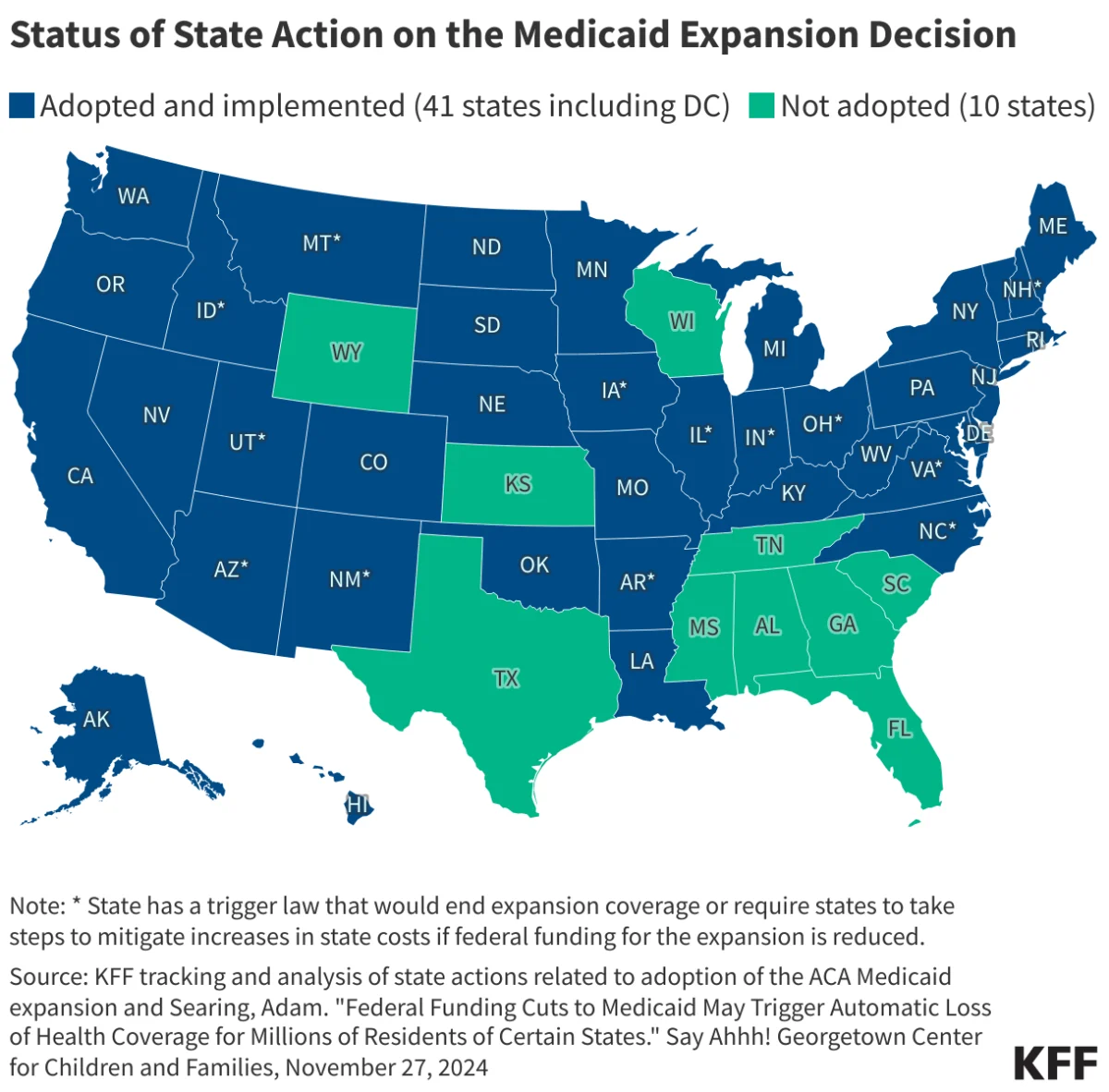
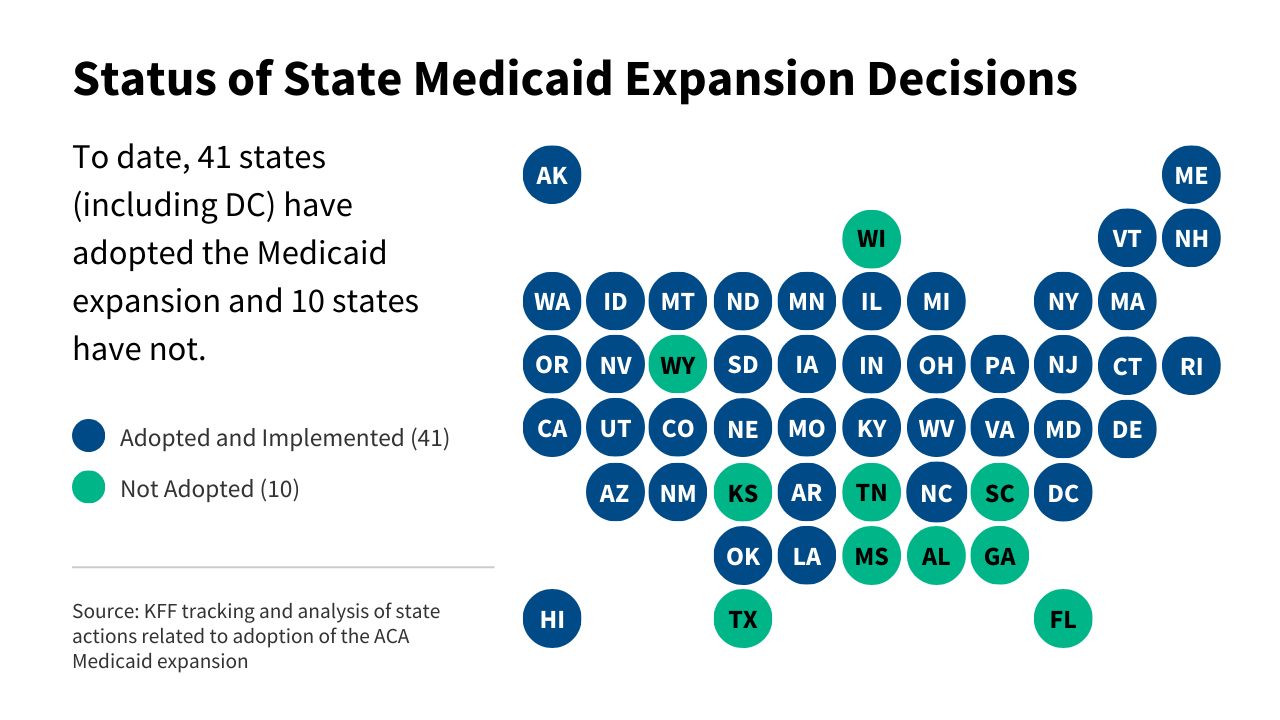
The landscape of American healthcare remains a patchwork of eligibility and access, defined largely by a single state-level decision: whether or not to adopt the Affordable Care Act’s (ACA) Medicaid expansion. As of early 2025, the divide between expansion and non-expansion states continues to shape the economic and physical well-being of millions. With 41 states (including the District of Columbia) having embraced the program and 10 states maintaining their holdout status, the debate has shifted from a question of "if" the ACA would survive to "how" states will manage the long-term financial and political commitments of the program.
n
The Medicaid expansion, a cornerstone of the 2010 ACA, was designed to provide a uniform floor of coverage for low-income adults across the country. By expanding eligibility to nearly all adults with incomes up to 138% of the Federal Poverty Level (FPL)—which in 2025 equates to approximately $21,597 for an individual—the program aimed to eliminate the "coverage gap" that previously left many working-class Americans with too much income for traditional Medicaid but too little to afford private insurance.
n
Main Facts: The Current Status of Expansion
n
The current map of Medicaid expansion reflects a decade of intense political maneuvering, legal challenges, and shifting public opinion. According to the latest tracking and analysis by the Kaiser Family Foundation (KFF), the breakdown stands at a 41-to-10 ratio. This majority includes a diverse array of states, ranging from early adopters like California and New York to more recent, voter-mandated expansions in historically conservative strongholds like South Dakota and Oklahoma.
n
Under the expansion, the federal government provides a significantly enhanced Federal Medical Assistance Percentage (FMAP). While the federal government typically covers between 50% and 75% of traditional Medicaid costs depending on the state’s per capita income, it covers 90% of the costs for the expansion population in perpetuity. This financial incentive was further bolstered by the American Rescue Plan Act (ARPA) of 2021, which offered an additional two-year, 5-percentage-point increase in the base FMAP for states that newly adopt the expansion.
n
Despite these incentives, 10 states—primarily concentrated in the Southeast and the Great Plains—have not yet adopted the expansion. These states include Alabama, Florida, Georgia, Kansas, Mississippi, South Carolina, Tennessee, Texas, Wisconsin, and Wyoming. In these jurisdictions, the "coverage gap" persists, leaving an estimated 1.5 million to 2 million people without a viable pathway to affordable health insurance.
n
Chronology: From Legislative Mandate to State Choice
n
The journey to the current 41-state consensus has been marked by three distinct phases of implementation:
n
1. The Mandatory Era and the Supreme Court Pivot (2010–2012)
n
When the ACA was signed into law in 2010, Medicaid expansion was intended to be mandatory for all states. However, the landmark 2012 Supreme Court ruling in NFIB v. Sebelius fundamentally altered the program’s trajectory. The Court ruled that the federal government could not withhold existing Medicaid funding from states that refused to expand, effectively making the expansion an optional choice for state governments.
n
2. The First Wave and the Rise of "Red State" Expansion (2014–2019)
n
Expansion officially began on January 1, 2014. A wave of Democratic-led states joined immediately, followed by several Republican-led states that sought "private option" models or Section 1115 waivers to customize their programs. During this period, states like Arkansas and Indiana implemented expansion with unique requirements, such as premiums or health savings account contributions, to make the program more palatable to conservative legislatures.
n
3. The Era of Ballot Initiatives and Legislative Breakthroughs (2020–2025)
n
In states where legislatures remained deadlocked, voters took matters into their own hands. Successful ballot initiatives in Idaho, Nebraska, Utah, Oklahoma, Missouri, and South Dakota forced expansion despite executive or legislative opposition. Most recently, North Carolina became a pivotal example of legislative compromise, with Republican leaders reaching a deal in late 2023 to expand the program in exchange for certificate-of-need reforms, bringing hundreds of thousands of residents into the fold by 2024 and 2025.
n
Supporting Data: The Economic and Fiscal Realities
n
The decision to expand or remain a holdout is often framed in fiscal terms. Proponents point to a mountain of data suggesting that expansion is a net positive for state budgets, while opponents worry about the long-term liability of the 10% state match.
n
The Federal Poverty Level and Eligibility
n
In 2025, the income threshold for expansion (138% FPL) is a critical benchmark:
n
- n
- Individual: $21,597
- Family of Three: $36,818
- Family of Four: $44,436
n
n
n
n
For individuals earning below these amounts in expansion states, Medicaid provides comprehensive coverage with little to no out-of-pocket costs. In non-expansion states, the eligibility for non-disabled adults is often near zero, meaning a parent working a part-time minimum-wage job may earn "too much" to qualify for Medicaid but not enough to qualify for ACA marketplace subsidies, which generally begin at 100% FPL.
n
The Rise of "Trigger Laws"
n
A significant and emerging trend in state activity involves "trigger laws." These are statutes that automatically terminate or scale back Medicaid expansion if the federal government reduces its 90% FMAP contribution.
n
- n
- South Dakota and West Virginia: Have considered or implemented triggers to protect state coffers against federal policy shifts.
- Virginia: Recently debated a budget amendment to remove an automatic termination clause, opting instead for a legislative committee review if federal funding fluctuates.
- Illinois and North Carolina: Have seen proposals to scale back or remove existing trigger laws to provide more stability for the covered population.
n
n
These triggers highlight the underlying tension between state and federal authorities regarding the long-term sustainability of the ACA’s funding model.
Official Responses: A Divided Political Philosophy
The discourse surrounding Medicaid expansion remains one of the most polarized issues in American domestic policy.
The Pro-Expansion Argument
State executives and healthcare advocacy groups in expansion states frequently cite the "triple aim" of healthcare: improving the patient experience, improving the health of populations, and reducing per capita costs.
- Governor Roy Cooper (D-NC): Upon signing expansion, Cooper emphasized that the move was not just a healthcare victory but an economic one, noting that it would bring billions in federal investment into the state’s rural hospitals.
- Healthcare Providers: Organizations like the American Hospital Association (AHA) argue that expansion drastically reduces "uncompensated care" costs—the bills that hospitals must absorb when uninsured patients seek emergency services.
The Opposition Perspective
In the 10 holdout states, the resistance is often rooted in concerns over federal overreach and fiscal "cliffs."
- Governor Greg Abbott (R-TX): Has consistently argued that expanding a "broken" system is not the answer and that the state cannot be sure the federal government will keep its 90% funding promise in the future.
- Fiscal Hawks: Critics often point to the "woodwork effect," where individuals already eligible for traditional Medicaid sign up because of the publicity surrounding expansion, thereby increasing state costs beyond the expansion-specific population.
Implications: The Future of Healthcare Coverage
As we look toward the remainder of 2025 and beyond, the implications of the Medicaid expansion decision will continue to resonate across several sectors of American life.
1. Hospital Solvency and Rural Health
There is a stark correlation between state expansion status and the survival of rural hospitals. In non-expansion states, rural hospitals are significantly more likely to close due to the high volume of uninsured patients. For the 10 holdout states, the continued refusal to expand puts their rural healthcare infrastructure at a permanent disadvantage compared to neighbors who have expanded.
2. Economic Productivity
Research has increasingly shown that Medicaid expansion improves workforce participation. By providing access to preventative care and treatment for chronic conditions (such as diabetes or hypertension), expansion allows low-income workers to remain in the workforce. Conversely, in non-expansion states, untreated health issues often lead to long-term disability and exit from the labor market.
3. The Threat of Federal Retrenchment
The "trigger laws" mentioned in recent state activity reflect a growing anxiety about the federal deficit. If a future Congress were to reduce the 90% FMAP for expansion, millions could lose coverage nearly overnight in states with automatic termination clauses. This creates a precarious "sword of Damocles" hanging over the heads of the expansion population.
4. Section 1115 Waivers as a Middle Ground
For the remaining 10 states, the path forward likely involves Section 1115 waivers. These allow states to test "experimental" policies, such as work requirements or health premiums. While the Biden administration has been skeptical of work requirements, a change in federal administration could see a resurgence of these "compromise" models, potentially enticing states like Georgia or Mississippi to move toward a limited form of expansion.
Conclusion
The status of Medicaid expansion in 2025 is a testament to the enduring complexity of the American federalist system. While 41 states have decided that the health and economic benefits of expansion outweigh the risks, 10 states remain firm in their opposition, creating a geographical lottery for healthcare access. As trigger laws evolve and the 138% FPL threshold adjusts for inflation, the battle over Medicaid will remain a defining feature of the American political and social contract for years to come. For the millions of Americans caught in the coverage gap, the outcome of these state-level debates is not merely a matter of policy—it is a matter of life and death.

