
The landscape of American healthcare financing is undergoing its most significant structural shift in decades. With the passage and subsequent implementation of the 2025 federal reconciliation law, the federal government has moved to aggressively curtail a primary mechanism states use to fund their portion of Medicaid: the provider tax. By imposing strict new ceilings on tax revenue and prohibiting the expansion of existing levies, the law threatens to create a multibillion-dollar "fiscal cliff" for state budgets, particularly those that expanded coverage under the Affordable Care Act (ACA).
n
As states grapple with slowing revenue growth and a rising number of uninsured residents, these new federal constraints represent a fundamental realignment of the state-federal partnership that has defined Medicaid since its inception.
n
Main Facts: A New Era of Fiscal Constraint
n
The 2025 reconciliation law, signed into law on July 4, 2025, introduces a tiered system of restrictions designed to phase out what federal critics describe as "financing loopholes" and what states describe as "essential funding streams." At the heart of the legislation are three primary pillars of restriction:
n
- n
- A Hard Freeze on New Revenue: The law prohibits all 50 states from establishing any new provider taxes or increasing the rates of existing taxes beyond their July 2025 levels.
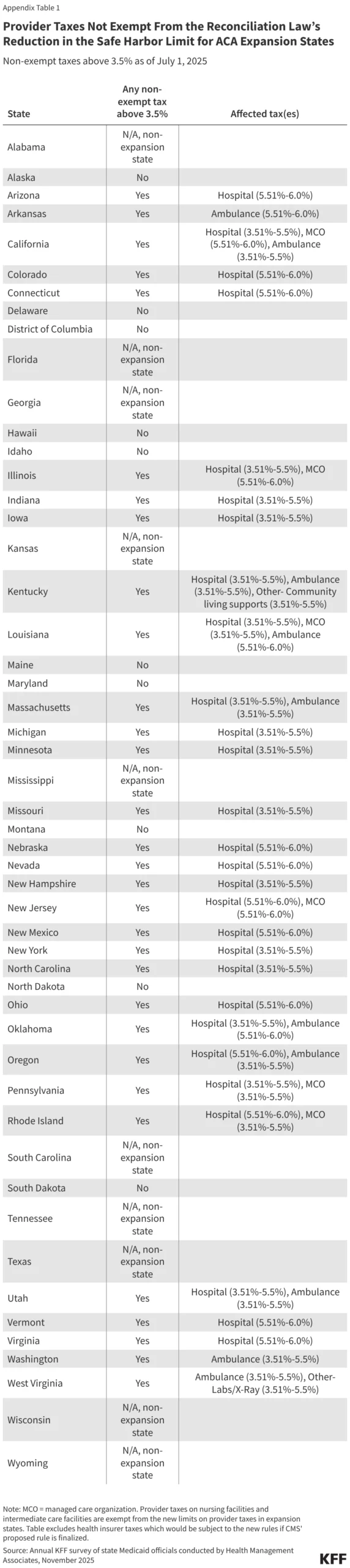
- The "Expansion State" Penalty: In a move targeted specifically at states that adopted the ACA Medicaid expansion, the law reduces the "safe harbor" limit—the maximum amount of tax revenue a state can collect relative to a provider’s net patient revenue—from the long-standing 6% down to 3.5% over a graduated period.
- Elimination of Uniformity Waivers: The law effectively bans the use of "uniformity waivers" that previously allowed states to tax different providers at different rates. This change specifically targets taxes that are "generally redistributive," often used to shield rural or high-Medicaid-volume hospitals from the full weight of the tax.
n
n
n
n
The financial stakes are massive. The Centers for Medicare & Medicaid Services (CMS) estimates that states will collect nearly $100 billion in provider tax revenue in 2026 alone. The Congressional Budget Office (CBO) projects that these new restrictions will slash federal Medicaid spending by $226 billion over the next decade, as states find themselves unable to generate the non-federal share required to "pull down" federal matching funds.
n
Chronology: From the "Wild West" to the 2025 Crackdown
n
The use of provider taxes has evolved from an obscure accounting maneuver to the backbone of state Medicaid financing over four decades.
n
The Rise of Provider Taxes (1980s–1990s)
n
In the 1980s, states discovered they could impose taxes on healthcare providers and use that revenue to meet their Medicaid funding obligations. Because the federal government matches state spending, this allowed states to increase their Medicaid budgets without using state general funds (taxpayer dollars). In many cases, the providers were "held harmless," meaning the state would pay them back the cost of the tax through increased Medicaid reimbursement rates.
n
The First Wave of Regulation (1991–2006)
n
Concerned by the "recycling" of federal funds, Congress passed the Medicaid Voluntary Contribution and Provider-Specific Tax Amendments of 1991. This established the core requirements that still exist today: taxes must be broad-based, uniform, and cannot hold providers harmless. In 2006, the "safe harbor" limit was formally set at 6% of net patient revenue.
n
The Expansion Era (2010–2024)
n
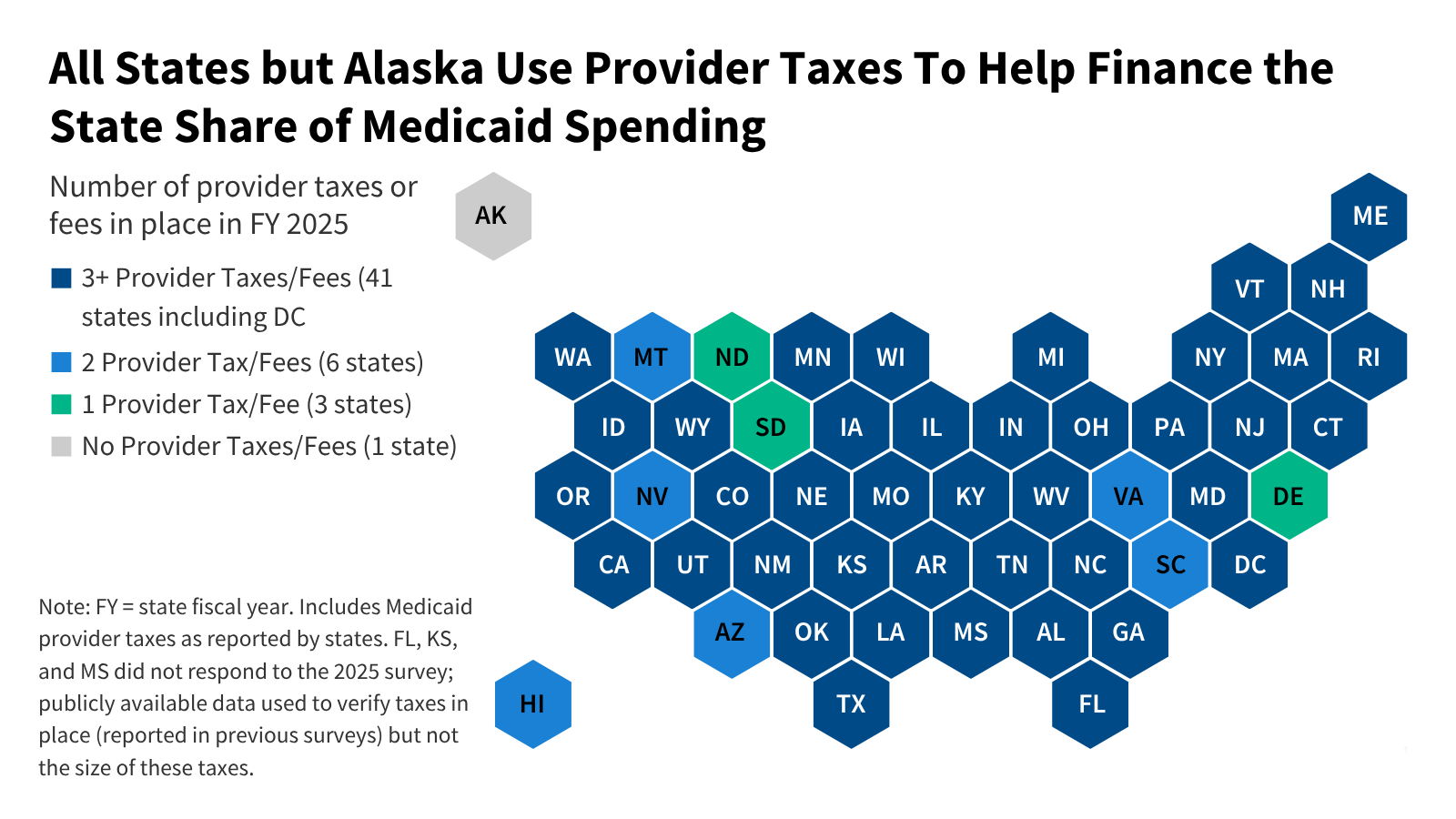
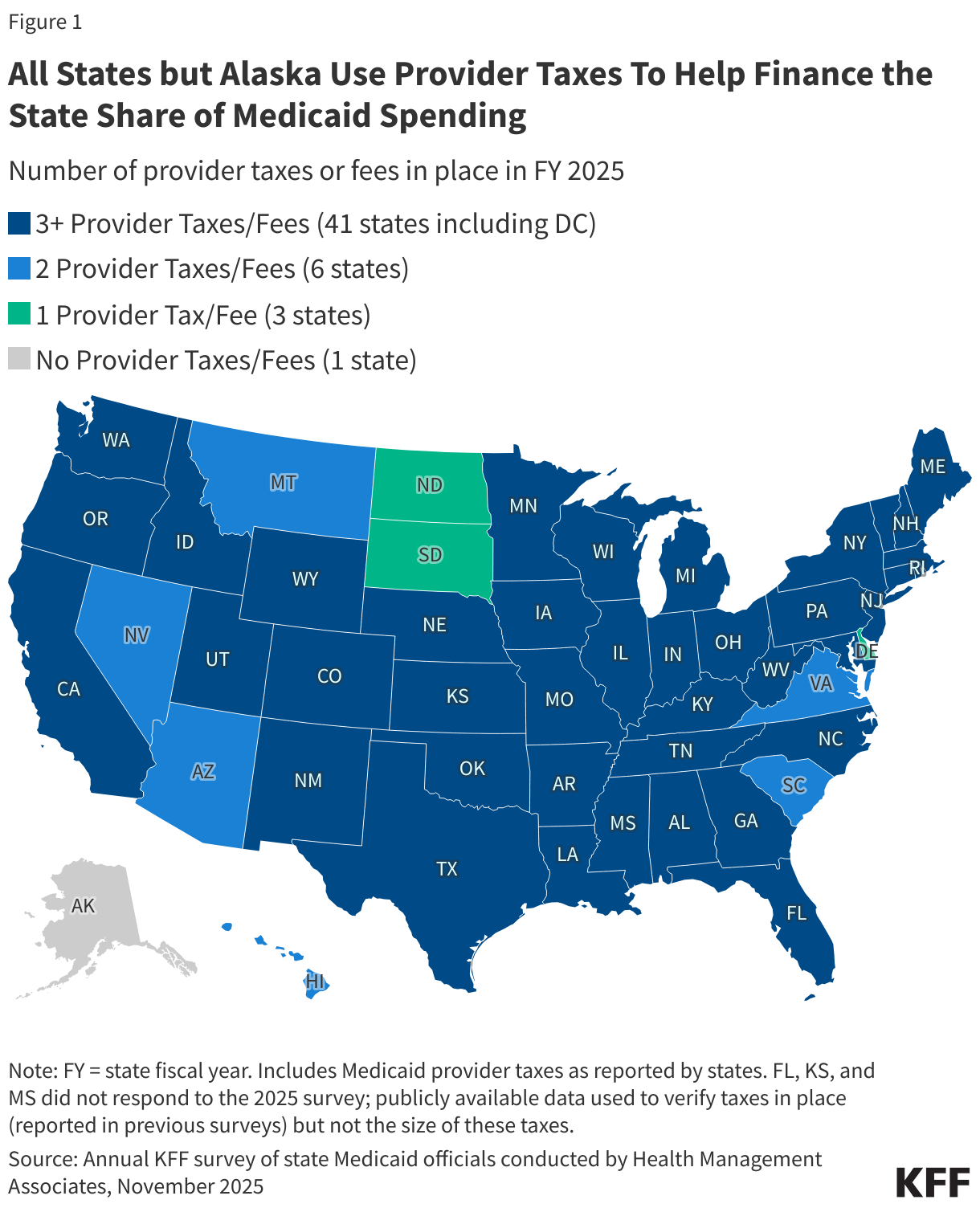
Following the passage of the ACA, many states used provider taxes to fund the state’s 10% share of the Medicaid expansion population. By 2024, 49 states (all except Alaska) utilized at least one provider tax, and 41 states utilized three or more.
n
The 2025 Reconciliation Law and 2026 Rulemaking
n
The Trump Administration and the 2025 Congress moved to finalize the current restrictions. On July 4, 2025, the reconciliation law was signed. This was followed by a February 2026 final rule on uniformity waivers and a July 2026 proposed rule by CMS to implement the decreasing safe harbor limits for expansion states.
n
Supporting Data: Mapping the Fiscal Impact
n
The reliance on provider taxes is not uniform across the country, but it is nearly universal. According to KFF’s 2025-2026 survey of Medicaid directors, while state general funds still account for the median 70% of the non-federal share of Medicaid spending, provider taxes have grown to contribute a substantial 18%.
n
Revenue Sources and Provider Types
n
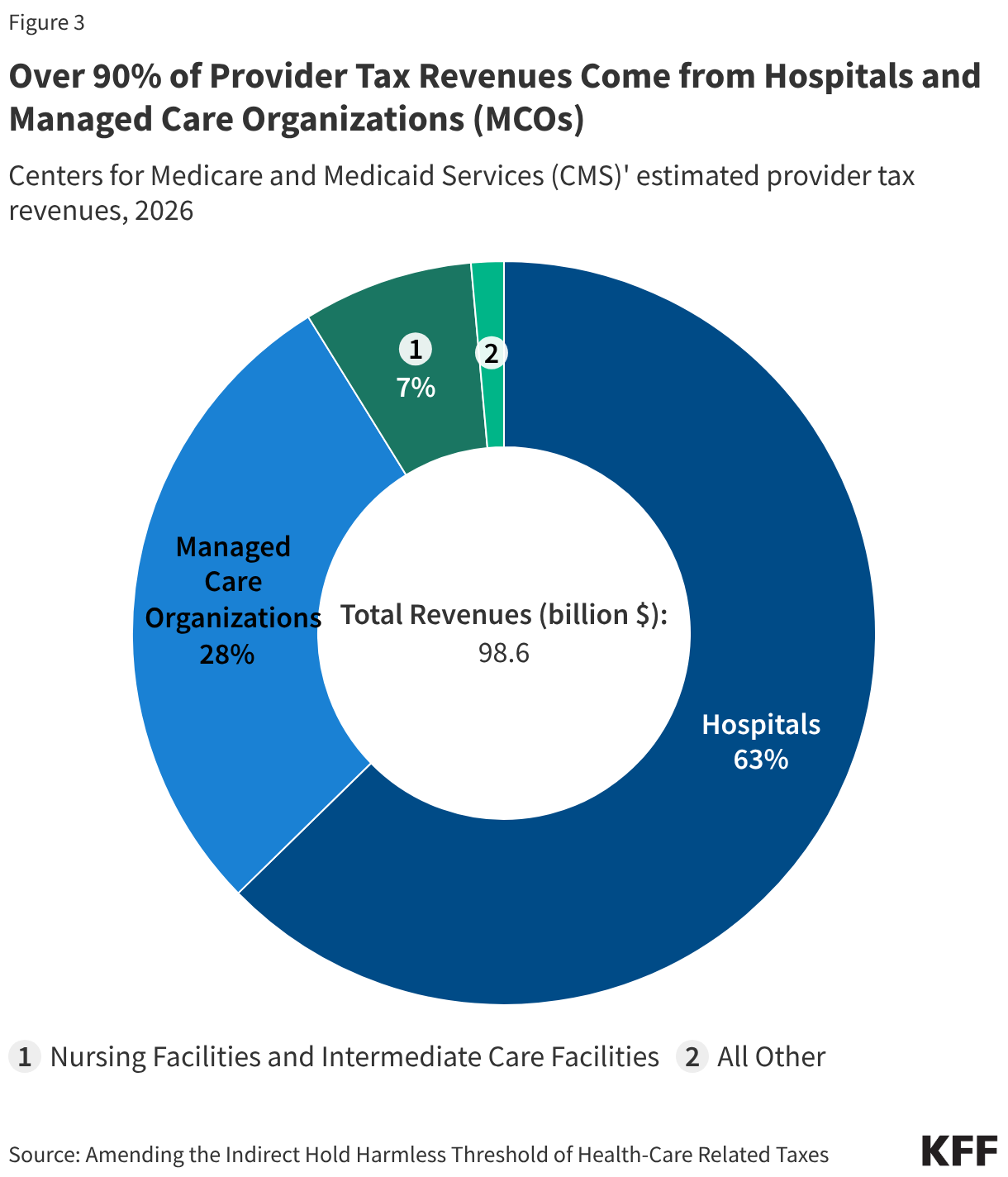
The $98.6 billion in projected tax revenue for 2026 is concentrated in two main areas:
n
- n
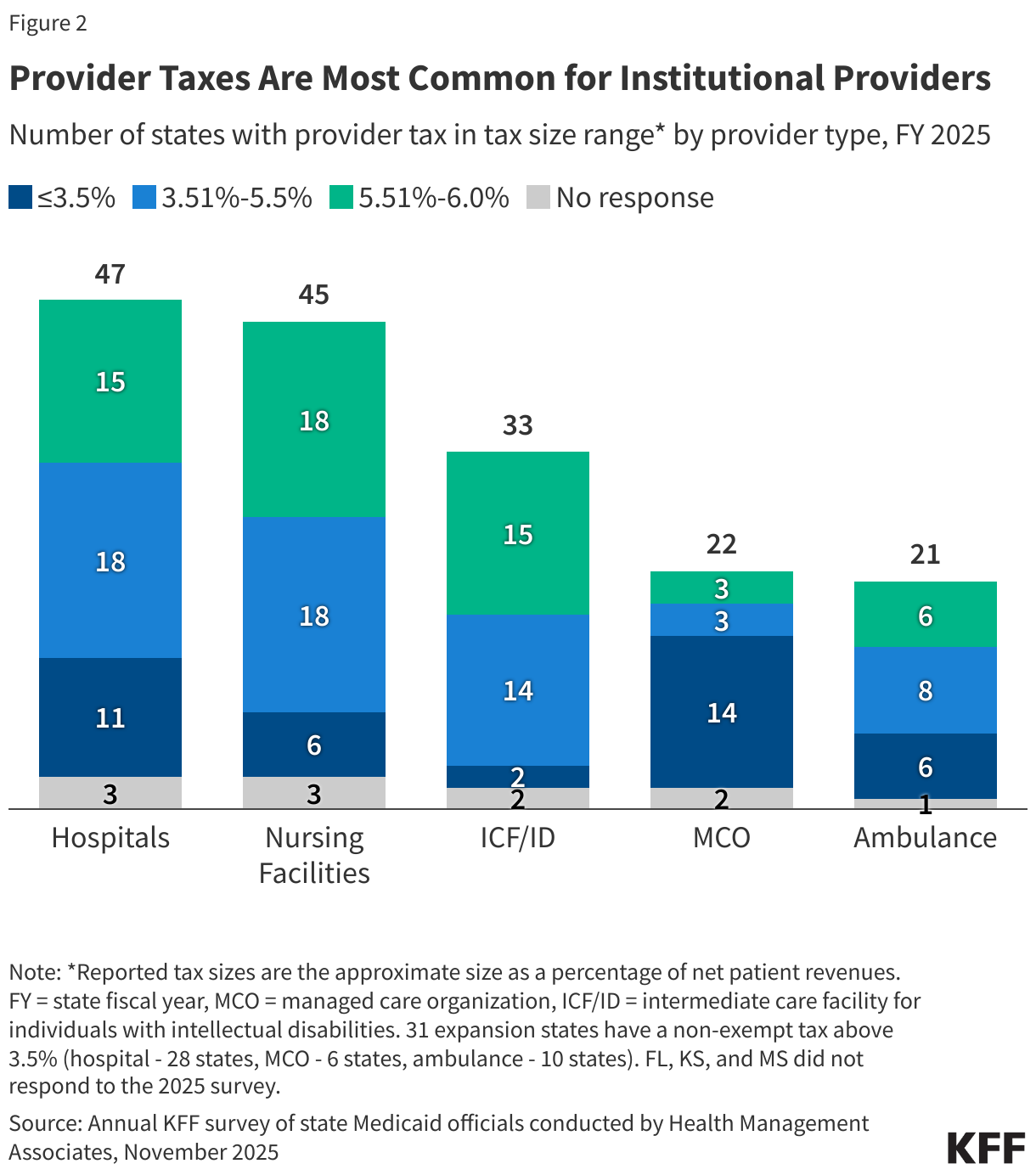
- Hospitals: $61.8 billion (63% of total revenue). Hospital taxes are active in 47 states.
- Managed Care Organizations (MCOs): $28.1 billion (28% of total revenue). MCO taxes are active in 22 states.
- Nursing Facilities: $28.1 billion in revenue is shared between MCOs and other providers, but nursing facility taxes are among the most common, appearing in 45 states.
n
n
n
n
States at the Edge of the "Safe Harbor"
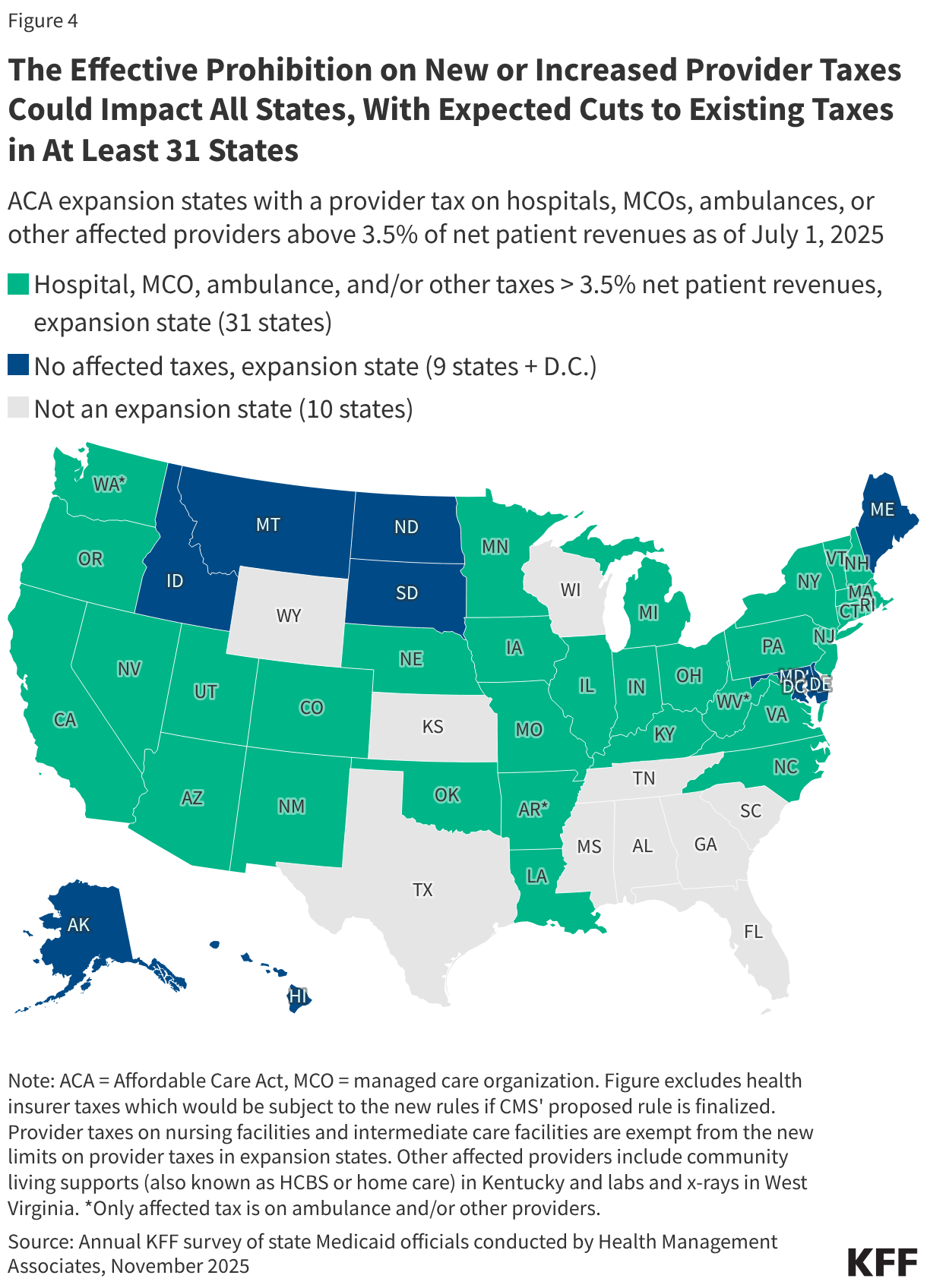
The reduction of the safe harbor limit from 6% to 3.5% for expansion states will hit 31 states immediately. KFF data indicates that 28 of these states currently have hospital taxes that exceed the new 3.5% threshold. If these states cannot find alternative funding, they will be forced to either cut provider payments or reduce the scope of their Medicaid programs.
The Uniformity Waiver Crisis
The new rules regarding "generally redistributive" taxes will force at least seven states—California, Massachusetts, Michigan, New York, Illinois, Ohio, and West Virginia—to overhaul their tax structures. In these states, MCO taxes that were designed to fall primarily on Medicaid-heavy plans will now be deemed illegal, potentially wiping out billions in state revenue as early as January 1, 2027.
Official Responses: Federal Oversight vs. State Sovereignty
The debate over the 2025 reconciliation law has pitted federal fiscal hawks against state administrators and healthcare advocates.
The Federal Perspective:
CMS and the CBO argue that the law is a necessary measure to ensure "fiscal integrity." In its July 2026 proposed rule, CMS stated that the changes would increase transparency and ensure that Medicaid financing is based on "genuine state contributions" rather than "circular financing schemes." Federal officials contend that the proliferation of provider taxes has artificially inflated federal spending, contributing to the national deficit.
The State and Provider Perspective:
State Medicaid directors have expressed deep alarm. The National Association of State Budget Officers (NASBO) has noted that the timing of these changes is particularly perilous, as states are already seeing a slowdown in general fund revenue.
Healthcare provider groups, including the American Hospital Association (AHA), have warned that the law will result in a "double hit." Providers will continue to face high costs of care while seeing the supplemental payments funded by these taxes vanish. "This is not just an accounting change; it is a direct threat to the stability of the safety net," one industry representative noted.
Implications: A Precarious Future for Medicaid
The implications of the 2025 reconciliation law extend far beyond the balance sheets of state treasuries. The ripples will be felt by providers, patients, and the broader economy.
1. The Threat to Provider Stability
Institutional providers—hospitals and nursing homes—rely on supplemental payments funded by these taxes to offset the fact that Medicaid base rates often fall below the actual cost of care. Without these "add-on" payments, many rural hospitals and safety-net facilities may face insolvency. This could lead to a wave of facility closures, particularly in states that have already seen a decline in rural healthcare access.
2. Reductions in Benefits and Eligibility
If states cannot fill the 18% funding gap left by reduced provider tax revenue, they will be forced to make difficult choices. This could include:
- Cutting Optional Benefits: Services such as adult dental, vision, and physical therapy are often the first to be cut during budget crunches.
- Restricting Eligibility: States may seek federal waivers to implement stricter work requirements or lower income thresholds for Medicaid eligibility, leading to a spike in the uninsured population.
3. Increased Pressure on General Funds
To maintain current Medicaid levels, state legislatures will have to divert money from other critical areas, such as K-12 education, infrastructure, and public safety. For many states, this may be politically or mathematically impossible, leading to a fundamental shrinking of the state’s social safety net.
4. The MCO Tax Reconfiguration
The seven states specifically identified as having "redistributive" MCO taxes face an immediate crisis. They must either tax all private insurers (a move that would likely face intense lobbying from the insurance industry and lead to higher premiums for all residents) or abandon the MCO tax entirely, losing a vital funding stream.
Conclusion
The 2025 reconciliation law marks the end of an era of creative Medicaid financing. While it achieves the federal goal of reducing expenditures and increasing transparency, it does so by shifting the financial burden onto states that are ill-equipped to handle it. As the 3.5% safe harbor limit begins to take effect and uniformity waivers expire, the true cost of this "fiscal integrity" will be measured in the health and stability of the nation’s most vulnerable populations.

