
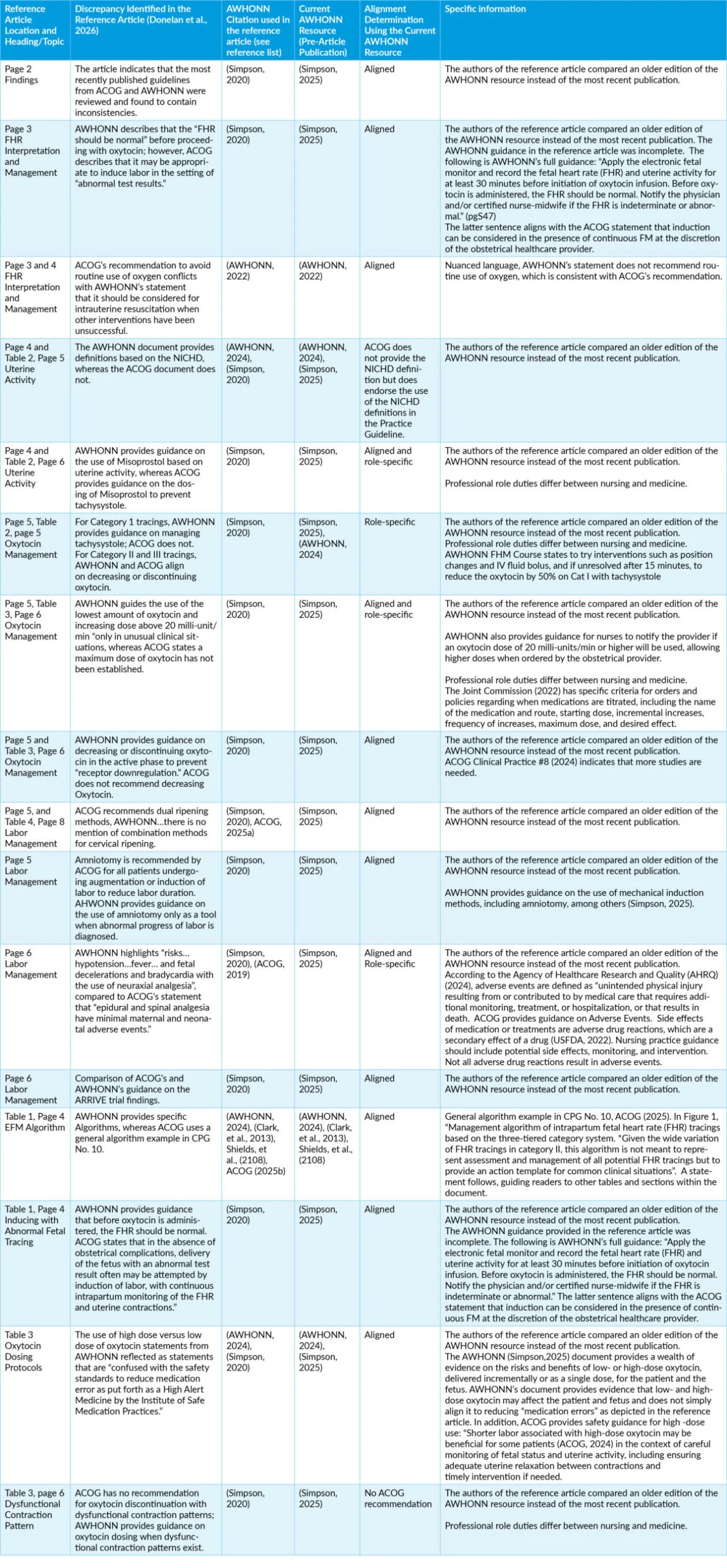
WASHINGTON, D.C. – In an effort to maintain clinical clarity and ensure the highest standards of patient safety at the bedside, the Association of Women’s Health, Obstetric and Neonatal Nurses (AWHONN) has released a comprehensive "Crosswalk Table" addressing significant inaccuracies in a recently published study. The move comes in response to the article "Professional Guideline Discrepancies as a Barrier to Labor Progress and Teamwork," authored by Donelan, E.A., et al., and published in the March 2026 issue of Obstetrics & Gynecology (widely known as the "Green Journal").
n
The central issue concerns the use of outdated clinical references, which AWHONN asserts has created unnecessary confusion among interdisciplinary healthcare teams. By providing a side-by-side comparison of the cited materials versus current standards, AWHONN aims to realign nursing and medical practices regarding cervical ripening, labor induction, and augmentation.
n
Main Facts: The Nature of the Discrepancy
n
The controversy stems from the Donelan et al. (2026) article, which sought to identify discrepancies between the guidelines of various professional organizations, specifically comparing the American College of Obstetricians and Gynecologists (ACOG) with AWHONN. The authors argued that these discrepancies act as a "barrier" to efficient labor progress and hinder effective teamwork.
n
However, AWHONN’s review of the publication revealed a fundamental flaw: the authors utilized the 5th Edition (2020) of AWHONN’s Cervical Ripening and Labor Induction and Augmentation Monograph. At the time of the article’s publication in March 2026, this edition had been superseded by the 6th Edition, which was released in August 2025.
n
The result was a scholarly analysis based on "expired" data. According to AWHONN, many of the "discrepancies" identified by Donelan et al. had already been addressed, reconciled, or updated in the 6th Edition of the monograph. By citing the 2020 version, the article inadvertently presented a version of nursing standards that no longer represented the current evidence-based practice endorsed by the organization.
n
The Purpose of the Crosswalk Table
n
To mitigate the potential for clinical errors or friction between nursing and medical staff, AWHONN developed the Crosswalk Table. This tool serves several functions:
n
- n
- Identification: It pinpoints specific page numbers and topic headings in the Donelan article where errors occur.
- Correction: It replaces the 5th Edition citations with the relevant 6th Edition references.
- Clarification: It provides bedside-specific information to alleviate confusion when clinicians are making real-time decisions about labor management.
n
n
n
n
Chronology: A Timeline of Publication and Notification
n
The timeline of events suggests a breakdown in the traditional "best practice" of resource tracking and editorial verification. The chronology of the discrepancy is as follows:
n
- n
- 2020: AWHONN publishes the 5th Edition of the Cervical Ripening and Labor Induction and Augmentation Monograph. This becomes the standard for nursing practice for the following five years.
- August 2025: Adhering to its five-year revision cycle, AWHONN releases the updated 6th Edition. This version incorporates the latest evidence-based research and aligns more closely with contemporary interdisciplinary standards.
- January 2026: The editorial team of the "Green Journal" (Obstetrics & Gynecology) is formally notified that the Donelan et al. manuscript, which is in the pre-release phase, contains inaccuracies due to the use of the expired 5th Edition of the AWHONN monograph.
- March 2026: Despite the notification, the article is published in Volume 147, Issue 3, of the journal, maintaining the outdated citations.
- Post-Publication: AWHONN issues the Crosswalk Table and a formal response to ensure that the healthcare community is not guided by obsolete information.
n
n
n
n
n
n
AWHONN emphasizes that authors and editorial boards have a responsibility to follow rigorous tracking of resources through the very moment of publication. In fields as dynamic as obstetrics, a six-month delay in updating a reference can mean the difference between following current safety protocols and relying on outdated methodology.
n
Supporting Data: The Impact of Outdated References
n
The reliance on the 2020 monograph in a 2026 publication is more than a clerical error; it has practical implications for how labor is managed. AWHONN’s monographs are not merely suggestions; they are the foundation for nursing education, hospital protocols, and legal standards of care.
n
The Role of the Monograph
n
Unlike a brief "practice bulletin," an AWHONN monograph is an exhaustive resource designed to guide nursing interventions. It includes detailed protocols for:
n
- n
- Oxytocin Administration: Precise dosing increments and intervals.
- Fetal Monitoring: Interpretation of heart rate patterns during induction.
- Cervical Ripening Agents: Safety protocols for the use of prostaglandins and mechanical dilators.
n
When an academic article suggests that nursing guidelines (AWHONN) are at odds with physician guidelines (ACOG), it can create a "psychologically unsafe" environment. Nurses may feel caught between their professional standards and the orders of a physician who is citing a different—or in this case, a more current—set of data.
Discrepancy Metrics
The Crosswalk Table highlights that several "discrepancies" noted by Donelan et al. regarding labor augmentation intervals and the definition of "active labor" were actually resolved in the 2025 AWHONN update. By failing to use the 6th Edition, the researchers presented a gap that, in many clinical settings, no longer existed. This highlights the necessity for professional organizations to communicate revision cycles clearly and for researchers to verify the "active" status of a guideline before going to print.
Official Responses: AWHONN and the Editorial Standard
AWHONN’s official response strikes a balance between professional correction and a call for better interdisciplinary collaboration. The organization maintains that nursing practice is inherently collaborative, requiring a "partnership with physicians, midwives, and patients."
On Editorial Rigor
AWHONN’s statement serves as a critique of the peer-review and editorial process in this specific instance. "Editorial teams should establish a process for reevaluating articles brought to their attention during the pre-release phase," the organization noted. The fact that the "Green Journal" was alerted to the inaccuracies in January but proceeded with the March publication suggests a need for more agile editorial workflows in medical publishing.
On Resource Utilization
The organization also pointed out a nuance often missed in academic comparisons: the difference in how resources are intended to be used. While ACOG guidelines often focus on medical management and decision-making, AWHONN monographs are tailored toward the nursing process, continuous monitoring, and the titration of medications. AWHONN asserts that these resources should "support—not silence—open dialogue."
"Optimal outcomes depend on respectful, interdisciplinary communication and shared decision-making grounded in mutual recognition of each discipline’s expertise," the statement read. AWHONN argues that by framing different professional guidelines as "discrepancies" or "barriers," the Donelan article may have inadvertently undermined the "high-functioning teamwork" essential for labor and delivery units.
Implications: The Path Forward for Obstetric Care
The fallout from the Donelan et al. (2026) article and the subsequent AWHONN correction has broader implications for the medical community, focusing on three key areas: bedside safety, interdisciplinary relations, and the integrity of medical literature.
1. Bedside Safety and Litigation
In the high-stakes environment of labor and delivery, clarity is paramount. If a hospital’s nursing protocol is based on the AWHONN 6th Edition, but a physician is referencing the Donelan article (which cites the 5th Edition), the resulting disagreement could delay patient care. Furthermore, in the event of an adverse outcome, conflicting "expert" sources can complicate legal proceedings. The Crosswalk Table is therefore an essential document for risk management departments to ensure their hospital protocols are aligned with the most current evidence.
2. Fostering Psychological Safety
AWHONN’s emphasis on "psychologically safe environments" is a nod to a growing movement in healthcare that prioritizes the ability of any team member to speak up without fear of retribution. When academic literature suggests that one discipline’s guidelines are a "barrier" to another’s, it reinforces a hierarchy that can silence nurses. AWHONN’s response seeks to reframe these guidelines as complementary tools that, when used correctly, enhance patient-centered decision-making.
3. The Five-Year Revision Standard
The incident underscores the importance of the five-year revision cycle common among professional organizations. As medical science evolves, guidelines must be living documents. AWHONN’s commitment to this cycle ensures that the nursing profession has up-to-date information, but it also places a burden on clinicians and researchers to ensure they are not using "expired" versions of these standards.
Conclusion
The release of the Crosswalk Table is a rare but necessary intervention by a professional nursing organization into the realm of medical publishing. By correcting the record on the Donelan et al. (2026) article, AWHONN is doing more than just fixing citations; it is protecting the integrity of the nursing profession and ensuring that the "teamwork" mentioned in the article’s title is built on a foundation of accurate, current, and shared evidence.
Moving forward, the healthcare community will likely look to editorial boards to implement more robust verification systems, especially when notified of errors prior to publication. For now, clinicians at the bedside are encouraged to consult the AWHONN Crosswalk Table to ensure that their practice remains at the cutting edge of obstetric safety.

