
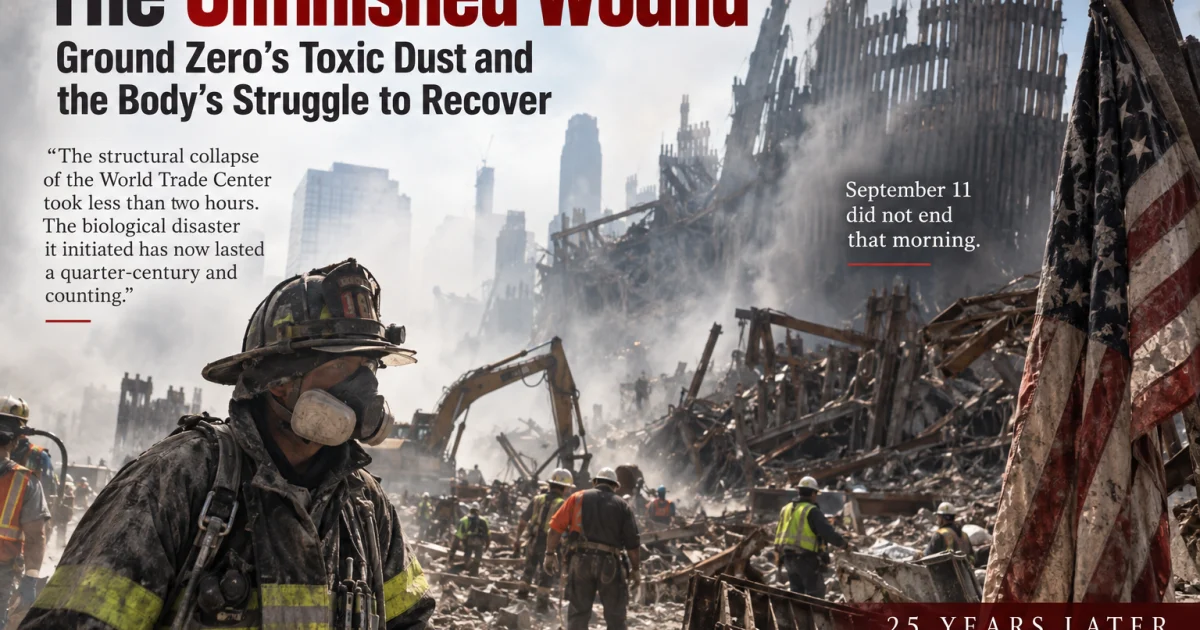
The dust has settled, but the wounds remain open. Twenty-five years after the catastrophic collapse of the World Trade Center, the enduring biological consequences for those exposed to Ground Zero continue to unfold, revealing a complex tapestry of illness and scientific challenge.
n
The Lingering Shadow: Beyond the Initial Catastrophe
n
The immediate devastation of September 11th, 2001, was a matter of hours. The biological disaster it unleashed, however, has proven to be a marathon. Decades of meticulous medical research have painted a stark picture: the human body was ill-equipped to process the synthetic, caustic assault of Ground Zero. For the first responders, survivors, and residents who inhaled the toxic cocktail of pulverized building materials, combustion byproducts, and resuspending debris, the wound inflicted on their bodies has never truly closed. This 25-year milestone serves not as a conclusion, but as a somber interim assessment of an ongoing biological saga.
n
A Cascade of Exposures: The True Nature of "Dust"
n
The official assurances that the air in Lower Manhattan was safe following the attacks proved tragically misguided. What settled over the city was not mere dust, but a potent, complex aerosol. The collapse of the Twin Towers generated an immense alkaline dust cloud, a potent irritant derived from pulverized concrete, gypsum, and other building materials. This dust was not only caustic but also significantly larger than the PM2.5 particles that typically concern public health officials, leading to mechanical trauma as the respiratory system struggled to clear them.
n
Adding to this perilous mixture, subterranean fires burned for months beneath the wreckage, venting a complex array of carcinogenic combustion products. Dioxins, furans, and polycyclic aromatic hydrocarbons (PAHs) saturated the air, their presence and concentration varying over time and location. As cleanup efforts progressed, excavation and vehicular activity repeatedly resuspended this toxic debris, perpetuating the exposure for those on-site. For residents and office workers in surrounding buildings, unaddressed contamination settled into ventilation systems, carpets, and furnishings, leading to prolonged, low-level exposure to the same hazardous elements.
n
This was not a singular event, but a succession of exposures. The initial deluge of alkaline dust was followed by months of combustion fumes and then by the persistent resuspension of contaminated materials. The very nature of the exposure varied dramatically, encompassing different particle sizes, chemical compositions, and durations, making a one-size-fits-all understanding of its impact impossible.
n
The Mechanics of Exposure: A Failure of Protection
n
The narrative of insufficient protection is central to understanding the enduring health consequences. For those laboring on the pile, the physical demands of their work altered their breathing patterns. Working at a strenuous pace, they often breathed more rapidly and through their mouths, bypassing the natural filtration mechanisms of the nasal passages and drawing contaminants deeper into their lungs.
n
Compounding this, premature official reassurances about air safety delayed the provision and mandatory use of appropriate respiratory protection. The readily available surgical and disposable dust masks offered minimal and inconsistent protection, failing to create a reliable seal against airborne toxins. While properly fitted elastomeric P100 cartridge respirators could have significantly reduced exposure, their inconsistent use and the difficulty workers experienced wearing them during strenuous labor meant their protective potential was largely unrealized. This failure to adequately safeguard those at the epicenter of the contamination set the stage for immediate and long-term health repercussions.
n
The Acute Respiratory Insult: "WTC Cough" and Beyond
n
The most immediate and well-documented consequence of inhaling the Ground Zero dust was a severe and persistent respiratory syndrome, colloquially known as "WTC cough." The alkalinity of the dust, primarily from pulverized wallboard and cement, caused significant irritation and chemical injury to the moist lining of the airways. This damage disrupted the natural mucociliary clearance mechanism, hindering the body’s ability to expel the foreign particles and leading to chronic inflammation and airway hyperresponsiveness.
n
The clinical manifestations were stark: a persistent, often debilitating cough, accompanied by wheezing, shortness of breath, and chronic nasal and sinus congestion. For many, this also led to gastroesophageal reflux disease (GERD), a testament to the interconnectedness of the aerodigestive system.
n
A particularly poignant piece of evidence emerged from the FDNY. Many firefighters had undergone pre-September 11th lung function tests as part of their routine medical evaluations. This provided an invaluable baseline, allowing researchers to quantify the immediate impact of the exposure. Within the first year following the attacks, non-smoking FDNY firefighters experienced an average decline of 439 mL in their Forced Expiratory Volume in one second (FEV1), a crucial measure of lung function. EMS workers saw a similar decline of 267 mL. These figures represent a dramatic compression of age-related lung function loss into a matter of months, highlighting the profound and rapid damage inflicted by the inhaled toxins.
n
The initial surprise for researchers was not only the speed of this decline but also the incomplete nature of recovery for many.
n
When Healing Fails: The Persistent Scars on the Lungs
n
While not everyone exposed developed chronic lung disease, for those who did, the damage manifested in various insidious ways. The chronic inflammation and narrowing of the small airways, known as bronchioles, led to air trapping, where portions of the lungs remain overinflated even after exhalation. In more severe cases, constrictive bronchiolitis, characterized by progressive inflammation and scarring, caused significant breathlessness.
n
The persistent presence of "super-coarse fraction" material in the lungs posed a unique challenge. The body’s macrophages, the immune cells responsible for clearing debris, struggled to digest these large, persistent particles. This led to a phenomenon known as "frustrated phagocytosis," where macrophages, unable to complete their task, continued to release inflammatory chemicals and reactive oxygen species, sustaining inflammation and impeding natural repair processes.
n
These findings underscore that there isn’t a single "9/11 lung disease." Instead, the exposures triggered multiple, overlapping pathways of injury and disease, often extending beyond the lungs themselves.
n
The Aerodigestive Interplay: A Wound That Connects
n
The interconnectedness of the aerodigestive system played a crucial role in the fallout of 9/11 illnesses. The throat serves as a shared pathway for both the digestive tract and the airways. Normally, swallowing mechanisms ensure that food and liquids are directed to the esophagus, while air enters the trachea. However, chronic sinus issues, throat irritation, asthma, cough, and GERD became common comorbidities among those exposed.

n
GERD emerged as one of the most frequently reported WTC-associated conditions. Drainage from irritated sinuses and throats could trigger coughing, which in turn exacerbated reflux. This created a vicious cycle, with reflux irritating the throat and airways, leading to more coughing. The failure of the linings of the airways and digestive tract to resolve their acute injury left the aerodigestive tract in a state of perpetual distress—an open wound amplified by the neural pathways of the vagus nerve.
n
This "vagal cross-talk" also amplified the psychological toll. The trauma of 9/11 contributed to high rates of Post-Traumatic Stress Disorder (PTSD) among the exposed cohort. Chronic autonomic dysregulation, characterized by persistent sympathetic overdrive and altered vagal tone, lowered the threshold for visceral irritation, perpetuating a feedback loop that maintained airway hyperreactivity. The trauma of the event was not confined to memory; it had tangible physiological consequences.
n
Cancer: A Signal Lost in a Statistical Hall of Mirrors
n
The link between chronic inflammation and an increased risk of cancer is well-established. The presence of asbestos fibers and a host of carcinogenic compounds at Ground Zero raised theoretical concerns about accelerated neoplastic change. However, untangling this biological suspicion from statistical observation has proven to be one of the most methodologically challenging aspects of environmental health research.
n
The standardized incidence ratio (SIR), which compares observed cancer rates in a study population to expected rates, has yielded complex results. In analyses of the largest cohorts of 9/11 responders, the overall SIR has hovered around 0.96, suggesting no significant overall increase in cancer. However, this figure is heavily influenced by several confounding factors.
n
The "healthy-worker effect" is a significant distorting variable. First responders, by nature of their occupations, undergo rigorous medical and physical screenings, leading to generally lower baseline rates of certain illnesses. This pre-existing lower risk can artificially lower the observed SIR, potentially masking an elevated occupational burden.
n
Furthermore, the very act of surveillance, while compassionate, has created a "statistical hall of mirrors." The WTC Health Program, established to monitor and treat eligible responders and survivors, requires certification of exposure likelihood to qualify for coverage. This administrative process, while necessary for resource allocation, means that the program’s data reflects a group actively seeking care, potentially leading to an overdetection of certain cancers.
n
Proactive and routine screening within the WTC Health Program has led to an elevated detection rate for cancers like thyroid cancer, prostate cancer, and melanoma. These malignancies are particularly susceptible to screening and diagnostic intensity, meaning that the program has identified smaller, asymptomatic, and often slower-growing lesions that might have gone unnoticed in the general population. This increased detection rate artificially inflates the incidence, without necessarily indicating a true increase in the risk of developing aggressive disease.
n
Compounding these issues is the disparate recruitment pathways into the program. Occupational cohorts, particularly those who worked directly on the pile, underwent proactive monitoring. Community survivors, conversely, were more likely to enter the program only after developing symptoms or receiving a diagnosis. This difference in recruitment introduces selection bias, making direct comparisons between groups challenging.
Paradoxically, despite significant inhalation exposure to combustion aerosols and heavy metals, major cohort studies have not yet demonstrated a clear excess of lung cancer or other solid tumors. As responders and survivors age into their sixties and beyond, it becomes increasingly difficult to disentangle age-related cancers from those potentially prompted by 9/11 exposures. The long latency periods for many cancers mean that a definitive accounting may still be decades away.
Molecular Footprints: The Subtle Signatures of Exposure
The long-lived nature of blood-forming stem cells makes them biological archivists, capable of recording acquired mutations over time. Researchers have begun to identify "Clonal Hematopoiesis of Indeterminate Potential" (CHIP) in WTC-exposed responders. CHIP occurs when mutations conferring a survival advantage lead to the clonal expansion of certain stem cells, even in the absence of overt blood cancers.
Studies have detected CHIP at higher rates in WTC-exposed responders compared to non-exposed firefighters. While this finding does not definitively link 9/11 exposures to increased cancer rates, it provides objective evidence that intense toxic exposure has left lasting molecular signatures in somatic stem cell lines. It suggests that while toxic exposure alone may not be sufficient to initiate cancer, it can create a biological environment where other triggers are more likely to lead to malignancy.
The Latency Horizon: An Unfinished Reckoning
The presence of chrysotile asbestos at Ground Zero raises concerns about asbestos-associated diseases like mesothelioma, asbestosis, and lung cancer. These conditions typically have latency periods of 30 years or more, meaning that the 25-year mark is merely an interim assessment. The true toll of these long-latency diseases remains to be fully understood.
An Unfinished Ledger: The Ongoing Science of Healing
The legacy of Ground Zero cannot be simplified into a single inflammatory pathway or an inevitable progression from toxic dust to cancer. In the respiratory system, the evidence of harm is stark and measurable. In the realm of oncology, however, the picture remains obscured by the very tools and systems designed to monitor health. This explains why respiratory injuries can be described with definitive confidence, while the oncological balance sheet remains open.
These complexities highlight the dynamic nature of scientific inquiry. September 11th lasted less than a morning, but its biological aftermath has already spanned a quarter-century. At this milestone, the most honest verdict is not that the final human toll has been calculated, but that the wound remains open, and the process of calculation and comprehension is still very much underway. The scars of Ground Zero are a testament to the enduring impact of environmental catastrophe and the ongoing scientific quest to understand and heal its deepest wounds.

