
Introduction
n
Medicaid, the cornerstone of the American social safety net, currently stands at a precarious juncture. As the primary program providing comprehensive health and long-term care to one in five people in the United States, it accounts for nearly $1 out of every $5 spent on healthcare nationwide. However, the symbiotic relationship between state budgets and federal funding is facing its most significant test since the Great Recession. According to the latest data from the National Association of State Budget Officers (NASBO) and analysis by KFF, a combination of slowing state revenue growth, the exhaustion of pandemic-era surpluses, and the implementation of the 2025 reconciliation law is forcing states to reconsider their commitment to Medicaid expansion and provider reimbursement.
n
I. Main Facts: The Medicaid Funding Landscape
n
Medicaid is unique in the American federalist system because of its "open-ended" matching structure. Administered by states within broad federal rules, it is jointly funded through a federal matching program with no cap. On average, the federal government covers approximately two-thirds of total Medicaid costs, while states cover the remaining third. This ratio, however, fluctuates significantly based on a state’s per capita income and its status regarding the Affordable Care Act’s expansion.
n
The program’s footprint on state budgets is massive. In state fiscal year (FY) 2025, Medicaid accounted for 31% of total state spending across all budget items. While it represented only 17% of expenditures from state-generated funds (general funds), it constituted a staggering 57% of all expenditures from federal funds. This makes Medicaid both a significant spending obligation and the largest single source of federal revenue for states.
n
The current fiscal environment is defined by "tightening." State revenue growth is slowing at the same time that spending pressures—driven by inflation, an aging population, and new federal mandates—are mounting. The 2025 reconciliation law, which includes substantial reductions in federal Medicaid spending, is the "black swan" event that many analysts fear will trigger a wave of eligibility restrictions and benefit cuts.
n
II. Chronology: From Pandemic Surpluses to the "Cooling" Era
n
To understand the current crisis, one must look at the fiscal trajectory of the last five years:
n
The Pandemic Shock and Recovery (2020–2022):nWhen the COVID-19 pandemic hit, state economies initially buckled, but recovered with unprecedented speed due to massive federal stimulus and a rapid rebound in consumer spending. This period saw record-breaking revenue growth. States found themselves flush with cash, leading to the largest budget surpluses in history. Many states used this windfall to bolster "Rainy Day Funds" or enact aggressive tax cuts.
n
The Moderation Phase (FY 2023–2025):nAs federal stimulus dried up and the Federal Reserve raised interest rates to combat inflation, the "pandemic high" began to fade. Revenue growth started to moderate. While FY 2025 remained relatively stable, the cracks began to show. States started to grapple with the "unwinding" of pandemic-era Medicaid continuous enrollment provisions, which had previously seen enrollment swell to record levels.
n
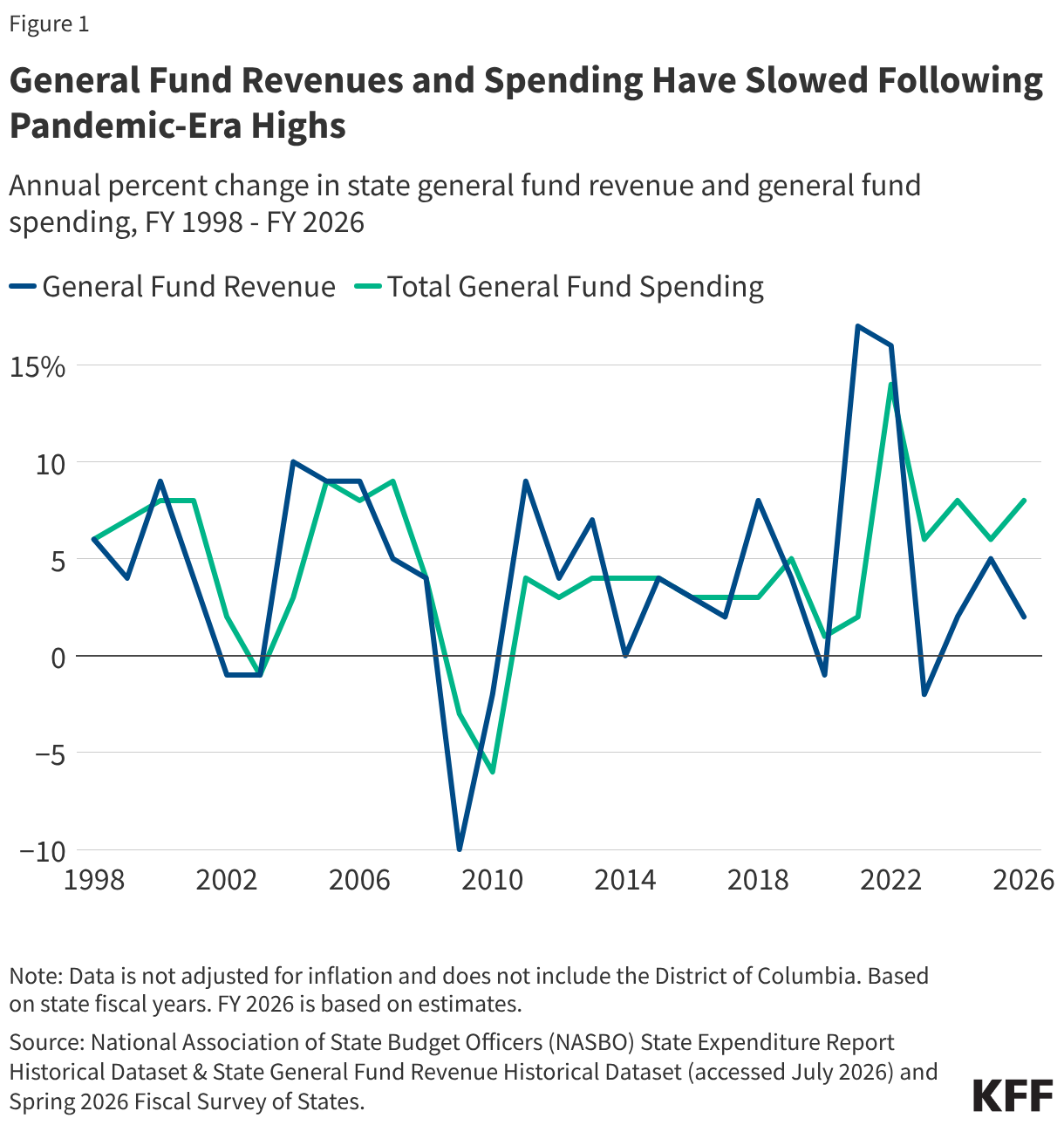
The Current Slowdown (FY 2026):nBy FY 2026, the fiscal environment shifted from "moderation" to "stagnation." Estimated total revenue growth fell to just 2%, a sharp decline from the 5% seen just a year prior. For the first time in years, 20 states reported actual declines in revenue collections.
n
The Reconciliation Era (FY 2027 and Beyond):nThe enacted budgets for FY 2027 signal a new era of austerity. Most states are projecting growth of only 2-3%. The implementation of the 2025 reconciliation law is now the primary concern, as it introduces structural changes to the tax code and direct cuts to federal Medicaid and SNAP (Supplemental Nutrition Assistance Program) funding.
n
III. Supporting Data: A State-by-State Divergence
n
The national average of 2% revenue growth masks a deeply fragmented reality across the 50 states.
n
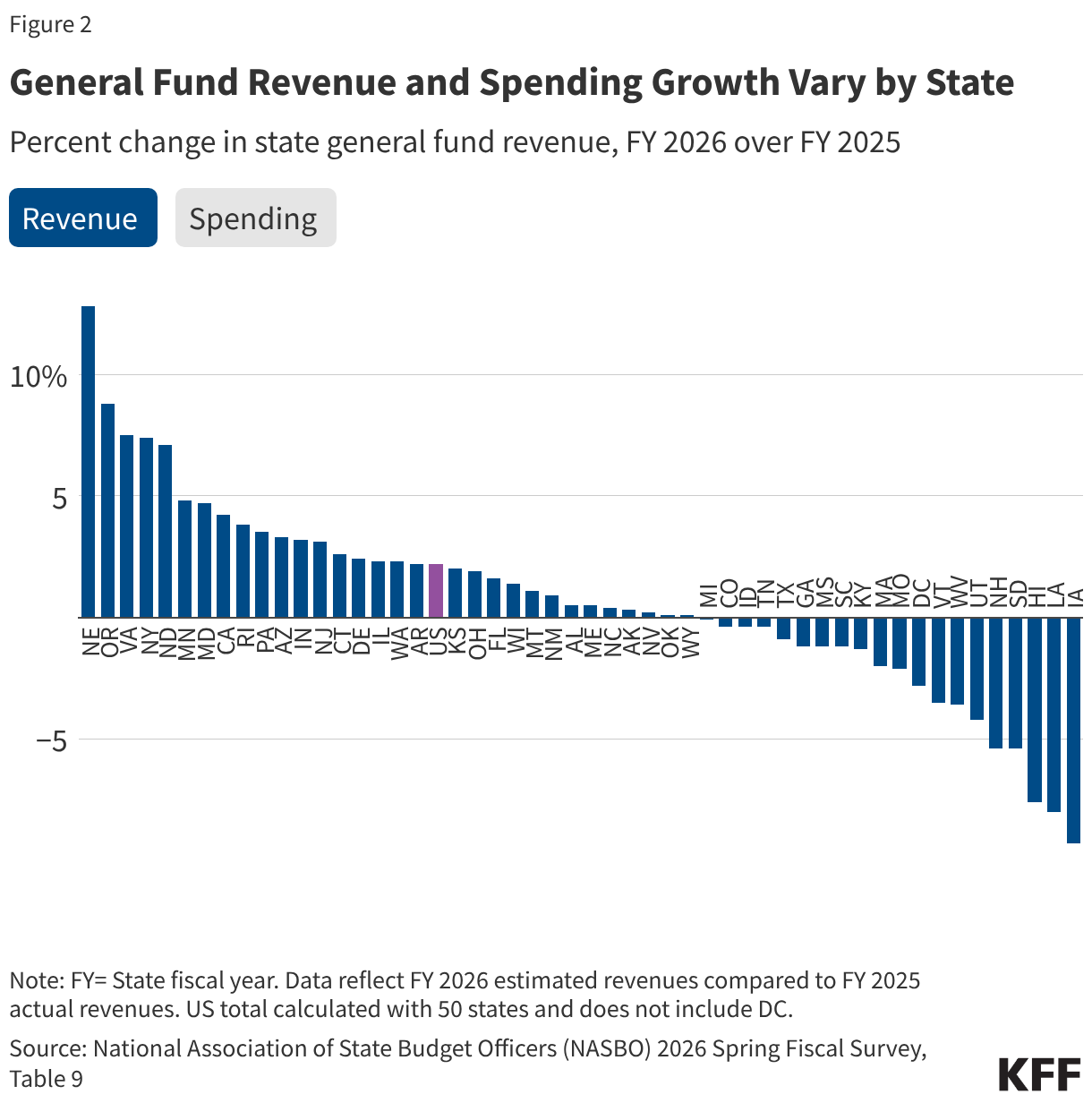
Revenue Disparity:nIn FY 2026, while 30 states saw modest increases (0–10%), 20 states experienced negative revenue growth. This decline is attributed to a "perfect storm" of factors: recently enacted state tax cuts, stock market volatility affecting capital gains taxes, and a shift in consumer behavior from taxable goods to non-taxable services.
n
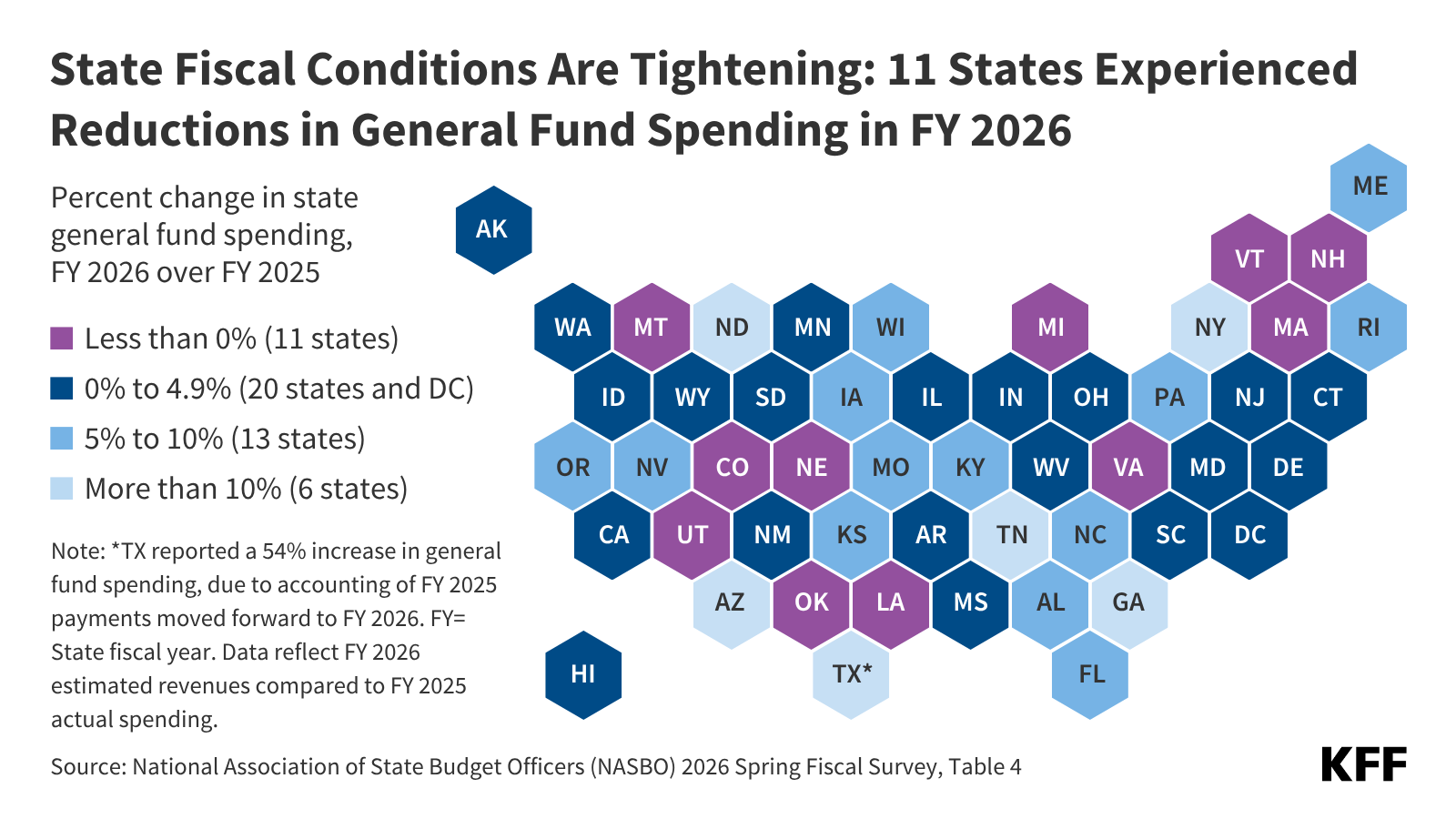
Spending Restraint:nGeneral fund spending growth, which peaked at 14% in FY 2022, plummeted to 8% in FY 2026. Projections for FY 2027 suggest a further drop to the 2-3% range. This indicates that states are no longer expanding services; instead, they are struggling just to maintain the status quo. Notably, 11 states saw absolute reductions in general fund spending in FY 2026—a rare occurrence in a period of high inflation.
n
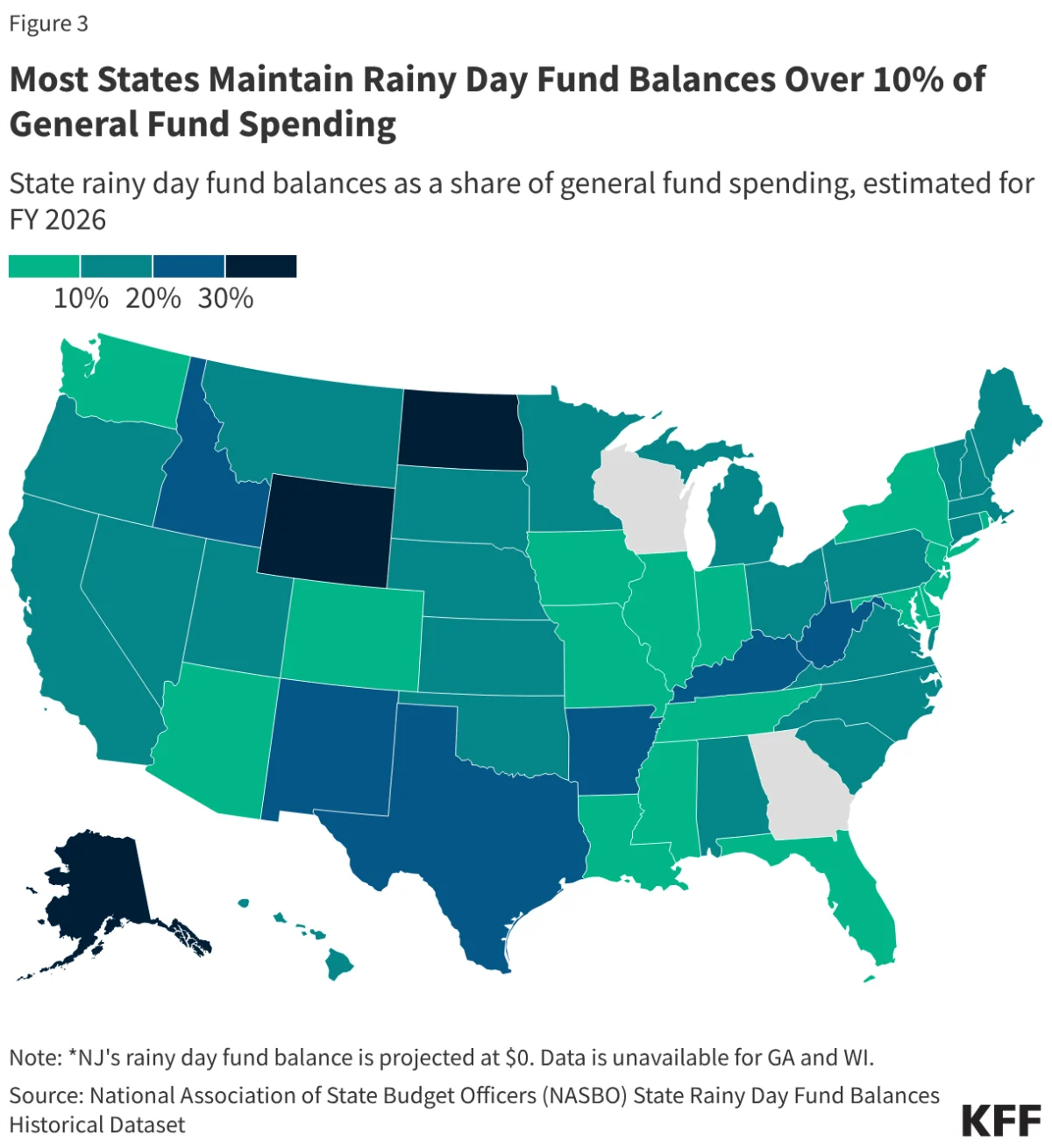
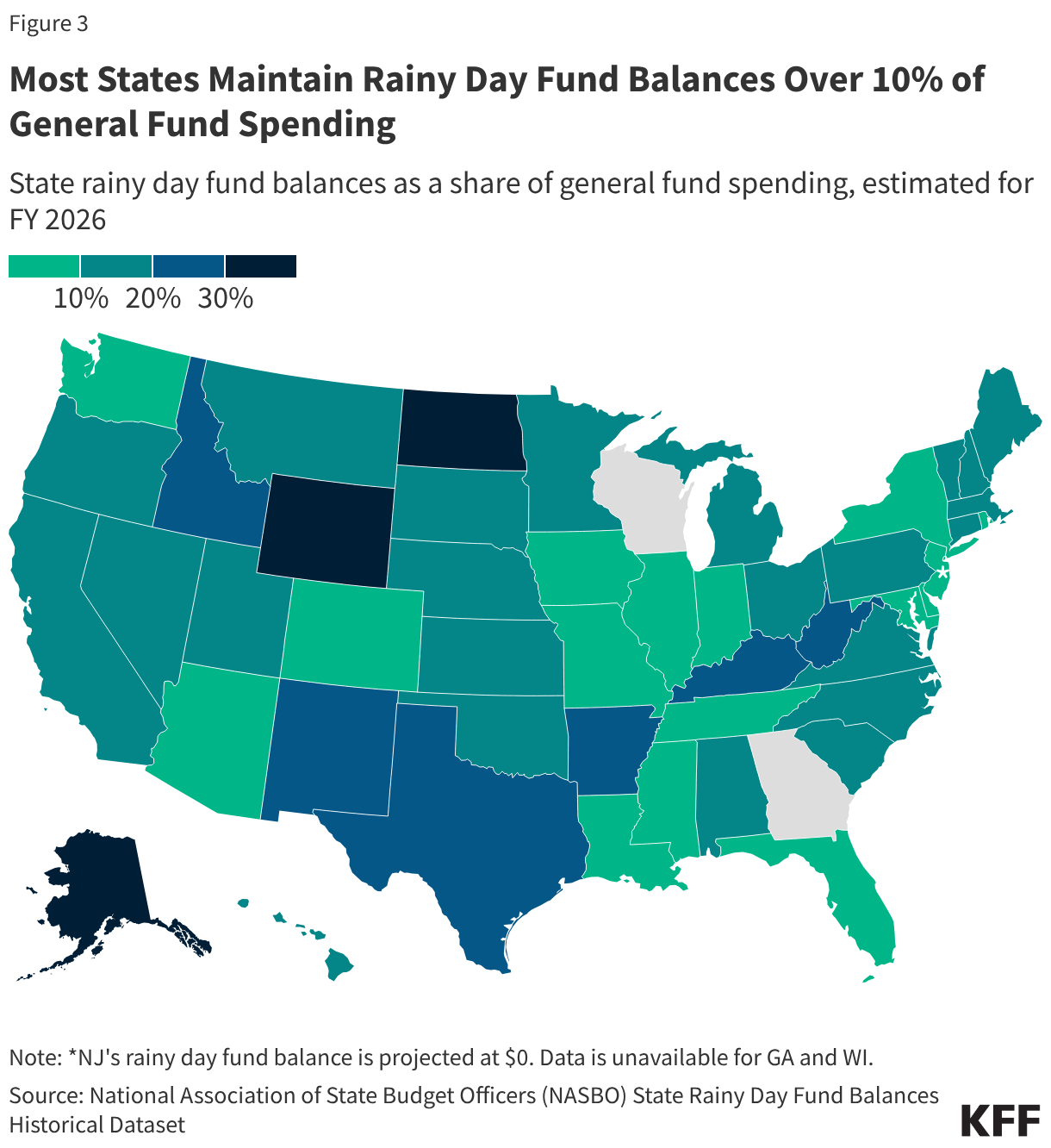
The Rainy Day Reality:nStates are currently living off their savings. While most states maintain Rainy Day Funds, these balances are beginning to dwindle. In FY 2026, 17 states had balances representing less than 10% of their general fund spending. As states spend down these surpluses to balance their FY 2027 budgets, their "buffer" against a potential recession is evaporating.
n
The Texas Anomaly:nData from FY 2026 shows Texas reporting a 54% increase in general fund spending. However, analysts note this was largely an accounting maneuver where FY 2025 payments were moved forward into the FY 2026 budget cycle, highlighting how states are using creative accounting to manage tightening margins.
n
IV. Official Responses and Legislative Maneuvers
n
State budget officers and governors are reacting to these pressures with a mixture of caution and strategic cutting.
n
Mid-Year Adjustments:nIn FY 2026, five states were forced to enact mid-year budget cuts to avoid deficits—the highest number since the height of the pandemic uncertainty in 2021. NASBO reports that many governors are now instructing agencies to prepare for "flat" budgets or percentage-based reductions.
The Impact of the 2025 Reconciliation Law:
Official responses to the federal reconciliation law have been largely critical at the state level. The law requires "costly administrative and systems changes" to comply with new federal funding formulas. States that rely heavily on "provider taxes" (a mechanism where states tax healthcare providers to generate the non-federal share of Medicaid) are particularly vulnerable, as the new law seeks to limit these arrangements.
Administrative Burden:
State health departments have noted that the reconciliation law’s provisions require significant overhauls of IT systems. At a time when state personnel are already stretched thin, these unfunded administrative mandates are siphoning resources away from actual healthcare delivery.
V. Implications: What This Means for Providers and Patients
The confluence of slowing revenue and federal cuts suggests a difficult road ahead for the millions of Americans who rely on Medicaid.
1. Benefit and Eligibility Restrictions:
Historically, when state budgets tighten, Medicaid is often the first area on the chopping block. States have limited options: they can raise taxes (politically difficult), cut other programs like education (equally difficult), or restrict Medicaid. We are likely to see more states implementing stricter asset tests, work requirements (where legally permissible), or eliminating optional benefits like adult dental and vision care.
2. Provider Reimbursement Squeeze:
To balance budgets, states often freeze or reduce the rates paid to doctors, hospitals, and nursing homes. If reimbursement rates fall too far below the cost of care, providers may stop accepting Medicaid patients altogether, creating "coverage in name only" where a patient has an insurance card but no accessible doctor.
3. The "Expansion" Debate Re-ignited:
For the 10 states that have not yet expanded Medicaid under the ACA, the current fiscal climate makes expansion even less likely. Conversely, in expansion states, the reduction in federal matching funds may lead to intense legislative debates about whether to "roll back" coverage for the expansion population (primarily low-income adults without disabilities).
4. The 2026 Midterm Factor:
The upcoming 2026 elections will feature 37 gubernatorial contests. In 19 of those states, the incumbent is not running. A new wave of governors will inherit these fiscal challenges. Depending on the political shift, we could see a radical divergence in how states handle the Medicaid crunch—some opting for "tax relief" that further starves the program, and others attempting to find new revenue streams to protect the safety net.
5. Long-term Uncertainty:
Beyond the immediate budget cycle, the national debt and fluctuating job market create a "permanent state of uncertainty." If a full-scale recession occurs while state Rainy Day Funds are already depleted and federal support is being scaled back by the reconciliation law, the Medicaid program could face a structural crisis unlike any in its 60-year history.
Conclusion
The "pandemic era" of state budget surpluses has officially ended. As the 2025 reconciliation law begins to take effect, the "hidden" costs of maintaining the nation’s largest health program are becoming visible. For policymakers, the challenge is no longer how to spend a surplus, but how to manage a decline without dismantling the healthcare infrastructure that millions of vulnerable Americans depend on. The decisions made in state capitals over the next 24 months will determine the health outcomes of the nation for the next decade.

