
Introduction
n
A fundamental shift is approaching the American social safety net. For decades, the Supplemental Nutrition Assistance Program (SNAP) has served as the primary testing ground for "community engagement" or work requirements. Now, the focus is shifting toward Medicaid. By January 1, 2027—or sooner at individual state discretion—44 states will be mandated to condition Medicaid eligibility for certain adults on meeting specific work or community engagement requirements.
n
At the heart of this transition lies a complex administrative challenge: the "medical frailty" exemption. While the law mandates that those physically or mentally unable to work be exempted, the process of verifying who is "frail enough" remains a bureaucratic minefield. As states prepare to implement these requirements for the Affordable Care Act (ACA) Medicaid expansion group, they are looking toward the long-standing SNAP model for guidance, even as both programs face escalating pressure to reduce administrative errors and financial waste.
n
n
I. Main Facts: The New Landscape of Federal Assistance
n
The upcoming changes represent a significant expansion of the "work-for-benefits" philosophy that has historically defined SNAP but has seen inconsistent application in Medicaid. The core of the current policy debate centers on the 44 states required to implement these mandates for adults in the ACA expansion group and certain waiver programs.
n
The Medical Frailty Mandate
n
Federal law specifies that certain individuals must be excluded from work requirements. The most significant of these is the "medically frail" designation. To qualify, an individual must not only possess a qualifying physical or mental condition but must also demonstrate that this condition specifically impairs their ability to fulfill work or community engagement obligations.
n
The Administrative Divide
n
Currently, the Centers for Medicare & Medicaid Services (CMS) has provided a framework for states to verify this status, but adoption is not mandatory. This creates a patchwork of potential eligibility hurdles. States are caught between two competing pressures:
n
- n
- Accessibility: Ensuring that truly vulnerable, disabled, or ill individuals do not lose life-saving healthcare due to paperwork.
- Integrity: Meeting strict federal "payment error rate" (PER) targets to avoid massive financial penalties.
n
n
n
The SNAP Precedent
n
Because SNAP has managed work requirements for years, its "unfit for employment" verification process is the primary blueprint. However, as the reconciliation law introduces new financial penalties for SNAP errors, even the established SNAP processes are becoming more rigid, signaling a more difficult path ahead for Medicaid enrollees.
n
n
II. Chronology: The Road to 2027 and Beyond
n
The evolution of work requirements has been marked by legislative shifts and changing administrative rules. Understanding the timeline is critical to anticipating the upcoming hurdles for states and enrollees.
n
- n
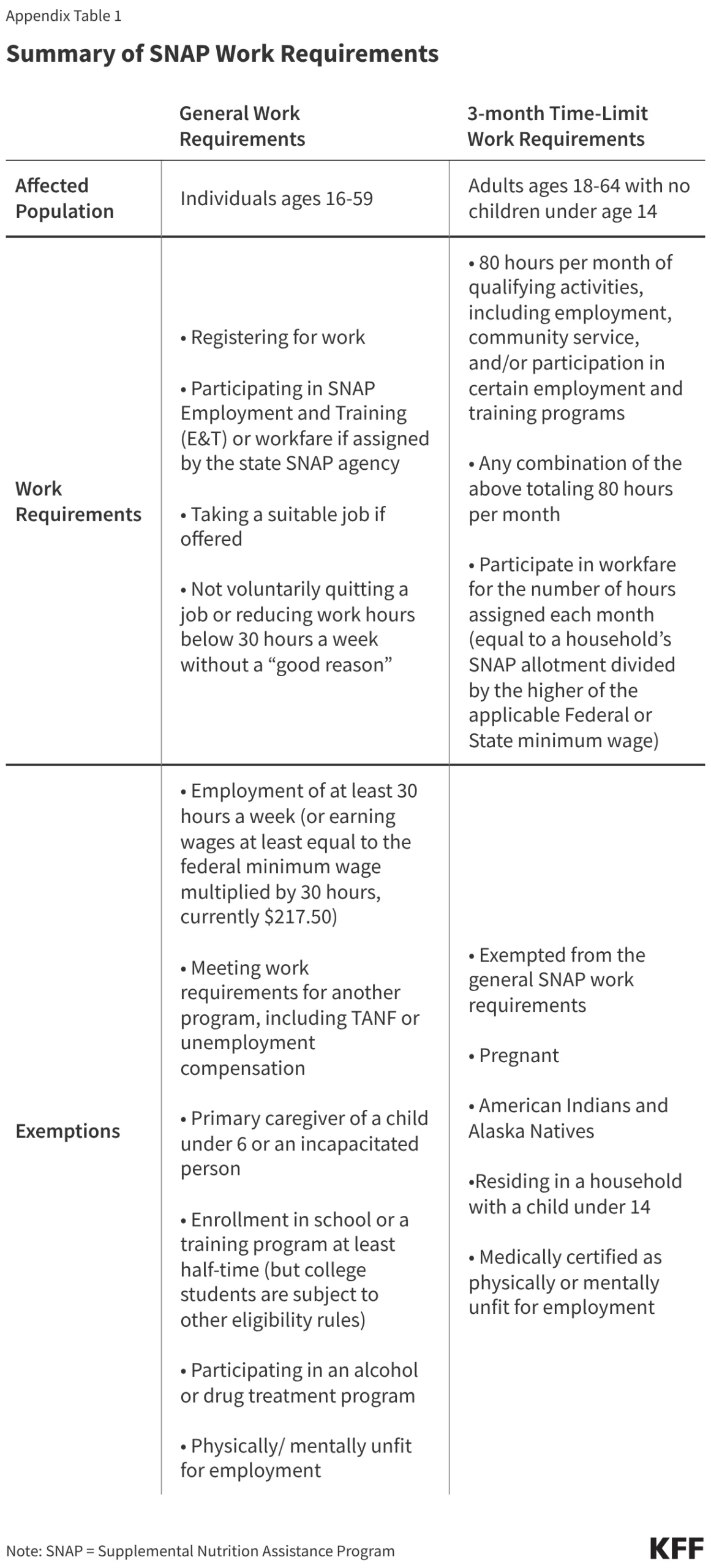
- 1996 – Present: The SNAP FoundationnWork requirements have long been a staple of SNAP. General requirements apply to most adults under 65, while "time-limited" requirements (the three-month limit in a 36-month period) apply to "Able-Bodied Adults Without Dependents" (ABAWDs).
- 2023 – 2024: The Medicaid Mandate EmergesnLegislative reconciliation efforts solidified the requirement for 44 states to implement work requirements for the Medicaid expansion group. CMS began drafting the "interim final rule" to provide states with a roadmap for medical frailty exclusions.
- June 2026: The CMS Interim Final RulenThe federal government released specific instructions for states, introducing a "tiered" approach to verification. This rule prioritized the use of existing data (claims and encounters) over manual paperwork, attempting to automate the exemption process where possible.
- January 1, 2027: The Medicaid Implementation DeadlinenThis marks the latest date by which the 44 states must have their work requirement programs and medical frailty verification systems operational.
- October 2027: The SNAP Fiscal CliffnA new mandate takes effect requiring states to pay a portion of SNAP benefit costs if their Payment Error Rate (PER) exceeds 6%. This is expected to trigger a wave of stricter documentation requirements across state SNAP agencies.
- January 1, 2028: The Medicaid Self-Attestation Cap
A pivotal date for Medicaid enrollees. After this point, states can only accept a "self-attestation" of medical frailty once per enrollment period. Subsequent renewals will require hard data or provider documentation, significantly raising the bar for maintaining coverage.
n
n
n
n
III. Supporting Data: Verification Mechanics and Error Rates
The transition from SNAP logic to Medicaid logic is complicated by the different data sets and "error" definitions used by each program.
SNAP’s Human-Centric Model
Historically, SNAP has relied on human interaction. A mandatory component of SNAP is the phone or in-person interview.
- Screening: As of 2023, most states screen for mental or physical limitations during the initial application.
- Discretion: Over 50% of state agencies allow eligibility workers "visual discretion." If a worker sees an applicant using an oxygen tank or a wheelchair, they can grant an "obvious" exemption without further paperwork.
- The "Questionable" Standard: Documentation is generally only required if the client’s statement is deemed "questionable" or if the limitation is not "obvious."
Medicaid’s Data-Centric Model
Medicaid lacks the interview infrastructure of SNAP, leading CMS to propose a three-tier verification framework:
- Tier 1 (Automated): Verification using claims data alone (e.g., a diagnosis code for a chronic, disabling condition).
- Tier 2 (Hybrid): Using claims data combined with "encounter data" or other state-held records.
- Tier 3 (Manual): An individualized process requiring provider attestation forms when no data is available—most common for new enrollees or those with recent diagnoses.
The Financial Stakes: PER and PERM
The drive toward stricter verification is fueled by fear of federal penalties.
- SNAP PER: States must stay below a 6% error rate. In Arizona, for example, the state recently shifted away from accepting client statements toward requiring hard documentation for almost all claims to avoid these costs.
- Medicaid PERM: The Payment Error Rate Measurement (PERM) program is even stricter, with financial consequences increasing for eligibility error rates above 3%.
IV. Official Responses: CMS and State Strategies
The federal government and individual states are currently in a period of "operational balancing," trying to interpret vague guidelines into actionable policy.
The CMS Stance
CMS officials have emphasized a "data-first" approach. By instructing states to use 12 months of preceding claims data, CMS hopes to reduce the "administrative churn" where eligible people lose coverage because they cannot navigate the paperwork. However, CMS has also warned that states will be considered non-compliant if audits show they are approving "medically frail" status with "insufficient support."
State-Level Innovation: North Carolina and Arizona
States are responding to these mandates in diverging ways:
- North Carolina: Taking a "unified" approach, the state has developed a single provider attestation form that covers both SNAP and Medicaid. This reduces the burden on doctors, who only have to fill out one form to exempt a patient from work requirements across multiple benefit programs.
- Arizona: Reflecting a more "risk-averse" fiscal strategy, Arizona has moved toward requiring additional documentation even in cases where they previously accepted a simple statement from the applicant. This move is a direct response to the threat of SNAP payment error penalties.
The Provider’s Role
Medical providers are the reluctant gatekeepers of this system. In both SNAP and Medicaid, states rely on "treating providers" to verify ability to work. However, providers rarely receive guidance on how to define "fitness for work." This lack of a standardized medical definition often leads to "provider shopping" or inconsistent determinations, where one doctor may find a patient "frail" while another does not for the same condition.
V. Implications: The Future of the Safety Net
The convergence of these policies suggests a future where the "safety" in the safety net is increasingly dependent on data accuracy and administrative stamina.
The "Churn" Risk
The greatest concern for policy analysts is "administrative churn." When self-attestation is capped in 2028, hundreds of thousands of Medicaid enrollees who cannot easily access a doctor for a signature—or whose claims data is incomplete—may be dropped from the rolls. These individuals are often the most "frail," yet they are the least equipped to navigate a tier-3 manual verification process.
The Fiscal Burden on States
States are facing a "double-edged sword." If they make the exemption process too easy, they risk federal audits and PERM penalties. If they make it too hard, they face the administrative cost of processing appeals, re-enrolling people who were erroneously dropped, and dealing with the public health fallout of an increased uninsured population.
Narrowing Definitions of Frailty
As states seek to protect themselves from "insufficient support" findings in audits, the definition of "medically frail" may narrow. While some states currently include chronic homelessness or domestic violence as qualifying conditions for SNAP exemptions, the data-driven nature of Medicaid verification (which relies on medical coding) may exclude these social determinants of health, leaving vulnerable populations without a clear path to exemption.
Conclusion
The transition to mandatory Medicaid work requirements in 2027 is more than a policy shift; it is an administrative revolution. By leaning on the lessons of SNAP while grappling with stricter data mandates and higher financial stakes, states are entering an era where "medical frailty" is no longer just a health status—it is a bureaucratic category that requires constant, data-backed proof. For the millions of Americans relying on these programs, the success of these new verification systems will determine whether the safety net remains a support or becomes a barrier.

