
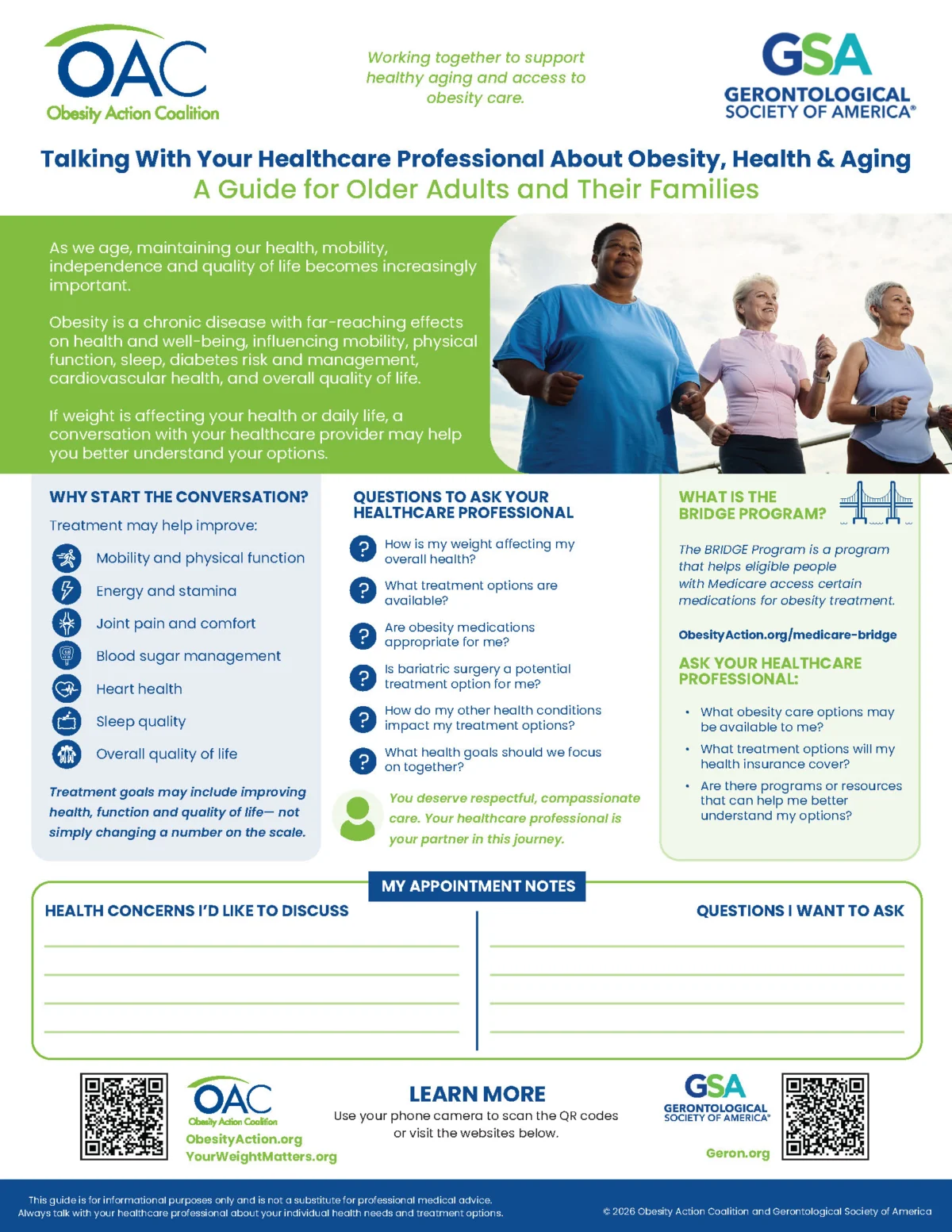
In an era defined by a rapidly aging population and a simultaneous rise in chronic health conditions, two of the nation’s leading advocacy and professional organizations have joined forces to address a critical intersection of public health: the management of obesity in older adults. The Gerontological Society of America (GSA) and the Obesity Action Coalition (OAC) have officially released a landmark resource titled, “Talking With Your Healthcare Professional About Obesity, Health & Aging.”
n
This guide represents a strategic shift in how the medical community and the public approach weight management for seniors. Moving away from a narrow focus on body mass index (BMI) and aesthetic weight loss, the initiative prioritizes functional independence, mobility, and the preservation of quality of life. As the "Silver Tsunami" continues to reshape the demographic landscape of the United States, the collaboration aims to provide older adults and their caregivers with the tools necessary to foster respectful, evidence-based, and compassionate dialogues with healthcare providers.
n
Main Facts: A Holistic Approach to Geriatric Wellness
n
The core of the GSA and OAC collaboration is the recognition that obesity is a complex, chronic disease that requires a nuanced approach, particularly when it intersects with the biological processes of aging. The newly released guide is designed as a practical roadmap for patients and families, focusing on three primary pillars:
n
- n
- Personalized Goal Setting: The guide encourages older adults to identify what "health" means to them personally. For many seniors, the primary goal is not a specific number on a scale but rather the ability to walk to a local park, play with grandchildren, or remain living independently at home.
- Effective Communication: Research has long shown that weight bias in healthcare can lead to poor patient outcomes and a reluctance to seek care. The guide provides specific scripts and questions to help patients initiate conversations that are productive rather than stigmatizing.
- Comprehensive Treatment Education: Obesity treatment for older adults is not a "one-size-fits-all" endeavor. The guide outlines various modalities—including nutritional counseling, physical therapy, pharmacological interventions, and metabolic surgery—while highlighting how these treatments must be balanced against the unique risks of aging, such as muscle loss (sarcopenia).
n
n
n
n
The partnership leverages the GSA’s deep scientific expertise in the field of aging and the OAC’s extensive experience in patient advocacy and obesity education. Together, they have produced a document that serves as both an educational tool and a catalyst for clinical change.
n
Chronology: The Evolution of Geriatric Obesity Management
n
The development of “Talking With Your Healthcare Professional About Obesity, Health & Aging” is the culmination of years of evolving medical understanding. To understand the significance of this guide, one must look at the timeline of how obesity has been treated in the elderly.
n
The Early 2000s: The "Obesity Paradox" Era
n
In the early 21st century, the medical community grappled with the "Obesity Paradox," a phenomenon where some studies suggested that being slightly overweight might actually be protective for older adults, providing a "reserve" against wasting diseases. This led to a period of clinical hesitation, where doctors were often reluctant to recommend weight loss to seniors for fear of causing bone density loss or muscle wasting.
n
2010–2020: The Rise of Sarcopenic Obesity
n
As geriatric research matured, scientists identified "sarcopenic obesity"—the dangerous combination of high body fat and low muscle mass. This condition was found to be a major driver of falls, fractures, and disability. The conversation began to shift from "weight loss" to "weight optimization" and "body composition."
n
2021–2023: Collaborative Planning
n
Recognizing that patients were often caught in the middle of conflicting advice, the GSA and OAC began a series of consultations. The goal was to synthesize the latest geriatric science with the lived experiences of those struggling with obesity. This period involved rigorous drafting, peer review by medical professionals, and focus groups with older adults to ensure the language was both accessible and empowering.
n
Late 2023: Official Launch
n
The guide was officially released to the public, distributed through the OAC’s vast network of advocates and the GSA’s membership of over 5,500 researchers, educators, and practitioners. It was introduced as a cornerstone of a broader effort to integrate obesity care into standard geriatric practice.
n
Supporting Data: The Magnitude of the Challenge
n
The necessity of this guide is underscored by staggering public health statistics. According to the Centers for Disease Control and Prevention (CDC), the prevalence of obesity among adults aged 60 and older has climbed significantly over the last two decades. Currently, approximately 41.5% of older adults in the United States are classified as having obesity.
n
The Impact on Mobility and Independence
n
Data from the National Institutes of Health (NIH) indicates that obesity in the elderly is a primary predictor of physical disability. Older adults with a BMI over 30 are twice as likely to experience limitations in activities of daily living (ADLs), such as dressing, bathing, or walking across a room, compared to their peers with a healthy weight.
n
The Economic Burden
n
The financial implications are equally profound. A study published in the Journal of the American Geriatrics Society estimated that the healthcare costs for an older adult with obesity are approximately 40% higher than for those at a healthy weight, primarily due to the management of comorbid conditions such as Type 2 diabetes, hypertension, and osteoarthritis.
n
The Risk of Weight Bias
n
Perhaps the most concerning data point involves the impact of weight stigma. A 2021 survey conducted by the OAC found that nearly 60% of individuals with obesity felt judged by their primary care physician. For older adults, this stigma is often compounded by ageism, leading to a "double burden" where symptoms are dismissed as simply "part of getting older" or "due to weight," resulting in delayed diagnoses of underlying issues.
n
Official Responses: A Commitment to Compassion
n
Leaders from both organizations have emphasized that this guide is more than just a brochure; it is a call for a cultural shift in the exam room.
The Obesity Action Coalition (OAC) expressed profound gratitude for the partnership, noting that the collaboration allowed for a more specialized focus on a demographic that is often overlooked in obesity discussions. "OAC is grateful for this collaboration and the opportunity to support respectful, compassionate, and individualized obesity care," the organization stated in an official release. They emphasized that the guide is a tool for empowerment, helping patients demand the high-quality care they deserve.
Representatives from the Gerontological Society of America (GSA) highlighted the scientific necessity of the guide. They pointed out that as the body ages, the metabolism and the way it processes nutrients change. Therefore, healthcare providers must be equipped to discuss obesity not as a moral failing or a simple lack of willpower, but as a physiological condition that interacts with the aging process. The GSA’s expertise ensures that the guide’s recommendations are grounded in the latest biogerontology and social science research.
Implications: Redefining the Future of Aging
The release of “Talking With Your Healthcare Professional About Obesity, Health & Aging” has far-reaching implications for the future of geriatric medicine and public policy.
1. Shifting the Clinical Paradigm
The guide encourages a move toward "Function-Focused Care." In this model, the success of an obesity intervention is measured by a patient’s grip strength, gait speed, and mental well-being rather than just the kilograms lost. This shift is expected to improve patient compliance and long-term health outcomes, as goals become more tangible and relevant to the patient’s daily life.
2. Influencing Policy and Reimbursement
As organizations like the GSA and OAC provide more structured resources, there is increased pressure on policymakers to expand coverage for obesity treatments under Medicare. Currently, Medicare coverage for obesity remains limited compared to private insurance. By highlighting the link between obesity management and the preservation of independence in seniors, these organizations are making a powerful economic argument: investing in obesity care today can prevent the high costs of nursing home care and hospitalizations tomorrow.
3. Combatting the "Double Stigma"
By providing a framework for "respectful and compassionate" care, the guide directly tackles the intersection of ageism and weight bias. As healthcare professionals adopt the communication strategies outlined in the guide, the medical environment becomes more inclusive. This is likely to lead to better preventative care, as older adults will feel more comfortable visiting their doctors and discussing their health concerns openly.
4. Empowerment of the Caregiver
An often-overlooked group is the millions of family caregivers who support older adults. This guide serves as a vital resource for them, providing a vocabulary to advocate for their loved ones during medical appointments. It equips them to ask the right questions about medication interactions, nutritional needs, and physical therapy options that are specifically tailored for the elderly.
Conclusion
The collaboration between the Gerontological Society of America and the Obesity Action Coalition marks a pivotal moment in the intersection of two major health trends. By synthesizing scientific rigor with patient-centered advocacy, the guide “Talking With Your Healthcare Professional About Obesity, Health & Aging” offers a vision of a future where aging with obesity does not mean a mandatory loss of dignity or independence.
As the medical community continues to digest the insights provided by this resource, the hope is that the conversation around weight in the golden years will finally move away from the scale and toward the person. In the words of the advocates involved, the ultimate goal is to ensure that every older adult has the opportunity to age with health, mobility, and the respect they deserve.

