
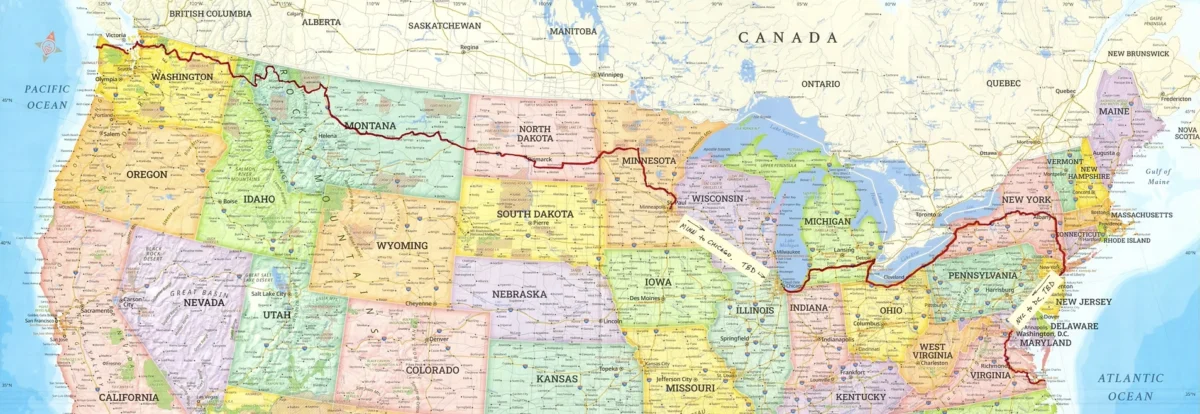
On a misty morning in mid-July, Pat McAleer stood on the rugged coastline of La Push, Washington, and dipped the tires of his bicycle into the Pacific Ocean. It was a symbolic gesture, marking the beginning of a transcontinental journey that most would find unfathomable. Over the next three months, McAleer will pedal more than 5,000 miles across the northern United States, traversing mountain ranges, high prairies, and bustling metropolitan corridors, eventually ending his journey at the Atlantic Ocean in Virginia Beach.
n
This is not a vacation, nor is it merely a personal test of endurance. Dubbed "Ride Pat Ride," the solo expedition is a high-stakes fundraising campaign aimed at a singular, life-changing goal: finding a cure for type 1 diabetes (T1D). Driven by a promise made to his daughter nearly 15 years ago, McAleer is transforming physical sweat and mental grit into a $250,000 windfall for medical research.
n
Main Facts: A Mission Born of Personal Adversity
n
The genesis of "Ride Pat Ride" dates back to 2009. At the time, Pat’s daughter, Mary Kate, was just 10 years old when she received a diagnosis that would irrevocably alter the trajectory of her life and that of her family: type 1 diabetes. T1D is an autoimmune disease in which the body’s immune system attacks and destroys the insulin-producing cells in the pancreas. Unlike type 2 diabetes, it has nothing to do with diet or lifestyle; it is a lifelong condition requiring constant monitoring of blood sugar levels and multiple daily insulin injections or the use of an insulin pump.
n
"Since then, my wife Molly and I have been 100 percent committed to improving the lives of people with T1D," Pat McAleer stated. For the McAleers, "commitment" has meant years of advocacy, but Pat felt the need to elevate his efforts to a scale that matched the magnitude of the challenge his daughter faces every day.
n
The "Ride Pat Ride" initiative is structured as a solo, self-supported trek. While many cross-country cyclists utilize "SAG" (support and gear) wagons—vehicles that carry food, water, and clothing—McAleer is hauling his own gear. His bicycle is laden with a full camping kit, repair tools, spare parts, and a solar-powered computer to track his progress.
n
Crucially, the fundraising model is designed for maximum impact. Pat and Molly McAleer are personally covering 100% of the trip’s expenses, including airfare, equipment, food, and lodging. This ensures that every dollar donated by the public goes directly to Breakthrough T1D (formerly known as JDRF), the leading global organization funding T1D research.

n
Chronology: From the Pacific Coast to the Rocky Mountains
n
The journey began on July 15, 2024, in La Push, Washington. However, the road to the Atlantic was almost cut short before it truly began.
n
The Early Setback
n
Just six miles into his 5,000-mile trek, disaster struck. A stray stick on the road was kicked up into McAleer’s drivetrain, shearing off his rear derailleur. The mechanical failure rendered the bike completely inoperable. In the remote wilderness of the Olympic Peninsula, this could have ended the expedition. Refusing to succumb to frustration, McAleer managed to hitch a ride to the small town of Forks, Washington, then caught a bus to Port Angeles. There, he located a bike shop, repaired the damage, and was back on the road within 24 hours.
n
The Mountain Phase
n
By Day 5, the true physical test began. McAleer entered the North Cascades, a range known for its brutal inclines and unpredictable weather. He successfully summited the 5,477-foot Washington Pass, a feat of endurance that served as a harbinger of the challenges to come.
n
As he moved eastward, the environment became increasingly hostile. Wildfires across the Pacific Northwest sent plumes of thick smoke and falling ash across his route. To protect his lungs while maintaining the aerobic output required for mountain cycling, McAleer was forced to pedal through the haze wearing a respirator mask. Despite the restricted airflow and scorched air, he conquered the 5,575-foot Sherman Pass.
n
Into the Big Sky Country
n
After transiting the narrow Idaho panhandle, McAleer entered Montana. This segment of the journey took him through the breathtaking vistas of Glacier National Park and across the Continental Divide. Moving out of the Rocky Mountains, he transitioned into the high prairies of central and eastern Montana. As of late August, McAleer remains in the "Big Sky" state, having successfully navigated the most significant elevation changes of the entire trip.
n
The Road Ahead
n
The upcoming legs of the journey will follow the Adventure Cycling Association’s "Northern Tier Route." McAleer’s itinerary includes:

n
- n
- The Great Plains: Navigating the winds of North Dakota and the lake regions of Minnesota.
- The Great Lakes: Traversing Wisconsin, Illinois, Indiana, Michigan, and Ohio.
- The Erie Canal: Upon reaching Buffalo, New York, McAleer will be joined by a group of supporters and friends. Together, they will cycle along the historic Erie Canal toward Albany.
- The Final Descent: From Albany, the route turns south toward New York City, then through Washington, D.C., and Fredericksburg, Maryland, before the final sprint to the Virginia coast.
n
n
n
n
n
Supporting Data: The Financial and Physical Toll
n
The scale of "Ride Pat Ride" is reflected in the numbers. As of his most recent update, McAleer has raised nearly $150,000, representing 60% of his $250,000 goal.
n
The Physical Logistics
n
Cycling 5,000 miles solo requires more than just leg strength; it requires meticulous logistical management. McAleer’s setup includes:
n
- n
- Total Distance: 5,000+ miles.
- Duration: 90+ days.
- Payload: Approximately 40–50 pounds of gear, including a tent, sleeping bag, stove, and clothing for temperatures ranging from near-freezing mountain nights to 90-degree prairie days.
- Technology: A solar-powered bike computer provides GPS navigation and tracks vitals, ensuring he stays on the Northern Tier path.
The Impact of T1D
To understand why McAleer is undertaking such a feat, one must look at the data surrounding the disease. Approximately 1.45 million Americans are living with T1D. Unlike type 2 diabetes, T1D cannot be prevented. The healthcare costs associated with the disease are staggering, and the mental burden of "24/7" management often leads to burnout among patients. The funds raised by McAleer are earmarked for Breakthrough T1D’s research portfolio, which includes projects on:
- Beta Cell Replacement: Regenerating or replacing the insulin-producing cells destroyed by the immune system.
- Immunotherapies: Finding ways to stop the immune system’s attack before it starts.
- Artificial Pancreas Systems: Improving the "closed-loop" technology that automates insulin delivery.
Official Responses: A Community of Support
The "Ride Pat Ride" campaign has garnered significant attention from the T1D community and the leadership of Breakthrough T1D.
"I wanted to take on a challenge that’s both physically difficult and that would offer an opportunity for me to fundraise in a way that is uniquely my own," Pat McAleer explained. "Riding my bike across the United States for three months felt like the right way to push myself while supporting an important cause."
A major milestone of the journey will occur in New York City, where McAleer is scheduled to sit down for a formal meeting with Breakthrough T1D CEO Aaron J. Kowalski, Ph.D. Dr. Kowalski, who also lives with T1D, has been a vocal proponent of individual-led fundraising initiatives. Their discussion is expected to focus on the current state of T1D research and the vital role that "DIY" fundraisers play in accelerating the timeline for a cure.

Furthermore, McAleer has turned his journey into a rolling community event. He has issued an open invitation to anyone living along his route to join him. "I hope to personally connect and perhaps ride with others—particularly those impacted by T1D," he said. "If you live along my route, please reach out… I’d love to ride together or just join up for a coffee break, a meal, or a cold beer."
Implications: The Power of the "DIY" Fundraiser
The success of "Ride Pat Ride" highlights a shifting trend in charitable giving. While large-scale galas and corporate sponsorships remain vital, individual "DIY" campaigns—powered by platforms like "Breakthrough T1D Your Way"—are becoming a cornerstone of non-profit growth. These campaigns allow donors to see a direct, human connection to the cause.
The implications of McAleer’s journey extend beyond the $250,000 goal. His trek serves as a powerful metaphor for the T1D experience: a long, often grueling journey filled with unexpected obstacles (like broken derailleurs or wildfire smoke) that must be managed with resilience and persistence.
For the T1D community, McAleer’s ride is a visible reminder that they are not alone in their struggle. For the scientific community, the funds represent the "gasoline" needed to power the engines of innovation.
As Pat McAleer pedals through the vast stretches of the American heartland, he carries with him the hopes of millions of families like his own. When he finally reaches the Cavalier Hotel in Virginia Beach and dips his bike into the Atlantic, it will mark the end of a 5,000-mile ride, but for McAleer and Breakthrough T1D, the journey toward a cure will continue with renewed momentum, fueled by the miles he left behind.
To follow Pat’s progress or contribute to his mission, visit RidePatRide.org or follow his updates on Instagram and Facebook.

