
WASHINGTON D.C. – A sweeping overhaul of federal healthcare eligibility is set to redefine the insurance landscape for over a million people residing in the United States. Under the provisions of the 2025 reconciliation law, the federal government is moving to significantly restrict access to subsidized health coverage for a wide swath of lawfully present immigrants. The move, which targets the Affordable Care Act (ACA) Marketplace, Medicaid, and the Children’s Health Insurance Program (CHIP), is projected to leave more than 1.2 million additional people uninsured over the next decade.
n
As the Centers for Medicare and Medicaid Services (CMS) begins releasing implementation guidance, advocates and state officials are bracing for a complex transition that could see families forced to choose between unaffordable premiums or losing medical care entirely.
n
n
Main Facts: A Dramatic Narrowing of the Safety Net
n
The 2025 reconciliation law represents one of the most significant shifts in immigrant health policy since the passage of the ACA in 2010. While undocumented immigrants have long been barred from federally funded coverage, this new legislation extends restrictions to those who are in the country legally and were previously eligible for financial assistance.
n
The New "Eligible Noncitizen" Definition
n
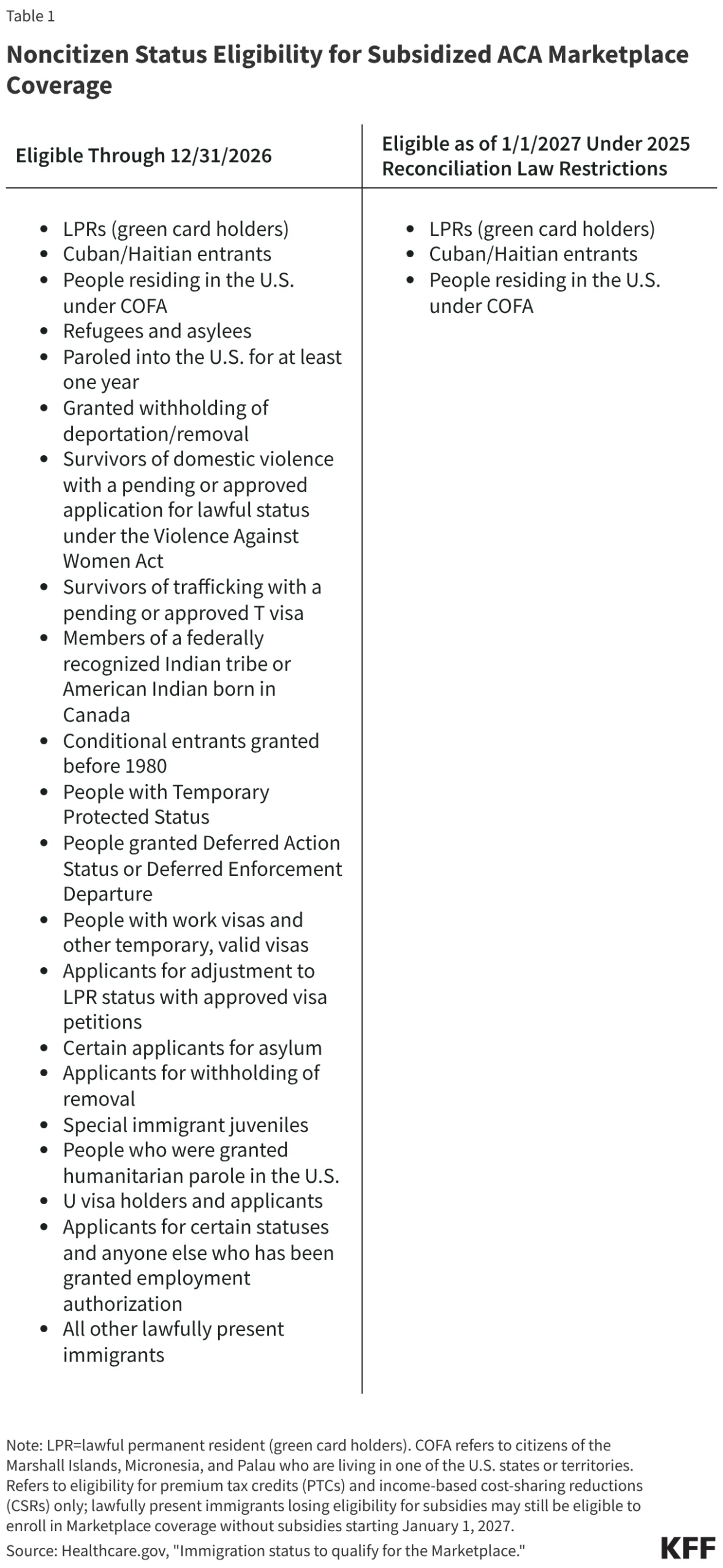
Starting January 1, 2027, federal subsidies—including Premium Tax Credits (PTCs) and Cost-Sharing Reductions (CSRs)—will be restricted to a narrow list of "eligible noncitizens." This group includes:
n
- n
- Lawful Permanent Residents (LPRs): Often referred to as "green card" holders.
- Cuban and Haitian Entrants: Specific categories of migrants granted special status.
- COFA Residents: Individuals from the Republic of the Marshall Islands, the Federated States of Micronesia, and the Republic of Palau residing in the U.S. under Compacts of Free Association.
n
n
n
n
Groups Losing Subsidies
n
The law effectively strips financial assistance from numerous groups who remain "lawfully present" but no longer meet the new federal criteria. These include:
n
- n
- Refugees and Asylees: Specifically those who have not yet secured a green card.
- Work Visa Holders: Individuals on various employment-based visas.
- Victims of Trafficking (T-Visa): Those awaiting permanent status.
- Temporary Protected Status (TPS) Holders: Individuals from designated countries facing conflict or disaster.
n
n
n
n
n
Furthermore, the law eliminates access to subsidized Marketplace coverage for lawfully present immigrants earning less than 100% of the Federal Poverty Level (FPL) who are ineligible for Medicaid due to their immigration status—such as those currently in the mandatory five-year waiting period. This specific provision takes effect earlier, on January 1, 2026.
n
n
Chronology: The Road to Coverage Loss
n
The implementation of these restrictions follows a multi-stage timeline that will force state and federal exchanges to overhaul their verification systems over the next two years.
n
- n
- September 2025: The Congressional Budget Office (CBO) releases a fiscal analysis of the 2025 reconciliation law, detailing the massive reduction in federal spending and the projected rise in the uninsured population.
- January 1, 2026: The first wave of restrictions begins. Subsidies are eliminated for lawfully present immigrants earning below 100% FPL who do not qualify for Medicaid.
- November 1, 2026: The Open Enrollment Period for the 2027 plan year begins. This is the first time the Federally Facilitated Exchange (FFE) will apply the new "eligible noncitizen" verification to all applicants and current enrollees.
- January 1, 2027: The broad restriction on PTCs and CSRs takes effect. Millions of enrollees who do not meet the new criteria will lose their subsidies. Those who do not manually cancel their plans may be auto-enrolled into full-price, unsubsidized coverage.
- January 1, 2028: New, more stringent verification rules for PTCs begin. No subsidies will be issued until an exchange has fully verified income, residency, and immigration status, removing the current "grace period" for receiving credits while documents are processed.
- 2035: The CBO predicts the full impact of the law will be realized, with 1.2 million additional individuals becoming uninsured compared to previous projections.
n
n
n
n
Supporting Data: The Fiscal and Human Toll
The scale of the policy shift is underscored by data from the Congressional Budget Office (CBO) and healthcare analysts. The primary driver for the legislation appears to be federal deficit reduction, though the human cost is substantial.
Fiscal Impact
The CBO estimates that the 2027 restrictions on Marketplace subsidies will reduce federal spending by $91.4 billion between 2027 and 2035. The earlier 2026 restrictions on those earning less than 100% FPL are expected to save an additional $27.3 billion. In total, the federal government anticipates a budgetary reduction of nearly $119 billion over the next decade resulting from these immigrant-specific health provisions.
Enrollment and Coverage Losses
- The Uninsured Spike: Most of the coverage losses are expected to occur in 2027. By 2035, the number of uninsured individuals is expected to rise by 1 million due to the 2027 provision and another 200,000 due to the 2026 provision.
- The Affordability Crisis: While affected immigrants can technically still purchase Marketplace plans at "full cost," premiums are expected to skyrocket. This is due to the expiration of enhanced PTCs and other federal policy shifts. For many families, an unsubsidized silver-tier plan could consume more than 30% of their annual income.
- The Repayment Trap: A secondary provision in the law eliminates the income-based caps on the repayment of excess PTCs. If an immigrant is found to have received subsidies they weren’t eligible for during a 95-day verification window, they must repay the full amount to the IRS, regardless of their income level.
Official Responses: Guidance and Implementation
CMS has released technical guidance for the 29 states that use the Federally Facilitated Exchange (FFE). However, the 22 states (including the District of Columbia) that operate State-Based Exchanges (SBEs) have more flexibility—and more administrative burden.
CMS and the SAVE System
Federal authorities will rely on the Department of Homeland Security’s Systematic Alien Verification for Entitlements (SAVE) system. However, CMS admitted in previous guidance that SAVE provides only "point-in-time" verification. This means if an immigrant recently adjusted their status from a work visa to a green card, the system might not reflect that change immediately, leading to a "false negative" and a loss of subsidies.
CMS is currently sending targeted notices to affected enrollees, urging them to update their status before the 2027 enrollment deadline.
The IRS and Repayment
The Internal Revenue Service (IRS) has proposed rules to implement the elimination of repayment caps. This move is seen as a deterrent to enrollment, as it places a massive financial risk on families who might unintentionally misreport their immigration category or whose status is in flux.
State-Level Countermeasures
Some states are moving to shield their residents from the federal cuts. New Mexico, for example, has announced it will use state funds to provide premium subsidies through its own exchange for lawfully present noncitizens and DACA recipients who are being locked out of federal assistance. However, many other states are moving in the opposite direction, scaling back state-funded immigrant health programs due to budget constraints.
Implications: A New Era of Health Inequity
The long-term consequences of the 2025 reconciliation law extend beyond mere budget numbers. Experts suggest the law will create a "chilling effect" that ripples through mixed-status families.
The "Chilling Effect" and Confusion
Even those who remain eligible for subsidies—such as green card holders—may drop coverage out of fear or confusion. The complexity of the new verification rules, combined with increased federal immigration enforcement and "public charge" concerns, often leads immigrant families to withdraw from all public programs to avoid potential deportation risks.
The Burden on Safety-Net Providers
As 1.2 million people lose insurance, the burden of their care will shift to Community Health Centers and emergency rooms. These providers, which offer sliding-fee scales, are already stretched thin. Without the predictable revenue from insured patients, the quality and availability of care in immigrant-heavy communities are expected to decline.
Administrative Strain on States
States operating their own exchanges face a daunting task. They must update their IT systems, retrain navigators, and conduct massive outreach campaigns in multiple languages to explain the new rules. For states also grappling with new Medicaid work requirements and more frequent eligibility redeterminations, the administrative cost could offset some of the projected federal savings.
The Financial Risk of Auto-Enrollment
Perhaps the most immediate danger for enrollees is the "auto-enrollment" policy. Current enrollees who are found ineligible for subsidies will be automatically moved into the same plan at the full, unsubsidized price. If they do not actively cancel their plan, they will be billed for the full premium. Failure to pay could lead to medical debt and the loss of coverage, with no ability to re-enroll until the following year.
As the 2026 and 2027 deadlines approach, the U.S. healthcare system faces a critical juncture. The reconciliation law may achieve its goal of federal spending reduction, but it does so by fundamentally narrowing the definition of who deserves access to affordable healthcare in America.

