
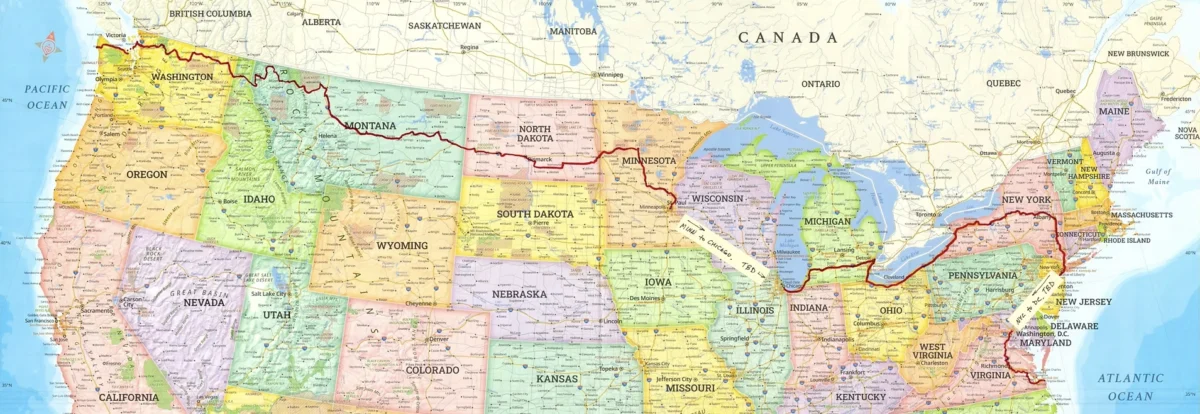
RICHMOND, VA — For most cyclists, a cross-country trek is a "bucket list" item, a test of physical endurance and mental fortitude. For Pat McAleer, however, a 5,000-mile journey from the Pacific to the Atlantic is more than a personal milestone; it is a mission born of a father’s love and a fifteen-year battle against a relentless autoimmune disease.
n
McAleer’s "Ride Pat Ride" initiative is currently making its way across the American Heartland. Having departed from the rugged coast of Washington State in mid-July, McAleer is navigating the vast expanse of the United States on two wheels to raise $250,000 for Breakthrough T1D (formerly JDRF). His journey is a testament to the lengths a parent will go to secure a healthier future for their child and the millions of others living with type 1 diabetes (T1D).
n
Main Facts: The Motivation Behind the Miles
n
The genesis of "Ride Pat Ride" dates back to 2009. It was the year Pat’s daughter, Mary Kate, then only ten years old, received a life-altering diagnosis: type 1 diabetes. T1D is an autoimmune condition in which the pancreas produces little to no insulin, a hormone required to allow sugar (glucose) to enter cells to produce energy. Unlike type 2 diabetes, T1D is not related to diet or lifestyle; it is a permanent condition that requires 24/7 management, including constant blood-sugar monitoring and multiple daily insulin injections or the use of an insulin pump.
n
“Since then, my wife Molly and I have been 100 percent committed to improving the lives of people with T1D,” Pat McAleer stated. This commitment has evolved from local advocacy to a massive, solo transcontinental undertaking.
n
The "Ride Pat Ride" Framework
n
McAleer’s campaign is unique not just for its scale, but for its financial transparency. Pat and his wife, Molly, are personally covering every cent of the journey’s expenses—from bike repairs and camping fees to food and travel logistics. This ensures that 100 percent of every donation goes directly to Breakthrough T1D, specifically toward research aimed at finding a biological cure and improving current management technologies.
n
As of late August, the campaign has raised nearly $150,000 toward its $250,000 goal. The ride serves as a high-profile example of "Breakthrough T1D Your Way," a DIY fundraising platform that encourages individuals to turn their passions—whether cycling, baking, or gaming—into engines for charitable giving.
n
Chronology: From the Pacific Surf to the High Prairies
n
McAleer’s journey officially began on July 15, 2024, in the coastal village of La Push, Washington. In a symbolic gesture of the task ahead, he dipped his bicycle wheels into the Pacific Ocean before turning east toward a finish line thousands of miles away.

n
Early Setbacks and Mountain Passes
n
The journey was almost immediately jeopardized. Only six miles into the first day, a stray stick on the road struck McAleer’s bike, tearing off the derailleur and rendering the vehicle inoperable. In a display of the resilience required for such a trip, McAleer managed to hitch a ride to Forks, WA, and eventually reached Port Angeles via bus to secure repairs.
n
By Day 5, he was back in the saddle, tackling the formidable Washington Pass in the North Cascades. At an elevation of 5,477 feet, the pass was the first of many grueling climbs. However, the terrain was not the only obstacle.
n
Navigating Environmental Hazards
n
As McAleer progressed through the Pacific Northwest, he encountered the harrowing realities of the region’s wildfire season. For several stretches, he was forced to cycle through thick wildfire smoke and falling ash. Photographs from this leg of the journey show McAleer wearing a heavy-duty respirator mask while pedaling, a stark visual representation of the grit required to maintain his schedule.
n
After crossing the 5,575-foot Sherman Pass, McAleer transited the Idaho panhandle and entered the expansive wilderness of eastern Montana. He successfully navigated Glacier National Park and crossed the Continental Divide, leaving the jagged peaks of the Rocky Mountains behind for the high prairies of the Great Plains.
n
Current Status and the Northern Tier
n
Pat is currently traversing the central portion of Montana. He is largely following the Adventure Cycling Association’s "Northern Tier Route," a path known for its scenic beauty and significant physical demands. His daily life is a minimalist existence; he hauls all necessary gear on his bike, including a camping kit, spare parts, repair tools, clothing, and a solar-powered bike computer to track his progress and maintain communication.
n
Supporting Data: The Impact of the T1D Crisis
n
To understand the weight of McAleer’s journey, one must look at the data surrounding type 1 diabetes in the United States.
n
- n
- Prevalence: According to the CDC and Breakthrough T1D, approximately 1.45 million Americans are living with T1D.
- Economic Burden: The cost of insulin and management supplies remains a significant burden for families, with many out-of-pocket costs exceeding thousands of dollars annually, even with insurance.
- The Research Gap: While technology like Continuous Glucose Monitors (CGMs) and automated insulin delivery systems have revolutionized care, a biological cure remains the "holy grail." Breakthrough T1D is the leading global non-governmental funder of T1D research.
n
n
n
n
McAleer’s $250,000 goal is designed to fuel specific research pillars:

n
- n
- Cell Therapies: Replacing insulin-producing cells that the immune system has destroyed.
- Disease-Modifying Therapies: Developing treatments to slow or stop the progression of T1D before the pancreas loses all function.
- Technology: Advancing the "Artificial Pancreas" systems that Mary Kate and others rely on daily.
n
n
Official Responses: Leadership and Community Engagement
The "Ride Pat Ride" initiative has garnered significant attention from the highest levels of the T1D community. As Pat approaches the East Coast, his itinerary includes a high-profile stop in New York City.
A Meeting of Minds
While in NYC, Pat is scheduled to sit down with Breakthrough T1D CEO Aaron J. Kowalski, Ph.D. Kowalski, the first person with T1D to lead the organization, has been a vocal proponent of community-led fundraising. Their discussion is expected to focus on the intersection of patient advocacy and the current state of clinical trials.
“I wanted to take on a challenge that’s both physically difficult and that would offer an opportunity for me to fundraise in a way that is uniquely my own,” Pat said in a recent update. “Riding my bike across the United States for three months felt like the right way to push myself while supporting an important cause.”
Community Outreach
McAleer has also turned his ride into a mobile meet-and-greet. He has actively invited members of the T1D community living along his route to join him.
“I hope to personally connect and perhaps ride with others—particularly those impacted by T1D,” Pat said. “If you live along my route, please reach out and let me know. I’d love to ride together or just join up for a coffee break, a meal, or a cold beer.”
Implications: The Future of DIY Philanthropy and T1D Advocacy
McAleer’s journey represents a broader shift in how charitable organizations approach fundraising in the 21st century. The success of "Ride Pat Ride" highlights the power of the "DIY" model, where the personal narrative of the fundraiser—in this case, a father’s 15-year journey alongside his daughter—drives engagement more effectively than traditional corporate appeals.
The Road to Virginia Beach
The final leg of McAleer’s journey will take him through the Midwest, across the Erie Canal in New York, and down through the Mid-Atlantic. After passing through Buffalo, Albany, and New York City, he will head south toward his home in Richmond, VA, passing through Washington, D.C., and Fredericksburg.

The odyssey is slated to conclude at the Cavalier Hotel in Virginia Beach. There, three months and over 5,000 miles after he began, McAleer will dip his bike into the Atlantic Ocean.
A Call to Action
The implications of this ride extend beyond the funds raised. It serves as a beacon of hope for families newly diagnosed with T1D, proving that the community is active, resilient, and unyielding in its search for a cure.
For those inspired by McAleer’s journey but unable to commit to a three-month trek, Breakthrough T1D offers several alternatives. The "Breakthrough T1D Ride" program features five destinations across the U.S. in 2026, while the "My Ride" initiative allows cyclists to log miles and raise funds from their own neighborhoods.
As Pat McAleer pedals across the plains of Montana and toward the Great Lakes, his progress can be tracked via his Instagram and Facebook pages. His journey is a reminder that while the road to a cure for type 1 diabetes is long and uphill, it is a path that no one has to travel alone.
To support Pat’s mission or to track his progress, visit RidePatRide.org. All donations go directly to Breakthrough T1D research.

