
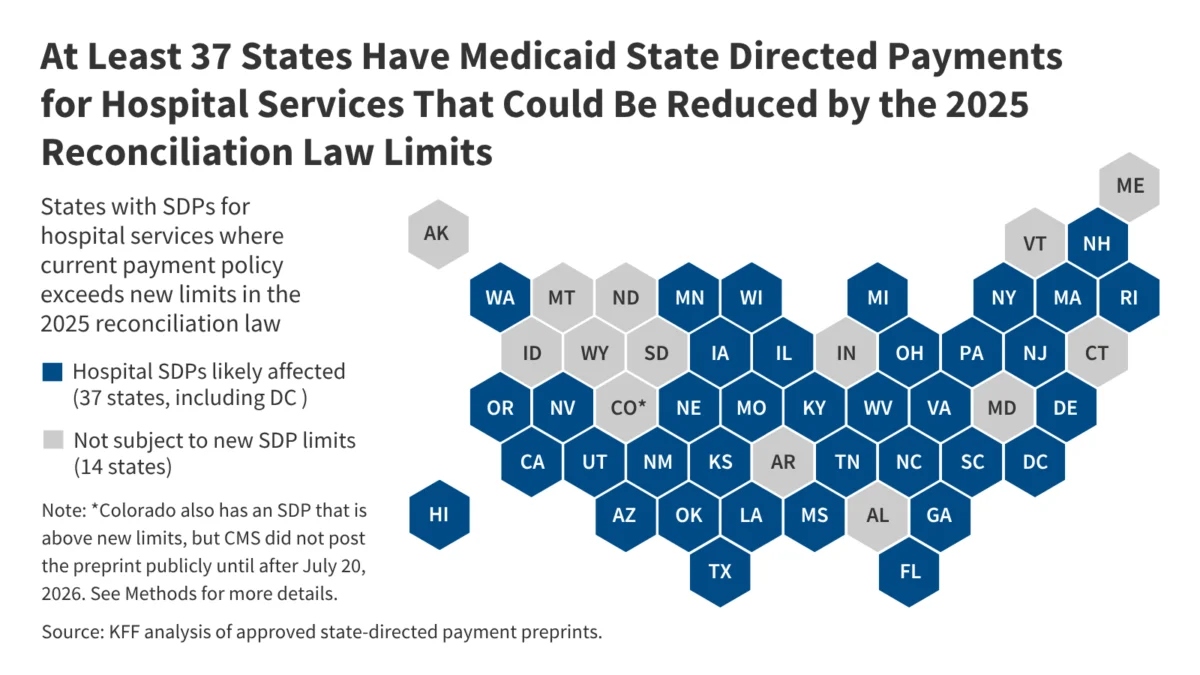
A seismic shift in healthcare financing is approaching as new federal regulations threaten to upend the fiscal stability of hospitals across the United States. According to a comprehensive new analysis by the KFF (Kaiser Family Foundation), an estimated $60 billion in federal Medicaid spending across 37 states and the District of Columbia is at risk of exceeding newly established federal limits. This looming reduction stems from the 2025 reconciliation law, which fundamentally restructured how states can direct payments to healthcare providers within Medicaid managed-care frameworks.
n
As the healthcare industry prepares for these changes, the transition from "Average Commercial Rates" to "Medicare-based" payment caps represents one of the most significant federal interventions in Medicaid financing in decades.
n
n
Main Facts: The Restructuring of Medicaid Managed Care
n
The crux of the issue lies in "State Directed Payments" (SDPs). Under Medicaid managed care, states traditionally pay a fixed monthly fee to private insurance plans to cover beneficiaries. However, SDPs allow states to bypass the standard negotiation between insurers and providers, instead mandating that managed care organizations (MCOs) pay specific providers—usually hospitals—at predetermined rates.
n
For years, states have utilized SDPs to bolster hospital revenues, often setting these rates to match what private, commercial insurers pay. These "Average Commercial Rates" (ACR) are significantly higher than standard Medicaid or Medicare rates. The 2025 reconciliation law seeks to end this practice by imposing a federal ceiling on these payments.
n
Key Takeaways from the KFF Analysis:
n
- n
- The $60 Billion Overhang: Approximately $60 billion in current federal funding for hospital services exceeds the proposed new limits.
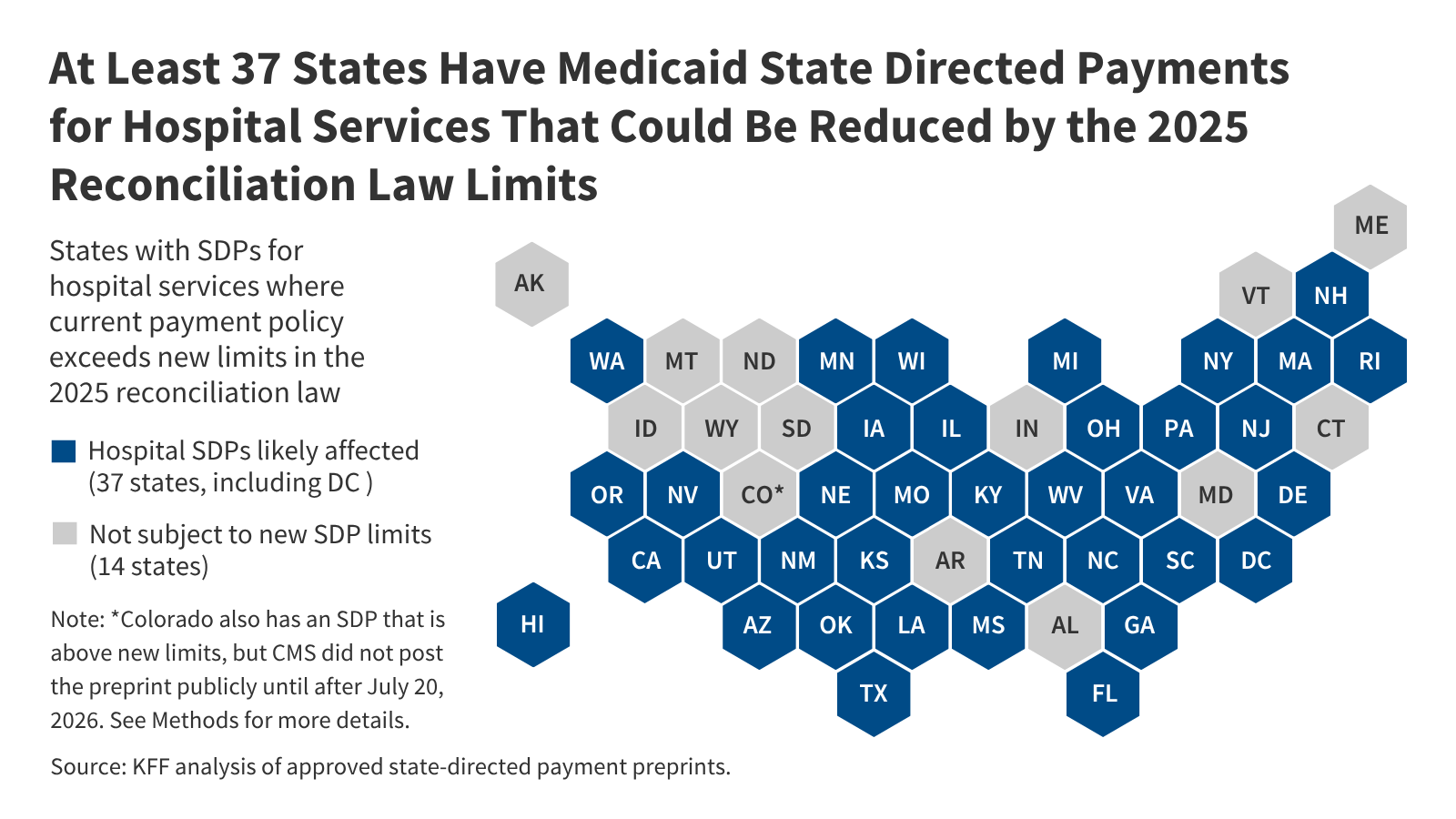
- Broad Geographic Impact: 37 states, plus D.C., currently have SDP arrangements that would require substantial reductions to meet the new federal criteria.
- The Medicare Benchmark: The law shifts the maximum allowable payment from commercial benchmarks to Medicare payment rates.
- Concentrated Fiscal Risk: Just eight states account for 50% of the total potential reductions, with California and Illinois leading the list of impacted jurisdictions.
n
n
n
n
n
n
Chronology: From Legislative Reform to Proposed Regulation
n
The path toward these new limits has been a multi-year process involving legislative action and executive branch implementation.
n
1. The 2025 Reconciliation Law
n
The foundation for these changes was laid with the passage of the 2025 reconciliation law. Amid concerns over rising federal deficits and the "gaming" of Medicaid financing mechanisms, Congress introduced strict caps on SDPs. The law aimed to standardize Medicaid payments and ensure that federal matching funds were not being used to artificially inflate hospital margins beyond what the federal government considers "reasonable" benchmarks.
n
2. June 2025: The Trump Administration’s Proposed Rule
n
Following the legislative mandate, the Trump administration issued a proposed rule in June 2025. This regulation provided the technical framework for how the SDP caps would be calculated and enforced. It introduced the specific requirement that payments be anchored to Medicare rates rather than commercial rates, signaling a move toward fiscal austerity in the Medicaid program.
n
3. Current Status: The Regulatory Limbo
n
As of late 2025 and moving into 2026, the final regulations have yet to be fully implemented. While the proposed rule has been published, the healthcare industry is currently in a "comment and preparation" phase. The KFF analysis serves as a critical assessment of the "fully implemented" scenario, providing states and hospitals with a roadmap of the potential fiscal carnage if the rules proceed as currently drafted.
n
n
Supporting Data: The State-by-State Breakdown
n
The impact of the new limits is not distributed evenly across the country. States that have historically been more aggressive in using SDPs to support their hospital systems face the steepest challenges.
n
The High-Impact States
n
The KFF analysis identifies eight states that bear the brunt of the $60 billion reduction. These states have relied heavily on SDPs to bridge the gap between low Medicaid base rates and the actual cost of providing care:
n
- n
- California: $7.4 billion at risk.
- Illinois: $4.0 billion at risk.
- Kentucky: $3.9 billion at risk.
- Texas: $3.5 billion at risk.
- North Carolina: $3.4 billion at risk.
- Louisiana: $3.3 billion at risk.
- Arizona: $3.0 billion at risk.
- Michigan: $2.6 billion at risk.
n
Commercial vs. Medicare Rates
The financial gap is driven by the disparity between what commercial insurers pay and what Medicare pays. In many markets, commercial rates can be 150% to 250% of Medicare rates. By capping SDPs at Medicare levels, the federal government is effectively removing a vital "subsidy" that hospitals have used to offset the costs of uncompensated care and low-income patient populations.
The Non-Expansion Exception
An interesting nuance in the law involves the 10 states that have not expanded Medicaid under the Affordable Care Act (ACA). In these states, the law allows for a slightly higher cap—just above Medicare rates. This is widely seen as a policy compromise to support safety-net hospitals in states where the uninsured population remains higher due to the lack of Medicaid expansion.
Official Responses and Stakeholder Perspectives
The reaction to the KFF findings and the 2025 reconciliation law has been polarized, reflecting the deep divide in American healthcare policy.
Federal Regulators and Proponents of the Law
Proponents of the new limits argue that the current system is unsustainable and lacks transparency. Federal officials have expressed concerns that states are using "financing loops"—such as provider taxes—to generate the state share of Medicaid funding, only to return that money to hospitals via inflated SDPs to maximize federal matching funds.
"The goal is to ensure that Medicaid remains a program for the vulnerable, not a mechanism for complex financial engineering," a senior administration official noted during the rollout of the proposed rule.
Hospital Associations and State Leaders
Hospital groups, including the American Hospital Association (AHA), have voiced strong opposition. They argue that Medicare rates are already below the actual cost of care for many facilities.
"Reducing payments by $60 billion will not make healthcare more efficient; it will simply make it less accessible," said a spokesperson for a coalition of safety-net hospitals. "For many institutions, particularly in rural areas, these payments are the difference between staying open and shuttering their doors."
State Medicaid directors have also expressed concern about the "fiscal cliff" this creates for state budgets. If hospitals lose federal SDP funding, they will likely pressure states to increase base Medicaid rates—an expense that many state treasuries cannot afford without raising taxes or cutting other services.
Implications: The Future of the Safety Net
The full implementation of these limits could trigger a cascade of unintended consequences across the U.S. healthcare landscape.
1. The Crisis for Rural and Safety-Net Hospitals
Hospitals with low operating margins are the most vulnerable. Rural hospitals, which often serve a high percentage of Medicaid and uninsured patients, rely on every dollar of supplemental funding. A multi-billion dollar reduction in payments could accelerate the trend of rural hospital closures, creating "healthcare deserts" in large swaths of the country.
2. The Provider Tax Dilemma
Many states fund their portion of Medicaid through taxes on the providers themselves. Hospitals agree to these taxes because they know the money will be returned to them—with a federal match—through SDPs. If the federal match is capped at Medicare rates, the "return on investment" for provider taxes diminishes. This could lead to a collapse of state-level Medicaid financing structures, forcing states to find new revenue sources or drastically reduce eligibility.
3. State-Level Mitigation Strategies
States are already looking for ways to circumvent or mitigate the impact of the new caps. Potential responses include:
- Increasing Base Rates: States could try to raise the standard fee-for-service rates. However, this is expensive and subject to separate federal "upper payment limit" (UPL) restrictions.
- Quality Incentive Programs: Some states may shift funding into "value-based" or quality-incentive payments, though the 2025 law also places tighter scrutiny on these mechanisms.
- Service Reductions: In the worst-case scenario, states may be forced to reduce the scope of covered services or tighten eligibility requirements to balance their budgets.
4. Impact on Patient Care
Ultimately, the burden of these fiscal changes may fall on patients. Reduced hospital revenue often leads to staffing cuts, longer wait times in emergency departments, and the discontinuation of less profitable services like behavioral health or maternity care.
Conclusion
The KFF analysis serves as a stark warning of the fiscal volatility ahead. While the 2025 reconciliation law aims for federal fiscal responsibility and standardization, the transition away from commercial-rate benchmarks puts $60 billion of hospital funding in the crosshairs. As the Trump administration moves toward finalizing the regulations, the healthcare industry must prepare for a new era of Medicaid financing—one defined by lower caps, tighter scrutiny, and a potentially weakened safety net. For the 37 states currently exceeding these limits, the clock is ticking to find a sustainable path forward.

