

In an era defined by interconnectedness and shared biological vulnerabilities, the United States continues to position itself as the primary architect and financier of global health infrastructure. According to the latest data for Fiscal Year (FY) 2024, the U.S. government maintains active health programs in over 80 countries, leveraging a sophisticated network of bilateral agreements, regional initiatives, and multilateral contributions to address the world’s most pressing medical challenges.
n
The scope of this engagement is vast, ranging from the eradication of infectious diseases to the strengthening of fragile health systems. Through the lens of the FY 2024 Global Health Tracker, it is evident that U.S. involvement is not merely a matter of philanthropic outreach but a core pillar of national security and international diplomacy.
n
Main Facts: The Seven Pillars of U.S. Global Health
n
The U.S. bilateral global health portfolio is organized into seven primary program areas. Each is designed to address specific health outcomes while contributing to the overall stability of partner nations.
n
- n
- PEPFAR (The President’s Emergency Plan for AIDS Relief): As the largest commitment by any nation to address a single disease, PEPFAR remains the cornerstone of U.S. global health efforts. It focuses on HIV prevention, treatment, and care, aiming to achieve the UNAIDS 95-95-95 targets.
- Tuberculosis (TB): U.S. programs target the world’s deadliest infectious disease by improving diagnostic capabilities, ensuring the supply of high-quality drugs, and addressing the rise of multi-drug-resistant TB (MDR-TB).
- The President’s Malaria Initiative (PMI): This initiative works to reduce malaria-related mortality through the distribution of insecticide-treated bed nets, indoor residual spraying, and the provision of life-saving antimalarial treatments.
- Family Planning and Reproductive Health (FP/RH): These programs aim to reduce unintended pregnancies and improve the well-being of women and families, which in turn fosters economic stability.
- Maternal and Child Health (MCH): Focus is placed on reducing preventable maternal and child deaths, primarily through immunization programs, nutritional support, and improved delivery conditions.
- Nutrition: Integration of nutritional support into broader health programs helps combat stunting and wasting, which are critical barriers to childhood development and long-term economic productivity.
- Global Health Security (GHS): Following the COVID-19 pandemic, GHS has seen significant expansion. It focuses on the "prevent, detect, and respond" framework, helping countries meet International Health Regulations (IHR) to stop outbreaks at their source.
n
n
n
n
n
n
n
n
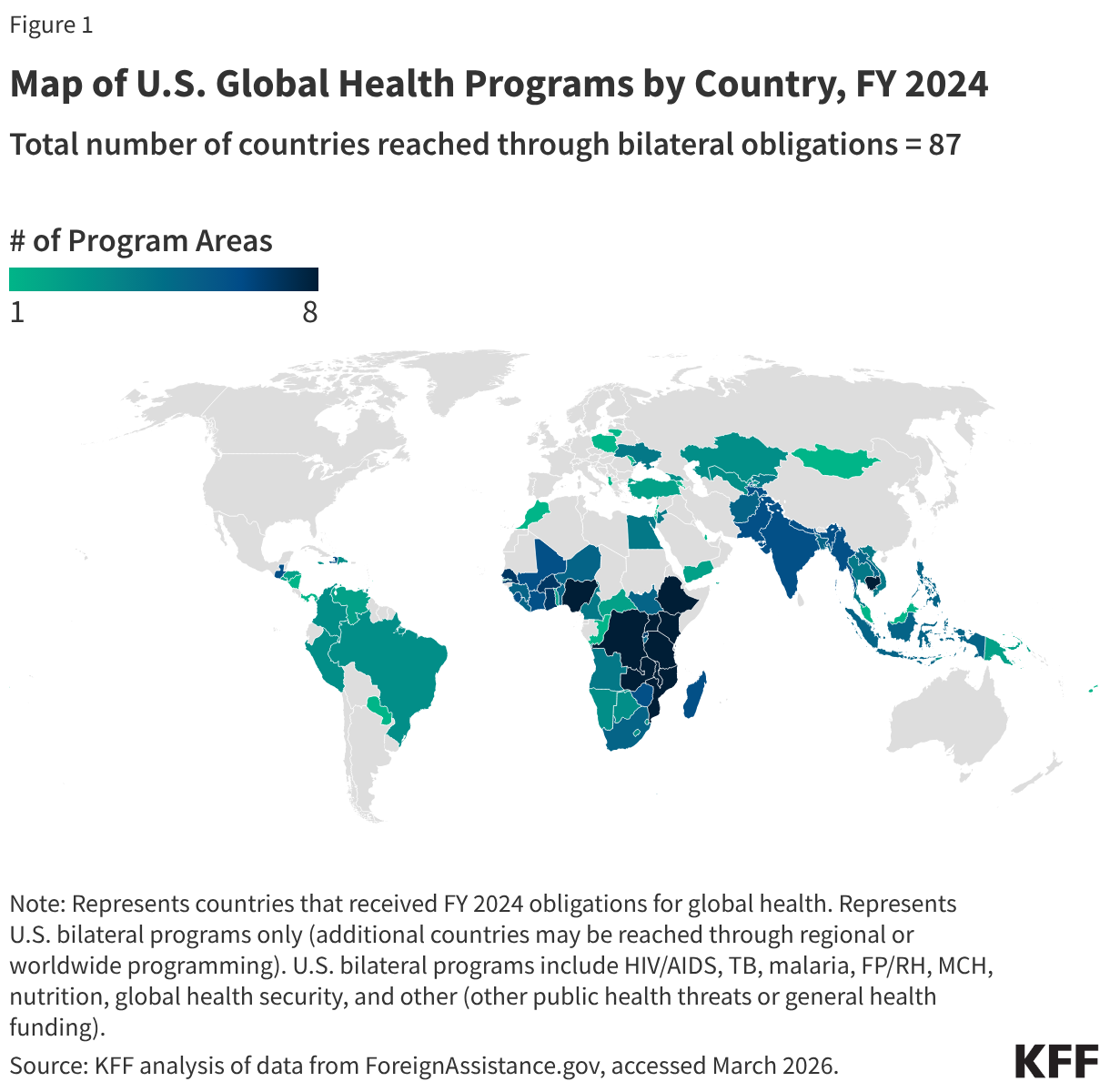
For FY 2024, these programs are distributed across more than 80 partner countries, with the heaviest concentration of resources located in Sub-Saharan Africa, followed by significant investments in South and Central Asia, and Latin America.
n
Chronology: The Evolution of American Health Leadership
n
The current landscape of U.S. global health is the result of decades of policy evolution, shifting from fragmented humanitarian aid to a structured, strategic framework.
n
The Foundation (1961–2000)
n
The formalization of U.S. global health began with the Foreign Assistance Act of 1961, which created the U.S. Agency for International Development (USAID). For decades, health assistance was largely focused on child survival and family planning. It wasn’t until the late 1990s that the global community recognized the existential threat posed by the HIV/AIDS epidemic, prompting a shift toward large-scale infectious disease management.
n
The Paradigm Shift (2003–2010)
n
In 2003, President George W. Bush launched PEPFAR, a move that fundamentally changed the scale of global health funding. This was followed by the launch of the President’s Malaria Initiative (PMI) in 2005. These "vertical" programs (focused on specific diseases) brought unprecedented resources to partner countries, significantly reducing mortality rates in high-burden regions.
n
Integration and Systems Building (2010–2019)
n
Under the Obama administration, the Global Health Initiative (GHI) attempted to integrate these vertical programs into a more holistic "horizontal" approach, focusing on strengthening the underlying health systems of partner nations. This era emphasized "country ownership," encouraging partner governments to take a more prominent role in managing and co-funding their health sectors.
n
The Pandemic Era and Beyond (2020–Present)
n
The COVID-19 pandemic served as a catalyst for the latest evolution in U.S. strategy. The focus shifted toward Global Health Security (GHS). The Biden administration has prioritized pandemic preparedness, re-engaging with the World Health Organization (WHO) and spearheading the creation of the Pandemic Fund. In FY 2024, GHS has become an integral part of the bilateral portfolio in nearly every partner country, reflecting a new reality where health security is synonymous with national security.
n
Supporting Data: Mapping the FY 2024 Footprint
n
The FY 2024 data highlights a complex distribution of health programs. While some countries receive support in only one or two areas—often Global Health Security or Nutrition—others are "comprehensive partners" where the U.S. operates across all seven pillars.
n
Geographic Concentration
n
- n
- Sub-Saharan Africa: Remains the primary recipient of U.S. bilateral health aid. Countries like Kenya, Uganda, Nigeria, and South Africa host some of the most extensive PEPFAR and PMI programs. In these regions, U.S. funding often accounts for a significant percentage of the total national health budget.
- Asia: Programs in countries like Vietnam, Indonesia, and India are increasingly focused on Tuberculosis and Global Health Security, reflecting the region’s role as a potential hotspot for emerging zoonotic diseases.
- Western Hemisphere: U.S. efforts in Latin America and the Caribbean often prioritize Maternal and Child Health, as well as migration-related health challenges, with a growing emphasis on GHS in countries like Brazil and Colombia.
n
The Growth of Global Health Security
Data from the FY 2024 tracker indicates that Global Health Security is the fastest-growing program area in terms of geographic reach. While PEPFAR is targeted at 50+ high-burden countries, GHS initiatives are now active in nearly all 80+ partner nations. This expansion reflects the U.S. government’s "7-1-7" goal: every country should be able to detect an outbreak within seven days, report it within one day, and initiate an effective response within seven days.
Official Responses: Perspectives from Washington and Beyond
The U.S. government’s global health strategy is a collaborative effort involving USAID, the Centers for Disease Control and Prevention (CDC), the Department of State, and the Department of Health and Human Services (HHS).
The Executive Branch
USAID Administrator Samantha Power has frequently emphasized that global health is a matter of "localization." In recent briefings regarding FY 2024 priorities, Power noted that the U.S. is moving toward a model where at least 25% of funding goes directly to local organizations within partner countries. "We are not just providing aid; we are building the capacity of nations to protect their own citizens," Power stated during a recent global health summit.
The Legislative Perspective
While global health has historically enjoyed bipartisan support in Congress, the FY 2024 budget cycle has seen intense debate. Fiscal conservatives have called for greater scrutiny of multilateral contributions, while proponents of the programs argue that every dollar spent on global health prevents much more costly military or humanitarian interventions later. The reauthorization of PEPFAR has been a particular point of contention, with debates centering on how to balance the program’s original mission with modern health challenges.
International Reception
Partner nations generally welcome U.S. bilateral support, though there is an increasing demand for "decolonizing" global health. Leaders in the African Union have called for more investment in local manufacturing—specifically for vaccines and essential medicines—rather than just the procurement of U.S.-made supplies. The FY 2024 programs have begun to reflect this, with increased funding for regional manufacturing hubs in Africa and Southeast Asia.
Implications: The Future of Global Health Diplomacy
The U.S. global health footprint in FY 2024 carries profound implications for the future of international relations and global stability.
Soft Power and Geopolitical Influence
Health programs are among the most effective tools of American "soft power." By saving lives and stabilizing communities, the U.S. builds long-term goodwill. In regions where the U.S. competes with other global powers for influence, such as Southeast Asia and Africa, these health partnerships provide a tangible counter-narrative to infrastructure-heavy investments from competitors.
Economic Stability
Health is a prerequisite for economic growth. By reducing the burden of malaria, HIV, and TB, U.S. programs help maintain a productive workforce in partner nations. The FY 2024 focus on Nutrition and Maternal Health is particularly significant here, as it addresses the foundational health of the next generation of global workers and consumers.

The Challenge of Sustainability
Perhaps the most significant implication of the FY 2024 data is the challenge of sustainability. As the U.S. supports programs in over 80 countries, the question remains: how long can this level of funding be maintained? There is a growing push for "transitioning" programs to host-government control. However, many partner nations face debt crises and climate-related shocks that make taking over these multi-billion-dollar health infrastructures a daunting prospect.
Conclusion
The U.S. Global Health Tracker for FY 2024 reveals a nation deeply committed to the biological well-being of the planet. Through PEPFAR, PMI, and the rapidly expanding Global Health Security initiatives, the United States remains the indispensable leader in global health. Yet, as the world moves further away from the acute phase of the COVID-19 pandemic, the focus is shifting. The challenge for the coming years will be to maintain the momentum of disease-specific successes while building the resilient, locally-led health systems necessary to withstand the next global threat.
As the data is updated and the fiscal year progresses, the international community will be watching closely to see if the U.S. can balance its domestic fiscal pressures with its role as the world’s primary health benefactor. For the millions of people in 80+ countries who rely on these programs, the stakes could not be higher.

