
Executive Summary
n
The landscape of American public health insurance is currently undergoing its most significant transformation since the implementation of the Affordable Care Act (ACA). Following a multi-year period of stabilized coverage during the COVID-19 pandemic, the "unwinding" of Medicaid continuous enrollment provisions has led to a massive reshuffling of the nation’s healthcare safety net. As of mid-2026, data from the Centers for Medicare & Medicaid Services (CMS) and analysis by the Kaiser Family Foundation (KFF) reveal a complex picture of shifting eligibility, administrative hurdles, and looming legislative changes that threaten to further reduce enrollment over the next decade.
n
With over 25 million disenrollments recorded since the unwinding began and a major policy shift toward work requirements slated for January 2027, the stability of coverage for millions of low-income Americans remains in a state of flux.
n
n
I. Main Facts: The Current State of Medicaid and CHIP
n
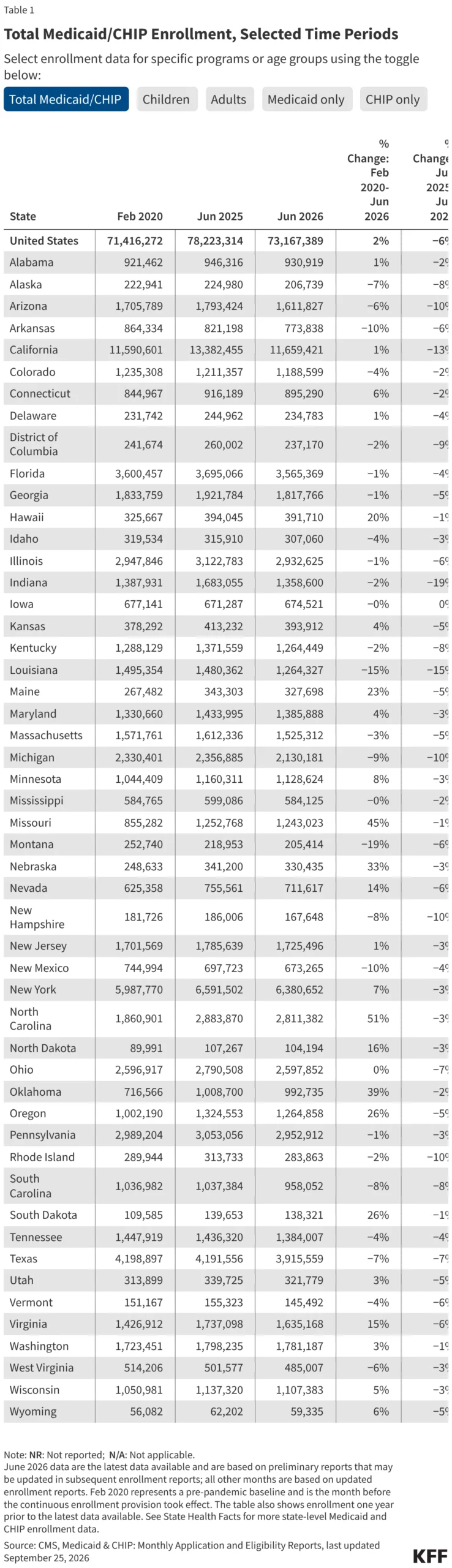
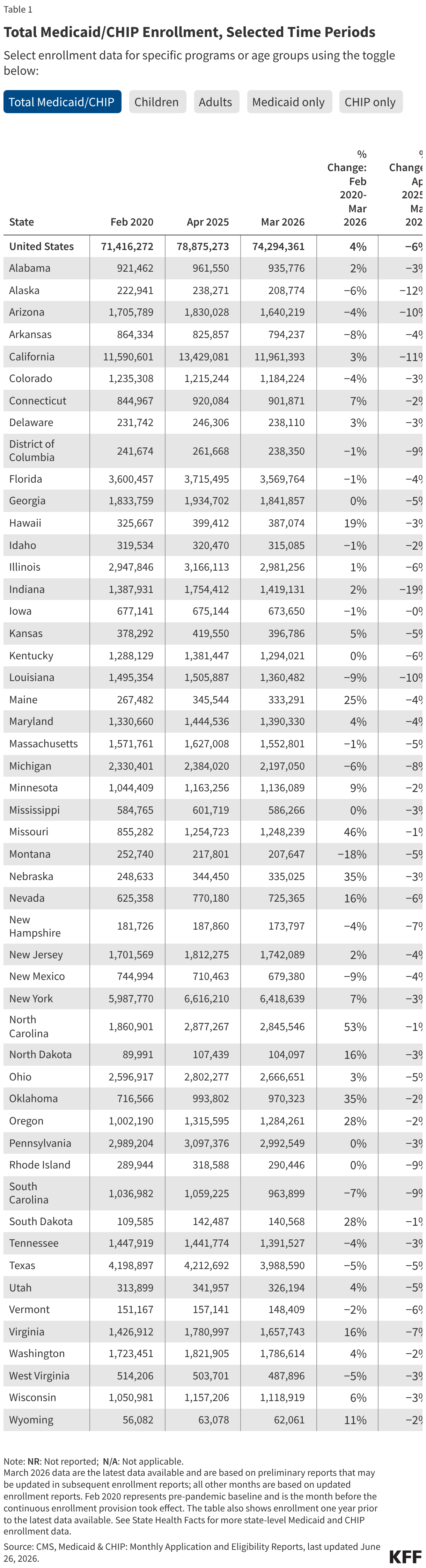
As of June 2026, the Medicaid and Children’s Health Insurance Program (CHIP) landscape is defined by the aftermath of the "unwinding" process—the period during which states were required to redetermine the eligibility of every single enrollee for the first time since 2020.

n
The Scale of Disenrollment
n
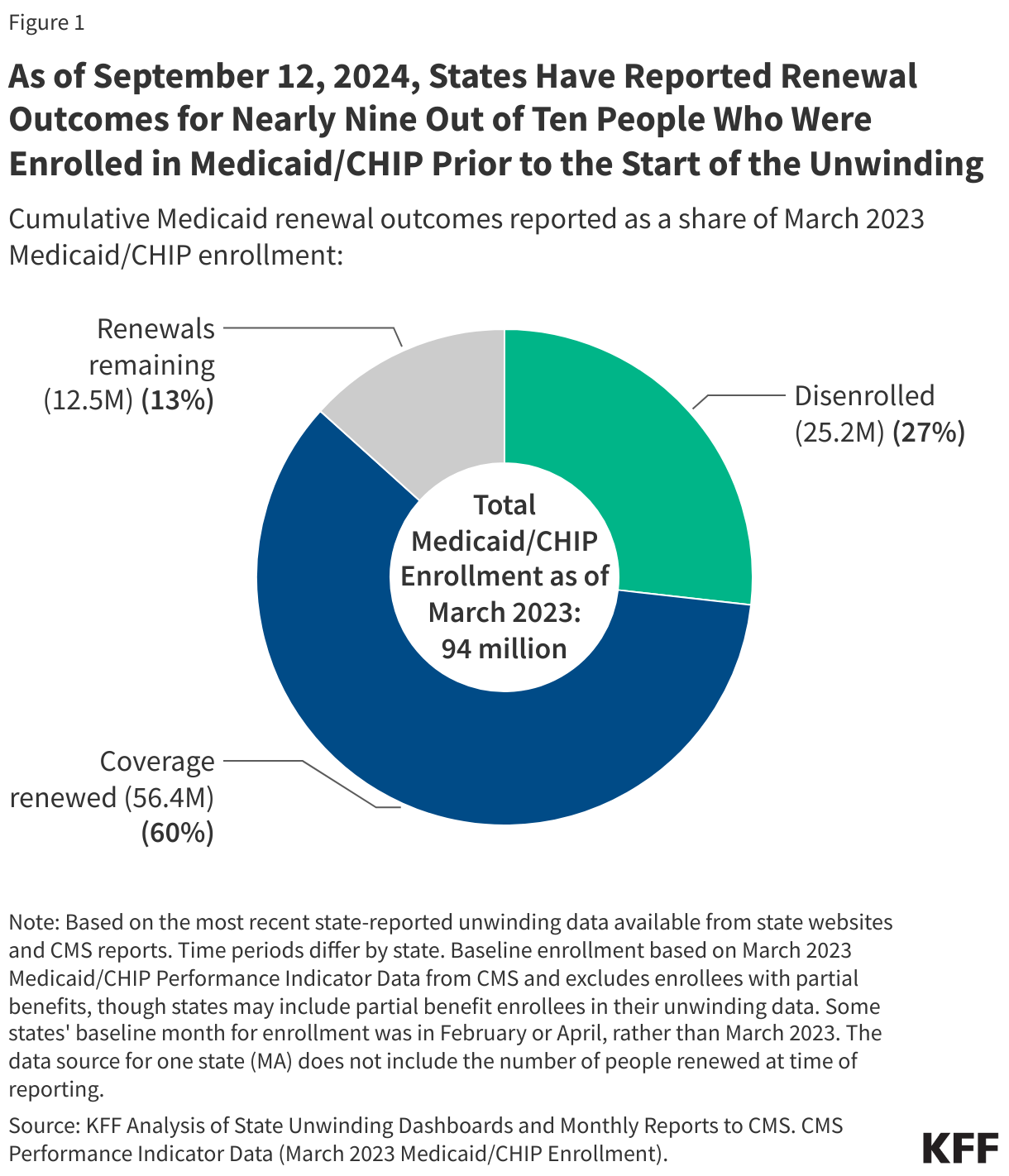
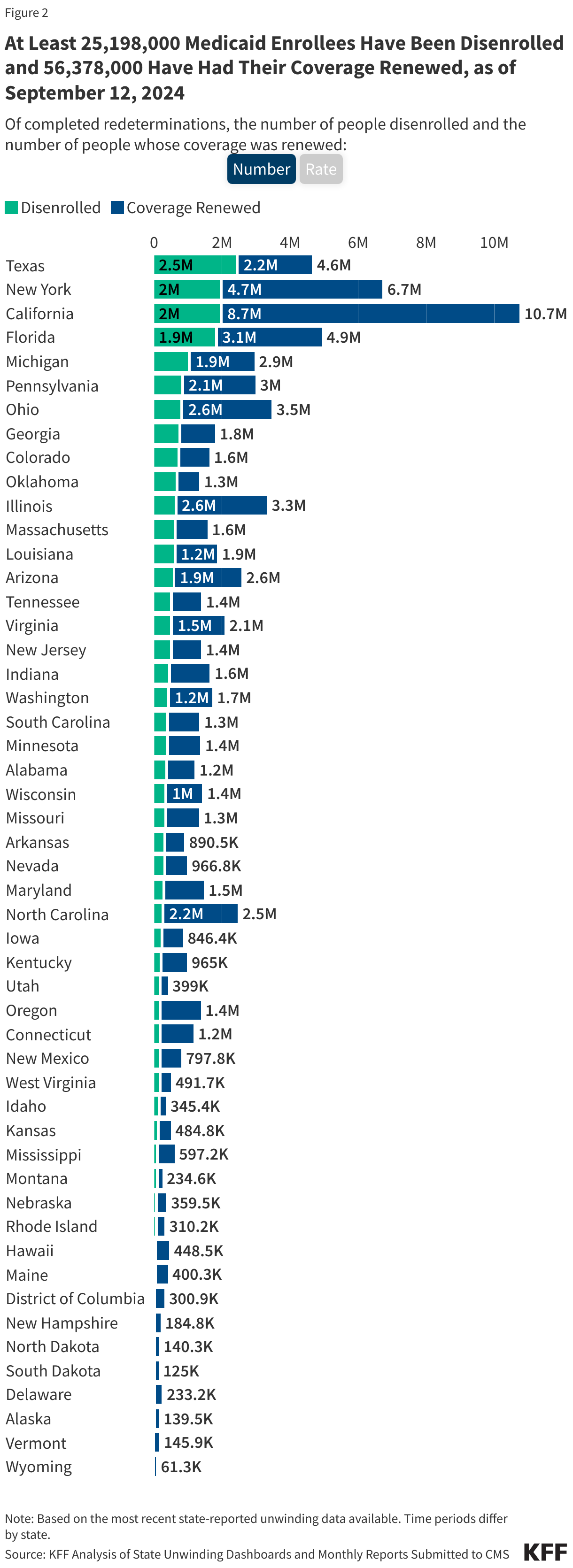
The data shows a historic contraction in coverage. Since the unwinding process commenced in early 2023, at least 25,198,000 individuals have been disenrolled from Medicaid. In contrast, approximately 56,378,000 individuals successfully had their coverage renewed. While the majority of enrollees retained their benefits, the sheer volume of those losing coverage has raised alarms among healthcare advocates and policymakers.
n
The Procedural Crisis
n
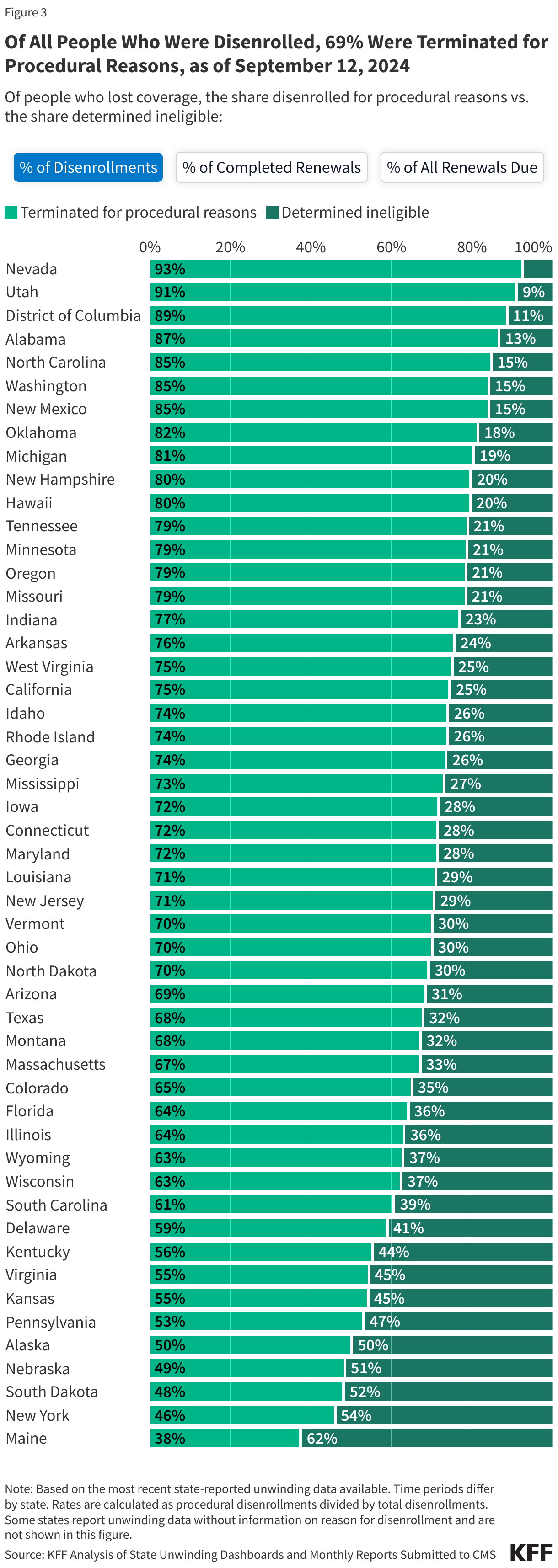
Perhaps the most striking finding in the CMS Performance Indicator Project data is the reason for coverage loss. Of all people disenrolled during the unwinding period, 69% were terminated for procedural reasons. These individuals did not necessarily become ineligible due to an increase in income; rather, they lost coverage because of administrative barriers, such as failing to return paperwork, states having outdated contact information, or enrollees being unable to navigate complex renewal systems.
n
Future Policy Shifts
n
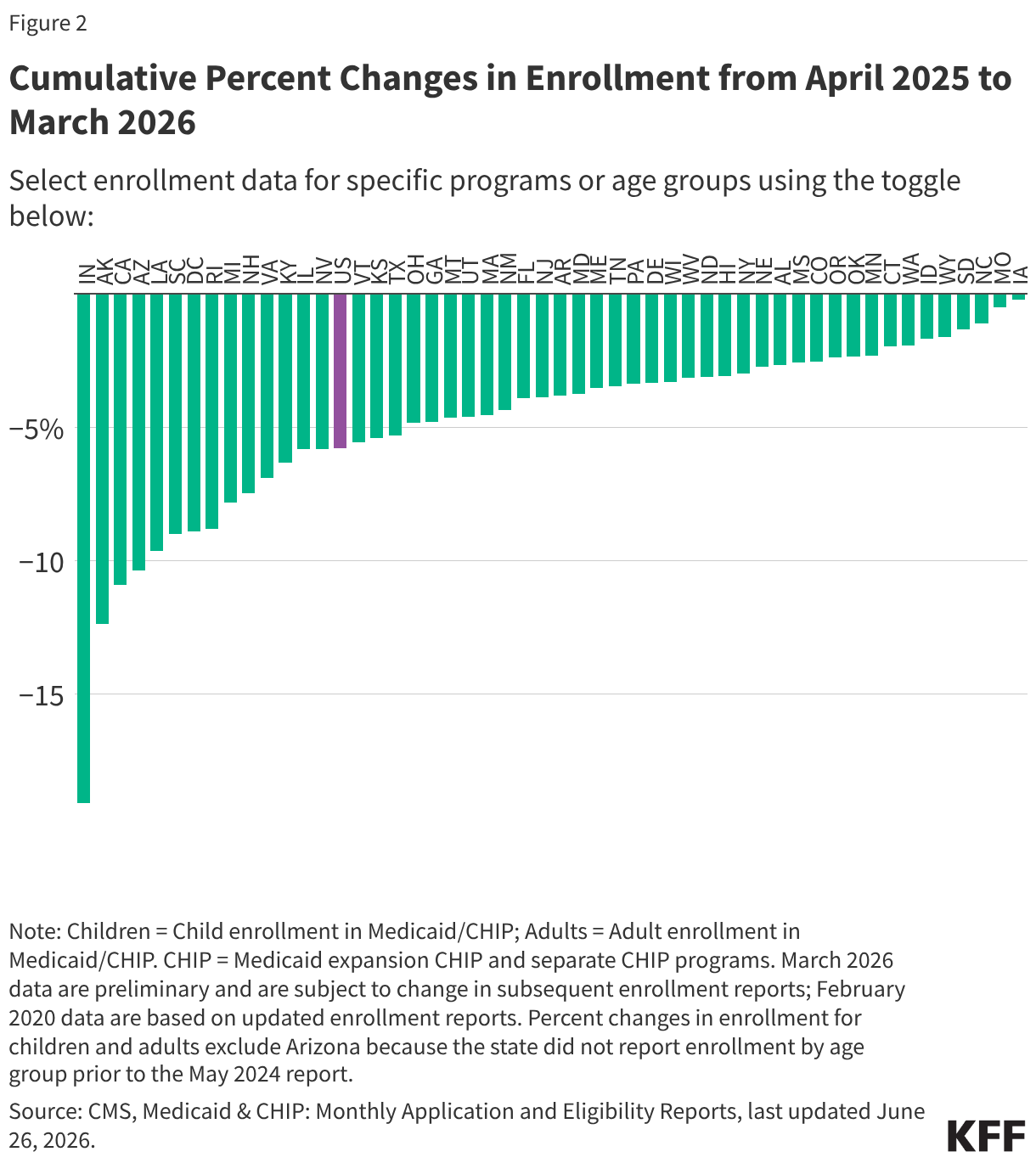
The 2025 federal budget reconciliation law has introduced a new variable into the Medicaid equation. Starting in January 2027, adults in the Medicaid expansion group and those in certain 1115 waiver programs will be required to meet new work and reporting requirements. Actuarial projections suggest these changes will significantly reduce Medicaid enrollment over the next 10 years as the federal government tightens eligibility pathways.
n
n
II. Chronology: From Pandemic Stability to the 2027 Mandates
n
To understand the current volatility, one must look back at the legislative response to the global pandemic and the subsequent rollback of emergency measures.
n
February 2020: The Pre-Pandemic Baseline
n
Before the COVID-19 pandemic, Medicaid and CHIP enrollment stood at a relatively stable baseline. However, the onset of the public health emergency prompted Congress to pass the Families First Coronavirus Response Act (FFCRA). This law provided states with increased federal funding on the condition that they maintained "continuous enrollment," effectively banning states from disenrolling anyone from Medicaid for the duration of the emergency.
n
2020–2023: The Coverage Peak
n
During this three-year period, Medicaid enrollment surged to record highs. Because the "back door" of the program was closed, individuals who joined Medicaid remained on the rolls regardless of changes in their financial or household status. This period saw the lowest uninsured rates in American history but created a massive administrative backlog for state health departments.
n
April 2023–Late 2024: The Unwinding Period
n
The Consolidated Appropriations Act of 2023 decoupled the continuous enrollment provision from the Public Health Emergency, allowing states to begin disenrollments as early as April 1, 2023. This "unwinding" lasted roughly 14 months for most states. It was during this window that the 25 million disenrollments occurred, as states raced to process millions of redeterminations.
n
2025–2026: The Reconciliation Era
n
With the passage of the 2025 reconciliation law, the focus shifted from pandemic recovery to fiscal restructuring. The law set the stage for the reintroduction of work requirements, a policy that had been largely paused or struck down by courts in previous years. This period has been characterized by states preparing their IT systems for the January 2027 implementation of these new mandates.
n
n
III. Supporting Data: A Deep Dive into Renewal Outcomes
n
The data provided by the CMS Performance Indicator Project offers a granular look at how different populations and states have fared during this transition.
n
State-Level Variation
n
The "unwinding" did not impact all states equally. There is a vast disparity in disenrollment rates across the country:
n
- n
- Montana: Reported the highest disenrollment rate at 57% of completed redeterminations.
- North Carolina: Reported one of the lowest disenrollment rates at 12%.
This variation is largely attributed to state-level policy choices, such as the investment in "ex parte" renewals—an automated process where the state uses existing data (like SNAP or tax records) to verify eligibility without requiring the enrollee to take action.
The Role of Ex Parte Renewals
Nationwide, 61% of people who retained their Medicaid coverage were renewed through these automated ex parte processes. States that prioritized this technology saw significantly lower procedural disenrollment rates, as it bypassed the need for physical mail and manual form submission.
Impact on Children
Children’s enrollment in Medicaid and CHIP has been particularly sensitive. While CHIP (Children’s Health Insurance Program) provides a secondary safety net, many children who were previously covered under Medicaid expansion were disenrolled during the unwinding. CMS reports that child enrollment trends continue to lag behind adult enrollment in several key states, including Arizona, where specific data for children remains unavailable for several reporting months.
IV. Official Responses and Regulatory Oversight
The federal government, primarily through CMS, has taken an active role in monitoring state performance to prevent "inappropriate" coverage loss.
CMS Performance Indicator Project
CMS has mandated monthly reporting from all 50 states and the District of Columbia. This project tracks applications, eligibility determinations, and total enrollment. When states showed excessively high procedural disenrollment rates, CMS intervened, in some cases requiring states to pause procedural terminations until their systems were corrected.
The 2025 Reconciliation Law Context
The official stance of the current administration, as reflected in the 2025 reconciliation law, represents a pivot toward "targeted" Medicaid. By requiring adults in the expansion group to meet work and reporting requirements, the federal government aims to transition able-bodied adults into employer-sponsored insurance or the ACA Marketplace. However, critics argue that the reporting requirements themselves—rather than a lack of work—will be the primary cause of future enrollment drops.
Data Limitations and Archiving
KFF and CMS have noted that as of September 2024, most states have completed their initial unwinding. Consequently, much of the "unwinding-specific" data has been archived. Future tracking will shift focus toward the impact of the 2027 work requirements and the long-term "churn" of enrollees moving between Medicaid and other forms of insurance.
V. Implications: The Long-Term Outlook for US Healthcare
The massive shifts in Medicaid enrollment carry profound implications for the American healthcare system, state budgets, and public health outcomes.
1. The "Churn" and the Uninsured Rate
The primary concern for health economists is the "churn" phenomenon—where individuals lose Medicaid, spend several months uninsured, and eventually re-enroll when they face a medical crisis. With 69% of disenrollments being procedural, a significant portion of the 25 million people who lost coverage likely still qualify for Medicaid. This gap in coverage leads to delayed care, higher emergency room utilization, and increased uncompensated care costs for hospitals.
2. Economic Impact on States
Medicaid is often the largest or second-largest item in state budgets. While disenrollment reduces the state’s direct insurance costs, it also reduces the amount of federal matching funds flowing into the state’s healthcare economy. For states like Montana with high disenrollment rates, the local healthcare infrastructure may face financial strain as the volume of self-pay or "charity care" patients increases.
3. The 2027 Work Requirement Hurdle
The upcoming January 2027 requirements are expected to create a secondary "unwinding" event. If the procedural hurdles of 2023–2024 are any indication, the "reporting" aspect of work requirements may lead to another wave of disenrollments among eligible individuals who simply cannot navigate the reporting portals or provide the necessary documentation.
4. Expansion vs. Contraction
As we move toward 2030, the trajectory of Medicaid appears to be one of contraction. The combined effects of the post-pandemic cleanup and the new federal mandates suggest that the era of "maximalist" Medicaid coverage is ending. The challenge for policymakers over the next four years will be ensuring that those who are truly ineligible find their way to the ACA Marketplace, while those who are eligible do not fall through the cracks of a bureaucratic system.
Conclusion
The data from June 2026 serves as a stark reminder of the fragility of the American healthcare safety net. While the "unwinding" is technically complete, its effects—characterized by millions of procedural disenrollments and a looming shift toward stricter eligibility mandates—will be felt for a decade. The success of the program will no longer be measured just by how many people it covers, but by how effectively it manages the transitions of those it leaves behind.

