
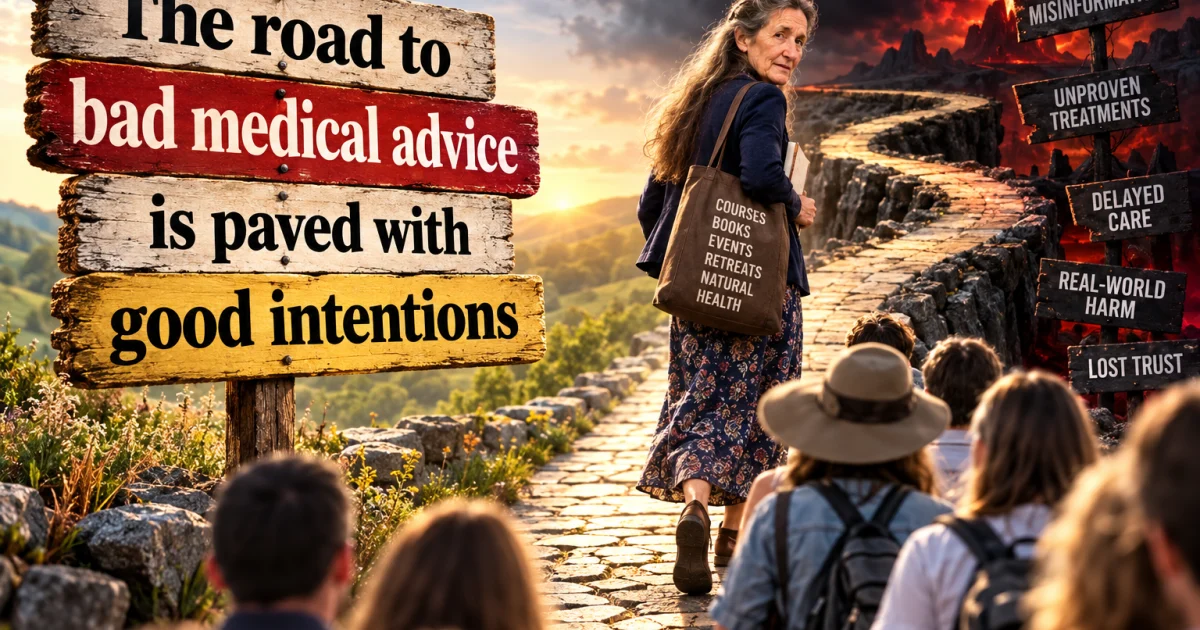
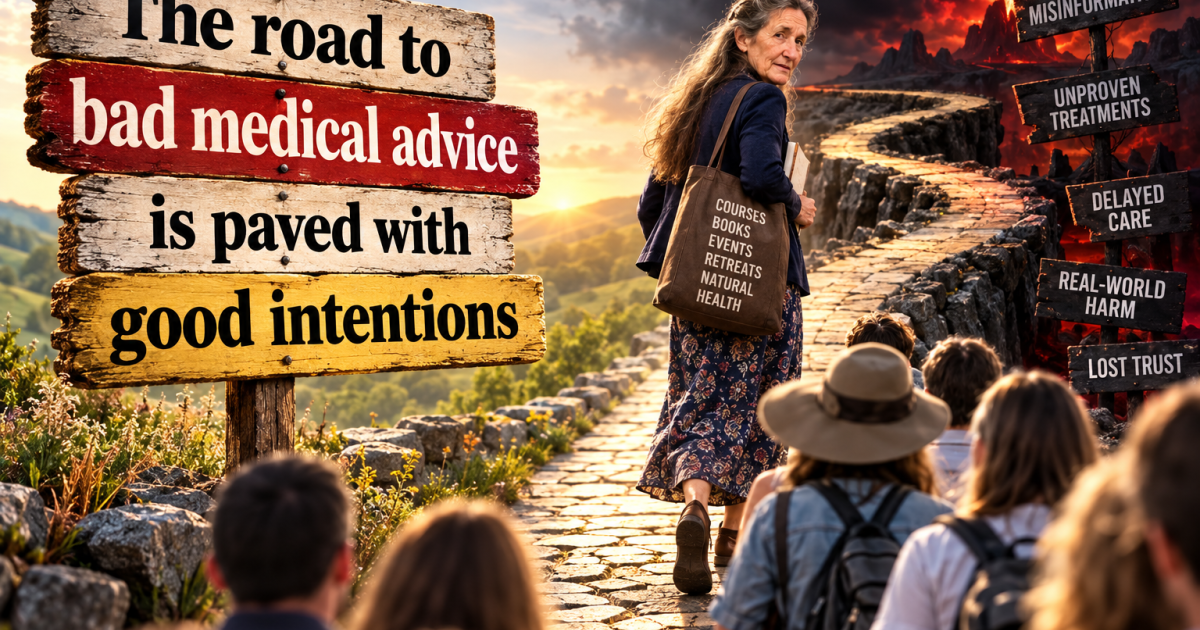
In the critical domain of healthcare, the adage "a warm heart is no substitute for a trained mind" rings with an urgent and often tragic truth. While many are drawn to health-related fields by a genuine desire to help others, this noble intention can become a dangerous facade when unaccompanied by rigorous training, verifiable expertise, and adherence to established professional standards. The case of Barbara O’Neill, an Australian naturopath banned from practicing in her home country, exemplifies this perilous intersection. O’Neill has cultivated a global following and built a substantial enterprise on the defense that she "just wants to help." However, as this article will explore, good intentions, divorced from competence and accountability, can lead to real-world harm, leaving individuals vulnerable to misinformation and potentially life-threatening advice.
n
The Siren Song of "Helping": A Global Phenomenon
n
Barbara O’Neill, a septuagenarian who identifies as a health educator, naturopath, and nutritionist, has become a polarizing figure on the international wellness stage. Despite being banned from practicing her purported professions in Australia in 2019, she has embarked on an extensive global tour, reaching audiences in countries as diverse as Brazil, Thailand, India, the United Kingdom, Germany, and the United States. Her message, often delivered at large-scale events and through various online platforms, resonates with a segment of the population disillusioned with conventional medicine or seeking alternative approaches to health.
n
The core of O’Neill’s defense, and indeed the rallying cry of her supporters, is her purported altruism. Phrases like "Even if she doesn’t have all of her facts straight, she has good intentions!" and "She cares so much!" are frequently cited by her advocates. This emphasis on perceived good intentions serves to deflect criticism and frame her actions as those of a well-meaning individual offering helpful advice. This narrative, however, conveniently sidesteps the crucial distinction between well-meaning sentiment and evidence-based, professionally sound healthcare.
n
The Illusion of Expertise: When Intentions Become Credentials
n
The proliferation of individuals like Barbara O’Neill highlights a significant regulatory gap in many sectors of the health and wellness industry, particularly in areas like health coaching. Without clear and enforced standards, the field becomes susceptible to an influx of individuals who, while perhaps genuinely motivated to help, lack the foundational knowledge and ethical framework necessary to provide safe and effective guidance. In these unregulated spaces, the assumption often takes hold that having good intentions is a qualification in itself.
n
This phenomenon can be vividly illustrated by considering societal responses to natural disasters. When catastrophic events like earthquakes or hurricanes strike, global sympathy is quickly mobilized. Millions offer donations, supplies, or even volunteer their time. However, imagine if an individual, driven by empathy, were to arrive in a disaster zone with no medical training, no logistical support, and no understanding of the on-the-ground needs. Such a person, however well-intentioned, would likely be perceived as an additional burden, an untrained hand attempting to manage complex and life-threatening situations. They would, rightly, be redirected or even removed from the scene.
n
This analogy underscores a critical societal consensus: in times of crisis, good intentions alone are insufficient. We demand demonstrable competence and relevant qualifications. The question then arises: why does this standard seemingly dissolve when it comes to health and wellness advice? The allure of perceived altruism appears to override the necessity for verifiable expertise. Barbara O’Neill, it is argued, possesses no formal medical credentials, has not completed modern, recognized training in her purported fields, and is not subject to any regulatory board that enforces a code of conduct. Her influence, therefore, appears to stem from a self-promoted brand rather than established professional standing.
n
The Business of "Caring": A Commercial Enterprise
n
The argument that Barbara O’Neill is solely motivated by a desire to help is significantly challenged by examining her operational model and the structure of her global enterprise. While her husband, Michael O’Neill, has publicly declared his unwavering support, stating, "I know her heart, and I will keep standing beside you," this sentiment overlooks the commercial underpinnings of her operations.
n
A review of O’Neill’s website reveals a distinct lack of information regarding her training or qualifications. There is no "About Me" or "My Qualifications" section that would typically be expected from a professional offering health advice. Instead, the website prominently features sections dedicated to products and courses that she offers for sale. These offerings are not limited to her own expertise; some courses appear to have been developed by family members, suggesting that O’Neill’s brand has evolved into a family business.
n
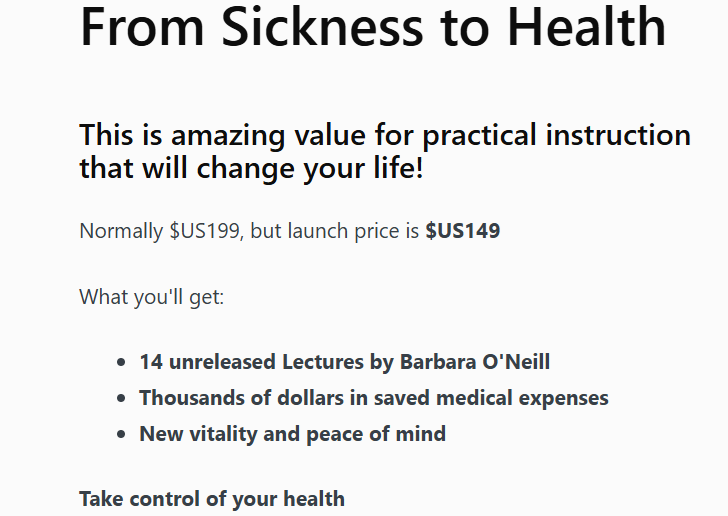
Crucially, there is no dedicated section outlining her beliefs or the scientific basis for her recommendations. To access this information, individuals are required to pay. O’Neill’s business model is built upon the sale of books, events, courses, and retreats, all of which serve as revenue streams derived from her pronouncements on health and well-being. This commercialization of her "advice" casts a significant shadow over the narrative of pure altruism. If her primary motivation were solely to impart knowledge freely, the emphasis on paid products and services would be considerably less pronounced. The structure of her website, prioritizing sales over verifiable credentials, suggests that her "good intentions" are inextricably linked to a profitable business model.
n
A Health Watchdog’s Intervention: The Australian Decision
n
The critical turning point in understanding the concerns surrounding Barbara O’Neill came in 2019 when Australia’s health care watchdog, the Health Care Complaints Commission (HCCC) of New South Wales, took decisive action. The HCCC banned O’Neill from dispensing any of her health advice within Australia. This ruling, while deeply resented by O’Neill and her supporters who perceive it as unfair persecution, is supported by a robust and detailed investigation.
n
The HCCC’s decision meticulously outlines the basis for the ban, highlighting significant deficiencies in O’Neill’s professional standing and practice. The Commission’s findings reveal that O’Neill possesses "limited qualifications in the area of nutrition and dietetics, which she attained more than 10 years ago." Furthermore, the report states that "Mrs O’Neill has not taken any steps to maintain and enhance her knowledge and skills in her field of practice to deliver a professional service to the community."
n
Perhaps the most damning indictment from the HCCC is the observation that O’Neill "cannot recognise and provide health advice within the limits of her training and experience." The Commission specifically noted that O’Neill "considers herself qualified to provide health advice in highly complex and specialised areas such as cancer treatment, use of antibiotics for Strep B and immunisation in circumstances where it is clear her knowledge is limited." This indicates a pattern of overreach, where advice is dispensed in areas far beyond her demonstrated competence, potentially endangering individuals who rely on her pronouncements. The HCCC’s public statement and decision underscore that the ban was not an arbitrary act but a necessary measure to protect public health from unqualified and potentially harmful advice.
n
The Consequences of Unqualified Guidance: A Broader Societal Concern
n
The case of Barbara O’Neill serves as a potent reminder of a broader societal challenge: the increasing prevalence of unqualified individuals dispensing health advice, often cloaked in the language of empathy and personal experience. While the impulse to "stay in your lane" can sometimes be perceived as impolite, it is a fundamental principle in any field where specialized knowledge and training are paramount. In the realm of healthcare, this principle is not merely about politeness; it is about safety and efficacy.
n
The assumption of good intentions, when applied to health advice, can be a dangerous distraction. It allows for the erosion of standards and the elevation of personal conviction over evidence-based practice. In medicine, emotion, however genuine, is not a substitute for expertise. The medical profession is heavily regulated for good reason. Legitimate healthcare providers are bound by stringent requirements for licensure, ongoing education, and strict codes of conduct. These measures are in place to ensure that compassion is always accompanied by competence, and that patient well-being is the paramount concern.
n
Without mandatory standards for education, training, and the rigorous evaluation of evidence, the term "good intentions" becomes a mere euphemism for unsubstantiated opinions or "vibes." In healthcare, relying on such intangible measures is a direct and rapid pathway to preventable harm. Individuals seeking health guidance are often at their most vulnerable. They place their trust in those who present themselves as knowledgeable, and when that trust is betrayed by misinformation or unqualified advice, the consequences can be severe, ranging from delayed or ineffective treatment to direct harm.
n
Conclusion: Competence Over Compassion, Expertise Over Enthusiasm
n
The narrative surrounding Barbara O’Neill underscores a critical failing within the broader health and wellness landscape: the willingness to prioritize perceived intent over demonstrable competence. Just as we would never permit an untrained volunteer to operate a surgical tent in a disaster zone, irrespective of their compassionate disposition, we cannot afford to treat health advice as a playground for uncredentialed goodwill. The consequences of such a laissez-faire approach are too dire.
n
Barbara O’Neill is not an isolated anomaly but a predictable outcome of a system that, in certain unregulated corners, allows subjective intent to eclipse objective impact. Her global reach and the fervent loyalty of her followers highlight the demand for alternative health narratives, but this demand must be met with responsibility and accountability. The bedrock of safe and effective healthcare lies in the rigorous application of scientific knowledge, validated training, and ethical practice. Until the wellness industry, in its entirety, embraces these fundamental principles, individuals like Barbara O’Neill will continue to thrive, potentially at the expense of those they claim to help. The imperative is clear: in matters of health, compassion must be anchored by competence, and enthusiasm must be guided by expertise.
nnnnnnn

