
Introduction: The Collision of 20th-Century Law and 21st-Century Intelligence
n
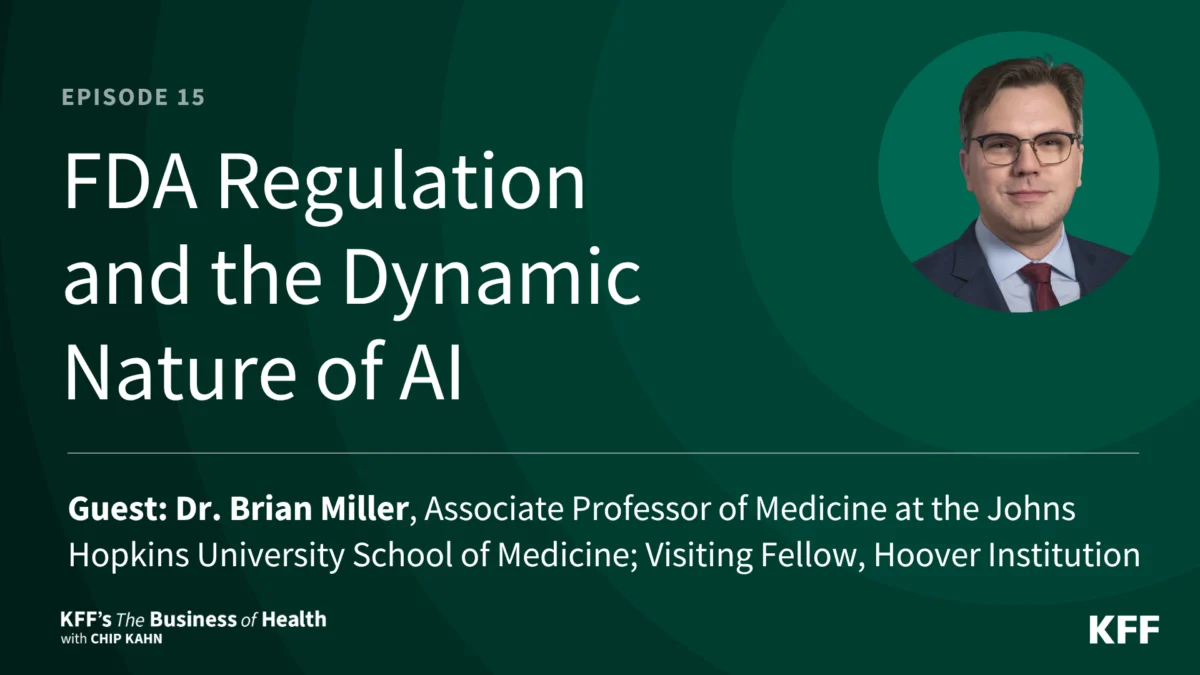
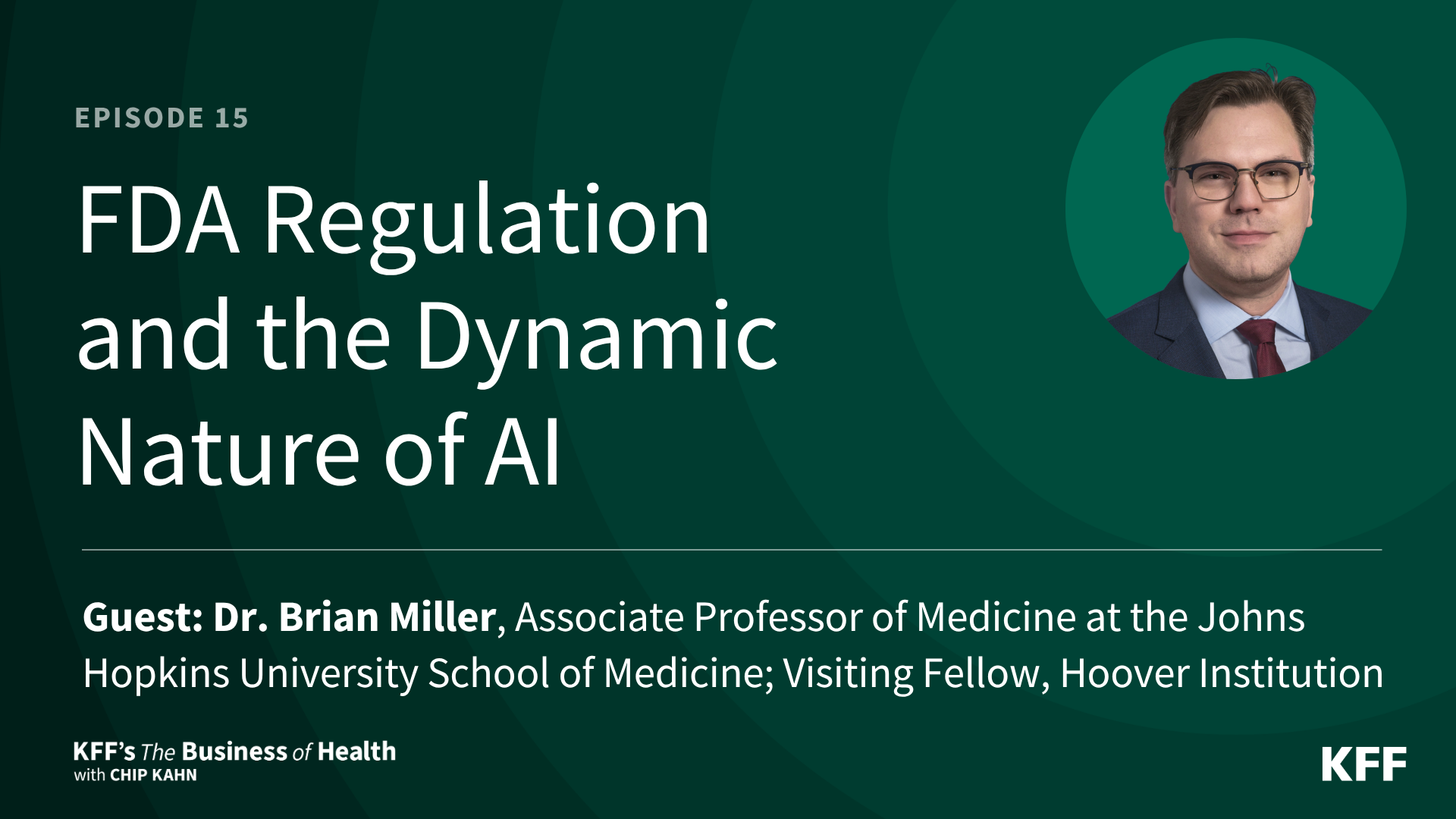
As the healthcare industry stands on the precipice of an artificial intelligence (AI) revolution, a fundamental tension has emerged between the breakneck speed of technological evolution and the deliberate, often glacial pace of federal regulation. This conflict was the focal point of a recent high-level discussion on The Business of Health, hosted by Chip Kahn, a senior visiting fellow at KFF and a prominent voice in health policy.
n
The episode featured Dr. Brian Miller, an Associate Professor of Medicine at Johns Hopkins University and a former official at the U.S. Food and Drug Administration (FDA). Dr. Miller, who also serves as a Commissioner on the Medicare Payment Advisory Commission (MedPAC), brought a unique, multi-disciplinary perspective to a question that is currently haunting Silicon Valley and Washington D.C. alike: How does a regulatory framework designed in 1976—the era of the rotary phone and the first personal computers—govern a technology that learns, adapts, and changes its own code in real-time?
n
The central thesis of the discussion challenged the prevailing narrative of AI skepticism. While many advocates call for tighter restrictions to prevent "black box" algorithms from harming patients, Dr. Miller argued that the greatest risk to public health may not be the AI itself, but rather a "fear-driven" regulatory environment that stifles the very tools capable of fixing a broken, inconsistent, and often unsafe manual medical system.
n
n
Main Facts: A Mismatch of Era and Essence
n
At the heart of the regulatory crisis is the Medical Device Amendments of 1976. This nearly 50-year-old framework was built for a world of static hardware—scalpels, heart valves, and X-ray machines. Under this system, a device is approved based on a specific, unchanging design. If a manufacturer wants to change a screw or a circuit board, they often must seek a new clearance.
n
Artificial Intelligence, particularly generative AI and machine learning (ML) models, defies this logic. By definition, these systems are dynamic. They ingest new data, refine their predictive capabilities, and evolve their outputs. Dr. Miller pointed out that the FDA is currently attempting to "square a circle" by applying static rules to a fluid technology.
n
Key takeaway points from the discussion include:
n
- n
- The Inconsistency of Manual Medicine: Dr. Miller posits that human-led medicine is inherently variable and prone to error, suggesting that AI offers a "floor" for quality that currently does not exist.
- The Regulatory Lag: The FDA’s current "Software as a Medical Device" (SaMD) protocols are struggling to keep pace with "locked" versus "adaptive" algorithms.
- The Market-Driven Solution: Beyond mere approval, the integration of AI into healthcare requires a total overhaul of Medicare payment policy to incentivize the adoption of high-value, safe AI tools.
n
n
n
n
n
Chronology: The Path to the AI Regulatory Crossroads
n
The journey to our current regulatory impasse has unfolded over several decades, marked by shifts in technology and reactive legislative updates.
n
1. The 1976 Foundation: Following several high-profile failures of medical devices (such as the Dalkon Shield), Congress passed the Medical Device Amendments. This established the three-tier classification system (Class I, II, and III) based on risk, which remains the bedrock of FDA oversight today.
n
2. The Digital Dawn (1990s–2010s): As software began to play a larger role in diagnostics and imaging, the FDA introduced the "Software as a Medical Device" (SaMD) framework. However, this was largely designed for "locked" software—code that stays the same until a human programmer updates it.
n
3. The AI Explosion (2020–2024): The emergence of large language models (LLMs) and advanced diagnostic AI moved the goalposts. For the first time, tools were being used not just to display data, but to interpret it and suggest clinical actions in ways that are not always transparent to the user.
n
4. The 2026 Context: The discussion between Kahn and Miller occurred in September 2026, a time when the FDA was transitioning from theoretical oversight to active policy-making. Shortly after their conversation, the FDA released a landmark discussion paper aimed at creating a "Total Product Life Cycle" (TPLC) approach. This shift acknowledges that an AI product must be monitored throughout its entire life, rather than just at the point of market entry.
n
n
Supporting Data: The High Cost of the Status Quo
n
To understand Dr. Miller’s argument that "fear-driven regulation" is a risk, one must look at the data regarding current medical safety. Research consistently shows that medical error is a leading cause of death in the United States.
n
- n
- Human Variability: Studies in clinical practice show that two different doctors, presented with the same patient data, will agree on a diagnosis or treatment plan less than 70% of the time in many complex specialties. AI, while not perfect, offers a level of reproducibility that human clinicians cannot match.
- The "Safety Gap": Dr. Miller noted that while the public fears an AI "hallucinating" a diagnosis, they often overlook the "manual hallucinations" that occur daily in hospitals due to fatigue, cognitive bias, and information overload.
- Regulatory Backlog: As of mid-2026, the volume of AI-enabled medical devices seeking FDA clearance has increased by over 400% since 2020. The traditional 510(k) clearance process, which relies on showing "substantial equivalence" to a predicate device, is increasingly ill-suited for AI models that have no historical equivalent.
n
n
n
n
Dr. Miller’s research group at Johns Hopkins emphasizes that the market currently lacks a "price signal" for quality in AI. Without a clear pathway for Medicare reimbursement, even FDA-cleared AI tools struggle to reach the bedside, leaving patients stuck with the older, less consistent manual methods.
Official Responses: The FDA’s Evolving Stance
The FDA has not been oblivious to these challenges. The discussion paper mentioned by host Chip Kahn represents a pivotal shift in the agency’s philosophy. The FDA is moving toward a "predetermined change control plan" (PCCP).
The PCCP approach entails:
- Anticipated Modifications: Manufacturers must tell the FDA upfront how the AI might change as it learns.
- Monitoring Protocols: Companies must prove they have the internal infrastructure to monitor their AI’s performance in the real world and "pull the plug" or retrain the model if it begins to drift.
- Transparency Requirements: New mandates are being considered to ensure that clinicians know exactly what data an AI was trained on, preventing "algorithmic bias" where a tool might work for one demographic but fail another.
In his concluding remarks, Chip Kahn weighed in on the FDA’s paper, noting that while the agency is moving in the right direction, the burden of "continuous certification" could favor large tech conglomerates over small, innovative startups, potentially stifling the market-driven solutions Dr. Miller advocates for.

Implications: The "Cost of Caution" and the Future of Care
The implications of this regulatory debate extend far beyond the walls of the FDA. They touch on the very nature of the doctor-patient relationship and the economic viability of the U.S. healthcare system.
1. The "Cost of Caution": If regulation is too stringent, the U.S. risks a "brain drain" of medical innovation to regions with more flexible frameworks. More importantly, patients may lose out on life-saving early detection tools for cancer, sepsis, and heart disease because those tools are stuck in a multi-year regulatory purgatory.
2. The Role of the Physician: Dr. Miller’s perspective suggests a shift in the physician’s role from a "manual laborer" of data to a "pilot" of advanced systems. In this future, the doctor’s value lies in their ability to interpret AI outputs within the context of human empathy and complex patient preferences.
3. Economic Stability: With Medicare spending reaching $1 trillion, the efficiency gains promised by AI are no longer a luxury—they are a fiscal necessity. Dr. Miller argues that if AI can reduce the 20-30% of healthcare spending currently classified as "waste," the regulatory hurdles must be viewed through an economic lens as well as a clinical one.
Conclusion: A Call for Dynamic Governance
The conversation between Chip Kahn and Dr. Brian Miller serves as a clarion call for a new era of "dynamic governance." As AI continues to evolve from a novelty into a core component of clinical infrastructure, the "manual system" of the 20th century is no longer a safe baseline for comparison.
The challenge for the coming years will be to build a regulatory "guardrail" that is as intelligent and adaptive as the technology it seeks to oversee. As Dr. Miller warned, the greatest danger is not that we move too fast, but that our fear of the future keeps us tethered to a less safe present. The FDA’s upcoming decisions on AI policy will likely be the most consequential regulatory actions in the history of modern medicine, determining whether AI becomes a ubiquitous lifesaver or a squandered opportunity.

