The Kemp-Kasten Amendment, a cornerstone of United States foreign policy for four decades, continues to serve as the primary legal mechanism through which the U.S. executive branch restricts funding to international organizations based on allegations of coercive reproductive practices. First enacted in 1985, the amendment stipulates that no U.S. funds may be made available to any organization or program that, as determined by the President of the United States, supports or participates in the management of a program of coercive abortion or involuntary sterilization. While the amendment’s language is broad enough to apply to any entity receiving U.S. foreign assistance, its application has historically focused almost exclusively on the United Nations Population Fund (UNFPA), reflecting a long-standing ideological divide in Washington regarding international family planning and multilateral engagement.
Historical Origins and the 1984 Policy Shift
The genesis of the Kemp-Kasten Amendment lies in the mid-1980s during the Reagan administration. In 1984, the United States participated in the Second International Conference on Population held in Mexico City. It was here that the administration first announced what would become known as the "Mexico City Policy," which required foreign non-governmental organizations (NGOs) to certify that they would not perform or actively promote abortion as a method of family planning using funds from any source as a condition of receiving U.S. assistance.
Simultaneously, concerns were mounting among conservative lawmakers and activists regarding China’s "one-child policy," which involved reports of forced abortions and involuntary sterilizations. Critics alleged that UNFPA, by maintaining a presence in China and partnering with the Chinese government on reproductive health initiatives, was indirectly supporting these coercive practices. In response, Congress enacted the Kemp-Kasten Amendment in 1985 as part of the Supplemental Appropriations Act. This allowed the Reagan administration to withhold a portion of UNFPA funding, marking the beginning of a cyclical pattern of funding and de-funding that has persisted across subsequent administrations.
The Legal Framework and Presidential Authority
The power of the Kemp-Kasten Amendment resides in its requirement for a "Presidential Determination." Unlike many other legislative restrictions that are absolute, Kemp-Kasten grants the sitting President (or the Secretary of State via delegated authority) the discretion to decide whether an organization has violated the standards of the amendment. This determination must typically be made within six months of the enactment of the annual appropriations bill and must be accompanied by a justification memorandum outlining the evidence used to reach the conclusion.
The scope of the amendment is extensive, covering all funds appropriated under the State and Foreign Operations (SFOPS) appropriations acts, as well as any unobligated balances from previous years. This encompasses the vast majority of U.S. global health spending managed by the Department of State and the U.S. Agency for International Development (USAID). Because the determination is an executive action, the status of funding for organizations like UNFPA often shifts immediately following a change in the White House.
UNFPA and the U.S. Funding Landscape
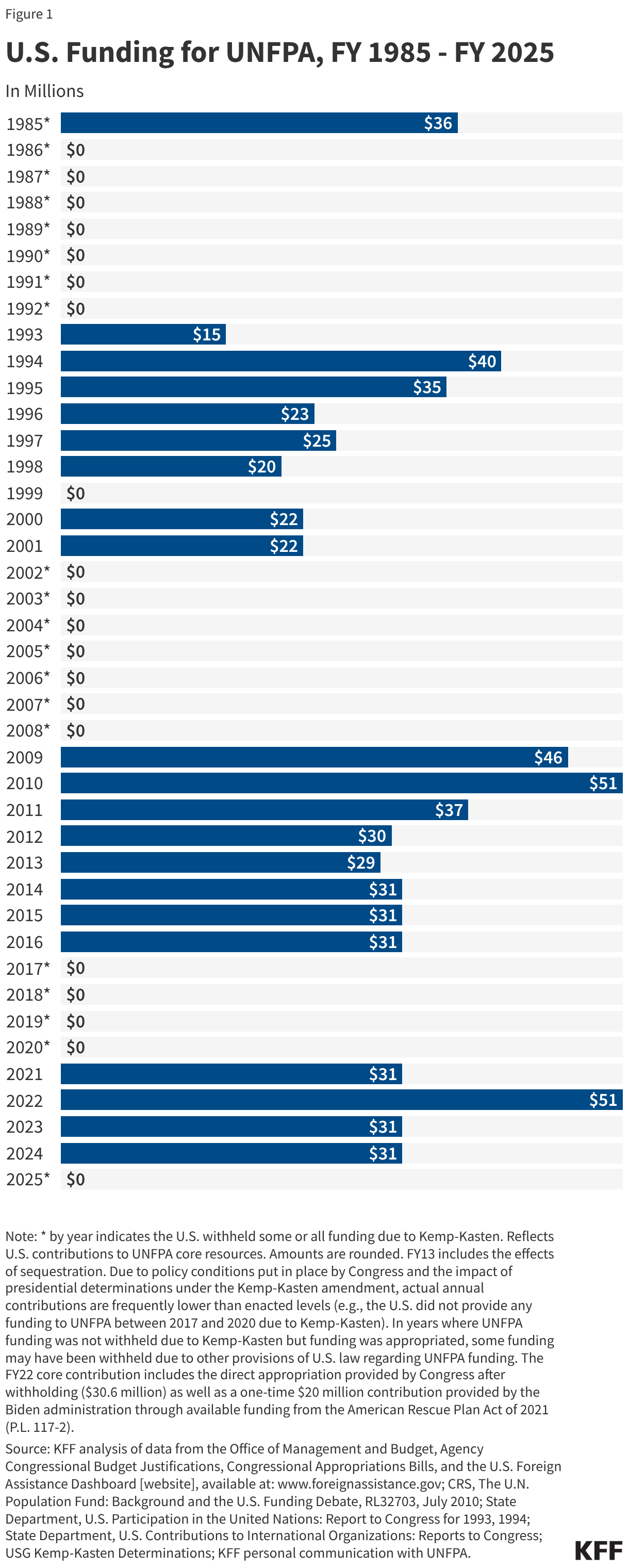
Historically, the United States was instrumental in the creation of UNFPA in 1969 and remained its largest donor for many years. However, since 1985, the U.S. has withheld core funding from the agency in 20 out of the last 41 fiscal years. These decisions have followed strict partisan lines: Republican administrations (Reagan, G.H.W. Bush, G.W. Bush, and Trump) have consistently invoked Kemp-Kasten to deny funding, while Democratic administrations (Clinton, Obama, and Biden) have consistently restored it.
The financial implications of these determinations are significant. In fiscal year 2024, the United States was the largest donor to UNFPA, contributing $231.8 million. This total included $30.5 million in "core support"—unearmarked funds that allow the agency to maintain its global infrastructure—and $201.3 million in "non-core" or earmarked support for specific humanitarian projects, such as maternal health kits in conflict zones. U.S. contributions represented approximately 17% of UNFPA’s total annual budget. When Kemp-Kasten is invoked, this entire stream of revenue is typically jeopardized, forcing the agency to seek alternative donors or scale back operations in high-need regions.
The 2025 Re-invocation and Current Status
Most recently, the Kemp-Kasten Amendment returned to the forefront of U.S. policy in early 2025. On January 24, 2025, during the opening days of his second term, President Donald Trump issued a presidential memorandum directing the Secretary of State to take all necessary steps to make a new determination regarding UNFPA. By May 2025, the administration officially invoked Kemp-Kasten, citing UNFPA’s continued partnership with the Chinese government as the basis for withholding funds.
The 2025 determination followed the logic of the 2017 justification, which acknowledged that while there was no direct evidence of UNFPA staff performing coercive procedures, the agency’s technical assistance and partnership with China’s National Health and Family Planning Commission constituted "participation in the management" of a coercive program. This "management" interpretation has been the primary point of contention between proponents of the amendment and global health advocates.
Assessing Evidence of Coercion
The debate over Kemp-Kasten often hinges on the definition of "participation" and "support." Over the decades, multiple independent investigations have sought to determine if UNFPA is complicit in human rights abuses. In 2002, a three-person assessment team sent to China by the Bush administration found "no evidence that UNFPA has knowingly supported or participated in the management of a program of coercive abortion or involuntary sterilization." Similar findings were reported by the British All-Party Parliamentary Group and various interfaith delegations.
Despite these findings, the U.S. government under Republican leadership has maintained that any involvement with a government that practices coercion is a violation of the spirit of the law. UNFPA, for its part, maintains a policy of "strict voluntarism" and argues that its presence in countries like China actually helps to move local policies toward international human rights standards. The agency emphasizes that it does not fund or promote abortion as a method of family planning, adhering to the consensus reached at the 1994 International Conference on Population and Development in Cairo.
Chronology of U.S.-UNFPA Funding (1985–2025)
- 1985: Kemp-Kasten is enacted. The Reagan administration withholds $10 million from UNFPA.
- 1986–1992: Funding remains withheld under the Reagan and G.H.W. Bush administrations.
- 1993–2001: The Clinton administration restores funding, arguing that UNFPA’s work is essential for maternal health.
- 2002: The G.W. Bush administration invokes Kemp-Kasten to withhold $34 million, despite the findings of its own assessment team.
- 2009–2016: The Obama administration restores funding, citing the need for global leadership in reproductive health.
- 2017–2020: The first Trump administration invokes Kemp-Kasten annually, redirecting funds to other USAID accounts.
- 2021–2024: The Biden administration restores record-level funding to UNFPA.
- 2025: The second Trump administration re-invokes Kemp-Kasten and initiates a process to cancel existing obligations.
Legislative Requirements and Financial Reallocation
When Kemp-Kasten is invoked, the withheld funds do not always return to the U.S. Treasury. Since fiscal year 2002, Congress has frequently included language requiring that any money withheld from UNFPA be reallocated to other "global family planning, maternal, and reproductive health activities" managed by USAID. This ensures that the overall "pot" of global health money remains the same, but the implementation shifts from a multilateral UN agency to various NGOs and bilateral programs.
However, this reallocation is not guaranteed. In 2025, for example, the Trump administration sought to "rescind" or permanently cancel the funding as part of a larger foreign aid reduction package. Furthermore, other legislative "riders" apply to UNFPA funding even when it is authorized. These include:
- Dollar-for-Dollar Withholding: The U.S. must reduce its contribution to UNFPA by the exact amount the agency spends in China.
- Segregated Accounts: UNFPA must keep U.S. funds in a separate account and ensure they are not used for abortion-related activities.
- Prohibition on Funding to China: No U.S. funds may be used for any UNFPA program within the borders of China.
Broader Implications for Global Health
The recurring invocation of the Kemp-Kasten Amendment has broader implications for U.S. foreign policy and global health outcomes. Critics of the amendment argue that withholding funds from UNFPA creates a "leadership vacuum" in humanitarian settings. UNFPA is often the lead agency providing reproductive health services in refugee camps and disaster zones, where NGOs may lack the scale to operate.
Conversely, proponents of the amendment argue that it is a necessary moral stand. They contend that U.S. taxpayers should not be forced to subsidize any organization that maintains a working relationship with regimes that violate bodily autonomy. They view the reallocation of funds to NGOs as a more effective and ethical way to provide family planning services without the political baggage of UN partnerships with authoritarian governments.
As the political landscape in the United States remains deeply polarized on reproductive rights, the Kemp-Kasten Amendment is likely to remain a volatile instrument of foreign policy. Its application continues to serve as a high-stakes barometer for how the U.S. balances its commitment to international human rights, its skepticism of multilateral institutions, and its internal ideological debates. For the millions of women and girls served by UNFPA programs globally, the annual determination of the Kemp-Kasten Amendment remains a pivotal event that dictates the availability of essential health services.