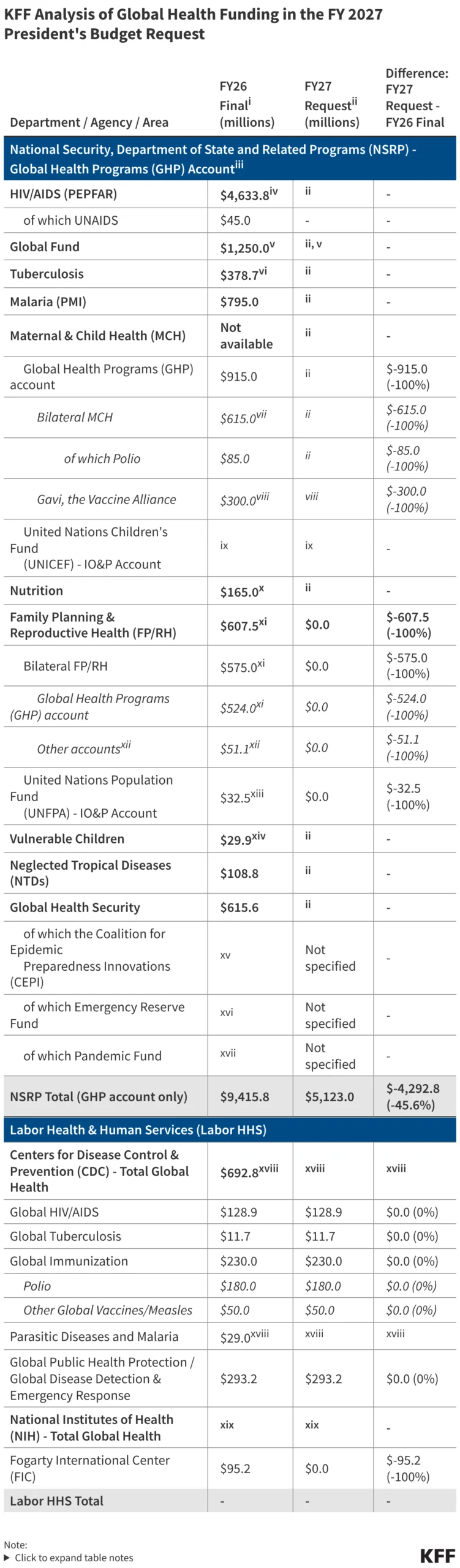
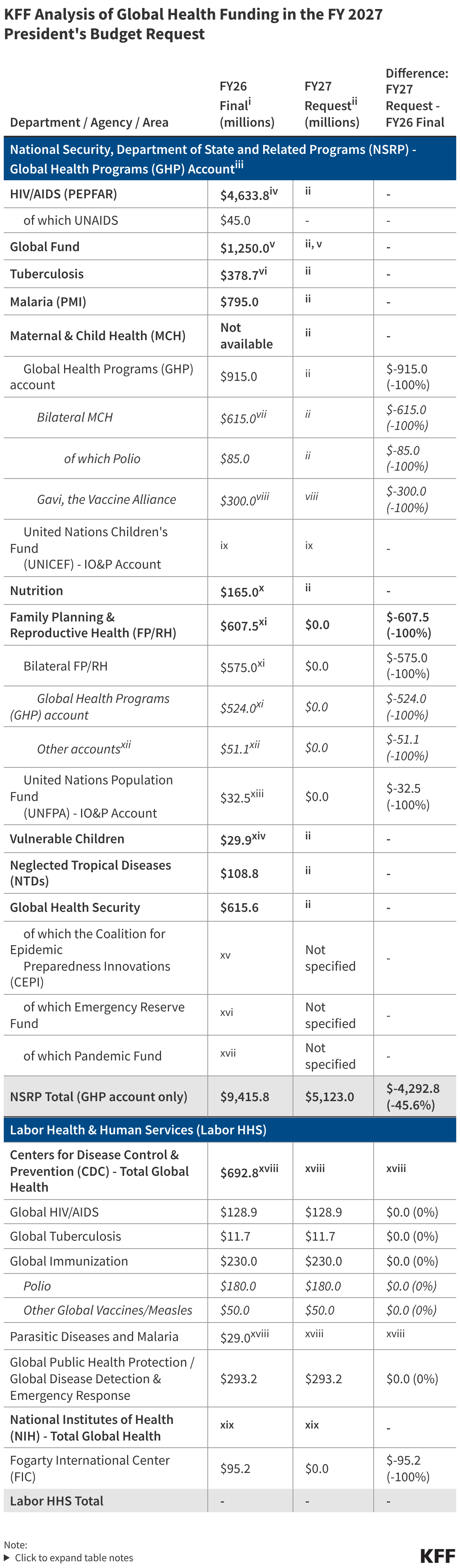
The administration released its Fiscal Year (FY) 2027 budget request on April 3, 2026, outlining a significant shift in the United States’ approach to international development and global health assistance. The proposal, which serves as the executive branch’s blueprint for federal spending, includes discretionary funding for U.S. global health programs across three primary entities: the Department of State, the Centers for Disease Control and Prevention (CDC), and the National Institutes of Health (NIH). Most notably, the request calls for a substantial restructuring of existing frameworks and a reduction in overall funding levels, including the elimination of several long-standing programs and activities that have defined U.S. global health policy for more than two decades.
The FY 2027 request arrives at a critical juncture for international health. While the world continues to move beyond the acute phase of the COVID-19 pandemic, new challenges including emerging infectious diseases, the impacts of climate change on health, and stagnant progress in the fight against HIV/AIDS, tuberculosis, and malaria have kept global health at the forefront of the foreign policy debate. The proposed budget suggests a prioritization of domestic fiscal constraints and a leaner approach to overseas obligations, marking a departure from the expansionary trends seen in previous years.
Strategic Restructuring at the Department of State
The Department of State traditionally oversees the largest portion of U.S. global health spending, primarily through the Office of the U.S. Global AIDS Coordinator and Health Diplomacy, which manages the President’s Emergency Plan for AIDS Relief (PEPFAR). In the FY 2027 request, the administration has proposed a comprehensive restructuring of these accounts.
Under the new proposal, several targeted initiatives within the State Department’s portfolio are slated for consolidation or elimination. Historically, PEPFAR has been the cornerstone of U.S. global health efforts, receiving bipartisan support since its inception in 2003. However, the FY 2027 request indicates a move toward "country-led sustainability," which critics argue is a euphemism for reduced direct financial support. The administration’s justification centers on the premise that partner nations should assume a greater share of the financial burden for their domestic health responses, particularly in middle-income countries that have seen significant economic growth.
The proposed budget also impacts U.S. contributions to multilateral organizations. The Global Fund to Fight AIDS, Tuberculosis and Malaria, a partnership that relies heavily on U.S. leadership, faces a proposed reduction in the FY 2027 request. This follows a period of intense debate regarding the U.S. "matching" requirement, where the U.S. traditionally provides one dollar for every two dollars provided by other donors. A reduction in this request could potentially trigger a downward trend in global contributions, as other nations often peg their commitments to the level of U.S. involvement.
Reductions in CDC Global Health Operations
The Centers for Disease Control and Prevention (CDC) plays a vital role in global health security, providing technical expertise and ground-level support for disease surveillance and laboratory capacity building. The FY 2027 budget request proposes a contraction of the CDC’s global footprint.
Key areas of the CDC’s global health portfolio, including Global Health Security (GHS) and the Division of Global HIV & TB (DGHT), are targeted for funding decreases. The GHS programs are designed to help countries prevent, detect, and respond to infectious disease outbreaks at their source. The administration’s proposal suggests a shift toward a more reactive model, focusing resources on immediate threats rather than long-term capacity building. This move has raised concerns among public health experts who argue that weakening global surveillance infrastructure leaves the United States more vulnerable to the next pandemic.

Furthermore, the budget request includes the elimination of specific regional CDC hubs that were established to provide localized expertise in areas like Southeast Asia and Eastern Africa. The administration posits that these functions can be centralized or managed remotely to save costs, though field reports often emphasize the importance of having "boots on the ground" to facilitate rapid response during health emergencies.
Impact on Research and Innovation at the NIH
The National Institutes of Health (NIH), particularly through the Fogarty International Center and the National Institute of Allergy and Infectious Diseases (NIAID), is the primary engine for global health research. The FY 2027 budget request proposes a significant scale-back in international research grants and collaborative studies.
The Fogarty International Center, which has a relatively small budget but a massive impact on training the next generation of global health researchers, faces a proposed reduction that could limit its ability to support scientists in low- and middle-income countries. Additionally, NIAID’s international research on neglected tropical diseases and vaccine development for pathogens with pandemic potential is slated for a "prioritization review," which often serves as a precursor to funding cuts.
The administration argues that the NIH should focus its research efforts on domestic health challenges, such as the aging population and the opioid crisis, suggesting that global health research should be increasingly funded by private philanthropy and international partners. However, the NIH’s role in developing the foundational science for tools like the mRNA vaccine platform demonstrates that international research often yields significant domestic benefits.
Chronology of the FY 2027 Budget Process
The release of the President’s budget request on April 3, 2026, is merely the first step in a long and complex legislative process. To understand the implications of this proposal, it is necessary to view it within the broader timeline of the federal fiscal cycle:
- April 3, 2026: The Executive Branch submits the FY 2027 Budget Request to Congress, detailing the administration’s policy priorities and proposed spending levels.
- April – June 2026: Congressional committees, including the House and Senate Appropriations Committees, hold hearings to examine the request. Agency heads from the State Department, CDC, and NIH are called to testify and defend the proposed cuts.
- July – September 2026: The House and Senate develop their respective versions of the appropriations bills. Historically, Congress has often restored funding for global health programs that administrations have sought to cut, reflecting a long-standing bipartisan consensus on the value of these initiatives.
- October 1, 2026: The start of Fiscal Year 2027. If a full budget is not passed by this date, Congress must pass a Continuing Resolution (CR) to keep the government funded at current levels, or face a government shutdown.
- Late 2026 – Early 2027: Final negotiations typically occur, leading to an "omnibus" spending bill that sets the actual funding levels for the remainder of the fiscal year.
Supporting Data and Financial Context
The proposed reductions must be viewed against the backdrop of historical funding levels. In FY 2025 and FY 2026, U.S. global health funding remained relatively stable, hovering between $12 billion and $13 billion annually across all agencies. Preliminary analysis of the FY 2027 request suggests a proposed total reduction of approximately 15% to 20% compared to FY 2026 enacted levels.
Specifically, the "Global Health Programs" (GHP) account at the State Department, which includes PEPFAR and USAID-managed programs for malaria, maternal and child health, and nutrition, would see a decrease from approximately $9 billion to $7.2 billion under the administration’s plan. The CDC’s global health budget, which had seen increases during the COVID-19 era to nearly $700 million, would be reduced to under $500 million, a level not seen since the pre-2014 Ebola outbreak period.
Official Responses and Inferred Reactions
While the administration has defended the budget as a "responsible fiscal roadmap that prioritizes the American taxpayer," the response from the global health community has been swift and largely critical.
Non-governmental organizations (NGOs) and advocacy groups, such as the Global Health Council and the ONE Campaign, have issued statements warning that the proposed cuts could lead to a resurgence of preventable diseases. "A retreat of this magnitude from the U.S. would create a leadership vacuum that our adversaries are all too eager to fill," noted one policy analyst. "Global health is not just a humanitarian issue; it is a national security issue. Pathogens do not respect borders."
On Capitol Hill, reactions have been mixed. Some fiscal hawks in the House of Representatives have signaled support for the administration’s efforts to trim overseas spending. Conversely, several members of the Senate Foreign Relations Committee have expressed concern that the cuts would undermine decades of progress and damage U.S. diplomatic relations, particularly in Sub-Saharan Africa.
Analysis of Implications and Broader Impact
The implications of the FY 2027 budget request extend far beyond the balance sheets of federal agencies. If enacted, these reductions could have several cascading effects on global stability and public health:
1. Reversal of Gains in HIV and Malaria Control:
PEPFAR and the Global Fund have been credited with saving over 25 million lives. A significant reduction in funding could lead to "drug stockouts" in clinics across Africa and Asia, leading to increased viral loads, higher transmission rates, and the development of drug-resistant strains of HIV and TB.
2. Erosion of Global Health Security:
By cutting CDC funding for disease surveillance, the U.S. reduces its ability to catch outbreaks before they become global pandemics. This "blind spot" in the global health architecture increases the risk of future economic disruptions similar to those experienced during the 2020-2022 period.
3. Diminished Soft Power:
Global health assistance is one of the most effective tools in the U.S. diplomatic toolkit. Programs that provide clean water, vaccines, and maternal care generate significant goodwill toward the United States. A withdrawal from these programs could allow other global powers to expand their influence through "health diplomacy," potentially shifting geopolitical alliances.
4. Economic Impact on the U.S. Bio-pharmaceutical Sector:
Much of the funding for global health programs is used to purchase American-made medicines, diagnostic tools, and services. A reduction in the global health budget could have a secondary impact on domestic industries that support international aid efforts.
As the budget process moves to Congress, the debate will likely center on whether the proposed "restructuring" is a necessary evolution of foreign aid or a dangerous retreat from global responsibilities. While the administration’s request sets the stage, the final funding levels for FY 2027 will depend on the willingness of lawmakers to maintain the United States’ role as the world’s leading donor in global health. The coming months of testimony and negotiation will determine the future of programs that millions of people around the world rely on for survival.