The implementation of the 2025 reconciliation law represents one of the most significant administrative shifts in the history of the Medicaid program, mandating that 44 states establish work requirements for specific enrollee populations. Beginning January 1, 2027, adults within the Affordable Care Act (ACA) Medicaid expansion group, as well as certain enrollees in 1115 waiver programs—including those in non-expansion states such as Georgia, Tennessee, and Wisconsin—must meet these "community engagement" or "activity" requirements to maintain their health coverage. This federal mandate necessitates a massive overhaul of state eligibility and enrollment systems, requiring sophisticated technological updates and a multi-tiered communication strategy to reach millions of potentially affected individuals.
The Regulatory Framework and Implementation Timeline
The path toward the 2027 implementation began in earnest on June 1, 2026, when the Centers for Medicare and Medicaid Services (CMS) issued a long-anticipated interim final rule. This rule serves as the primary guidance for states, outlining the rigorous standards for outreach, notification, and compliance monitoring. The timeline is exceptionally tight, creating a high-pressure environment for state Medicaid agencies that are already grappling with limited workforce capacity and aging infrastructure.
Under the law, states must send targeted outreach notices to enrollees at least three months prior to the first "lookback" month. For the majority of states (36, according to recent surveys) that have opted for a one-month lookback period to verify compliance, the first lookback month will be December 2026. This necessitates that initial outreach notices be mailed no later than September 2026. However, states like Idaho and Indiana, which intend to implement a three-month lookback period, must begin their formal notification processes as early as July 2026.
This chronology places an immediate burden on state agencies to finalize their communication materials. The CMS rule mandates that notices must be delivered via at least two different modalities. This typically includes traditional mail and one additional electronic format, such as text messaging, email, or notifications through a dedicated online portal. The goal is to ensure that the "churn" often associated with Medicaid—where enrollees lose coverage due to address changes or lost mail—is minimized through redundant communication channels.
Lessons from the Great Unwinding
State officials are not approaching this challenge in a vacuum. The recent "Medicaid unwinding"—the process of redetermining eligibility for all enrollees following the end of the COVID-19 Public Health Emergency—provided a blueprint for large-scale administrative transitions. During the unwinding, states discovered that clear, plain-language communication was the single most important factor in preventing procedural disenrollment (loss of coverage due to paperwork errors rather than actual ineligibility).
Data from the 23rd annual budget survey of Medicaid officials indicates that partnerships with Managed Care Organizations (MCOs) and community-based organizations were vital during the unwinding. For the 2027 work requirements, states are expected to lean even more heavily on these partners. MCOs, which often have more frequent contact with enrollees than the state agencies themselves, are being tapped to provide education on how to prepare documents for work program appointments and how to navigate the complex web of exemptions.
The Complexity of Targeted Outreach
One of the most significant hurdles in the upcoming implementation is the complexity of the "expansion adult" category. Not all Medicaid enrollees are subject to work requirements, and the criteria for exemptions are nuanced. Federal law requires states to exempt individuals who are medically frail, pregnant or postpartum, and parents or caretakers of dependent children under the age of 14.
The CMS interim final rule introduced a surprising requirement: states must send notices to all expansion adults and applicable waiver enrollees, even if the state believes an individual might eventually qualify for an exemption. CMS justifies this by noting that state databases often lack real-time information on an enrollee’s health status or family changes. For example, an individual might become "medically frail" or a parent might have a change in household composition between the time a notice is sent and the requirement takes effect.
This "broad-brush" notification strategy carries the risk of causing unnecessary alarm. To mitigate this, states are tasked with developing "screening tools" and "unofficial calculators." New Jersey and West Virginia have already taken the lead in this area, developing web-based tools that allow enrollees to answer a series of questions to determine if they are likely subject to the requirements.
Administrative and Workforce Challenges
The technical demands of the 2025 reconciliation law extend beyond simple mailers. State eligibility systems must be programmed to track hours of work, job training, or community service on a monthly basis. This requires data integration between state Medicaid agencies and Department of Labor "American Job Centers."
Furthermore, call center capacity remains a critical concern. During previous eligibility shifts, call wait times in many states spiked to several hours, leading to high abandonment rates. To meet the 2027 mandate, states are considering expanding call center hours beyond the traditional 9-to-5 window, as many of the individuals subject to work requirements may already be working part-time jobs that prevent them from calling during business hours.
Budgetary constraints also loom large. While the federal government provides a match for administrative costs, the initial investment required for system upgrades and mass media campaigns is substantial. States are currently navigating their legislative sessions to secure the necessary funding for these "readiness" activities.
Strategies for Broad Community Engagement
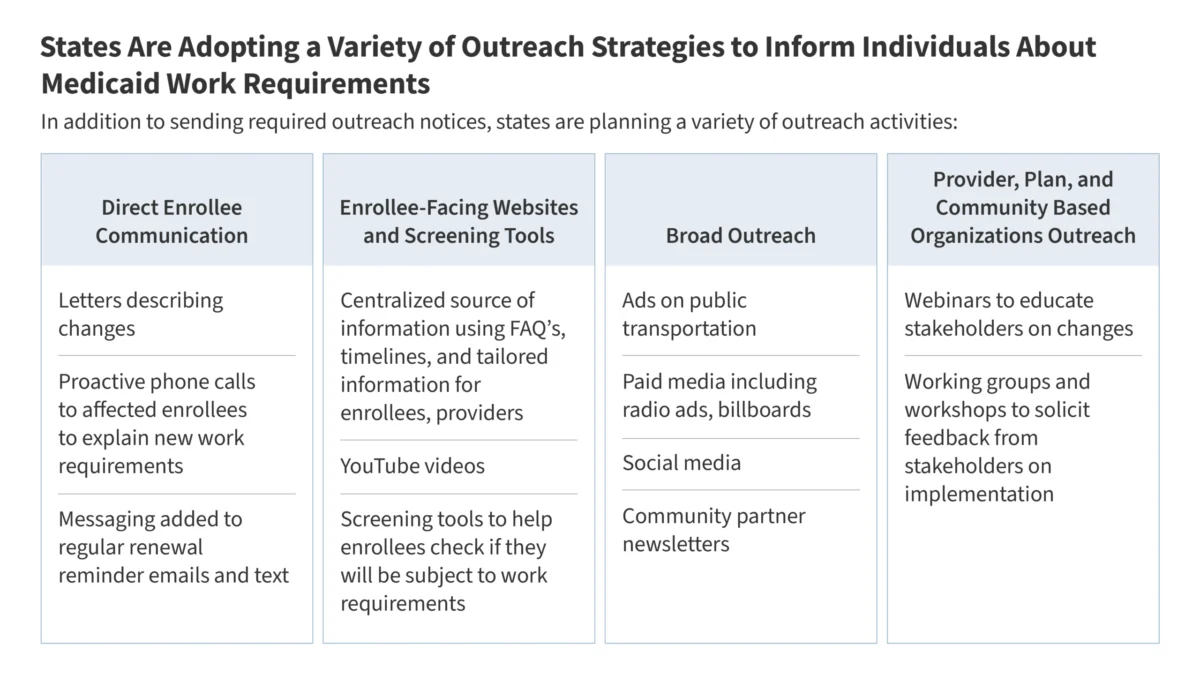
Beyond direct mail and digital alerts, states are planning "road shows" and social media blitzes. The challenge with broad outreach is the risk of confusing populations that are entirely unaffected by the law, such as seniors (those 65 and older) or those receiving Supplemental Security Income (SSI).
A specific area of concern involves parents. In many states, parents with very low incomes are covered through a "mandatory" pathway and are exempt from work requirements. However, parents with slightly higher incomes may be covered through the "expansion" pathway and thus are subject to the new rules if their children are 14 or older. Explaining this distinction to a layperson requires a level of linguistic precision that many state notices have historically lacked.
To address this, states like Nebraska and Montana have begun sharing draft notices with Medicaid Advisory Committees (MACs) and advocacy groups to ensure the reading level is appropriate—ideally at or below a 6th-grade level—and that the instructions for proving an exemption are clear.
Broader Implications and Analysis
The shift toward Medicaid work requirements reflects a broader national debate over the role of the social safety net. Proponents of the 2025 reconciliation law argue that these requirements encourage labor force participation and help transition individuals from public assistance to employer-sponsored insurance. They point to the potential for work requirements to foster "community engagement" and provide enrollees with access to job training resources that were previously underutilized.
However, healthcare analysts and advocacy organizations express concern that the administrative complexity will lead to a significant "coverage gap." They cite the experience of Arkansas in 2018, where thousands of individuals lost coverage not because they weren’t working, but because they found the reporting website difficult to navigate or lacked stable internet access to log their hours.
The fiscal impact on providers is another consideration. If large numbers of enrollees lose coverage due to procedural hurdles, hospitals and primary care providers may see an increase in uncompensated care costs. To counter this, many states are developing "provider toolkits," enabling doctors and clinic staff to help patients understand the new requirements during routine medical visits.
Conclusion: A Test of State Administrative Agility
As January 1, 2027, approaches, the success of the Medicaid work requirement implementation will depend less on the policy itself and more on the efficacy of state-level administration. The coming months will be a period of intense activity, as states finalize their interim rules, upgrade their IT infrastructures, and launch unprecedented outreach campaigns.
The lessons learned from the post-pandemic "unwinding" suggest that transparency, partnership, and multi-channel communication are the most effective tools for protecting eligible enrollees. Whether states can successfully navigate the tight timelines and complex regulatory requirements of the 2025 reconciliation law remains to be seen, but the groundwork being laid in 2026 will undoubtedly determine the health security of millions of Americans for years to come.