The United States government maintains its position as the largest donor to global health in the world, supporting comprehensive health programs in over 80 countries through a sophisticated network of bilateral agreements, regional initiatives, and contributions to multilateral organizations. As of Fiscal Year (FY) 2024, these efforts represent a cornerstone of American foreign policy, aimed not only at addressing humanitarian crises but also at bolstering global stability and national security. By deploying resources across diverse health sectors—including HIV/AIDS, malaria, tuberculosis, and maternal health—the U.S. seeks to build resilient health systems capable of preventing, detecting, and responding to infectious disease outbreaks before they become global pandemics.
The current landscape of U.S. global health involvement is defined by its multifaceted approach, where programs often overlap within a single partner country to provide a holistic "wrap-around" service model. According to the latest data trackers, the U.S. bilateral global health portfolio is organized into several key program areas: the President’s Emergency Plan for AIDS Relief (PEPFAR), the President’s Malaria Initiative (PMI), Tuberculosis (TB) control, Family Planning and Reproductive Health (FP/RH), Maternal and Child Health (MCH), Nutrition, and the increasingly critical field of Global Health Security.
The Strategic Pillars of U.S. Global Health Policy
At the heart of the U.S. global health strategy is PEPFAR, an initiative launched in 2003 that remains the largest commitment by any nation to address a single disease. In FY 2024, PEPFAR continues to operate in dozens of countries, focusing on achieving the UNAIDS "95-95-95" targets: ensuring 95% of people living with HIV know their status, 95% of those diagnosed are on antiretroviral therapy (ART), and 95% of those on ART achieve viral suppression. Beyond the clinical treatment of HIV, PEPFAR has been instrumental in strengthening laboratory systems and supply chains that have subsequently been utilized for other health emergencies, including the COVID-19 pandemic.
The President’s Malaria Initiative (PMI), another flagship program, focuses on reducing malaria-related mortality and morbidity. Led by the U.S. Agency for International Development (USAID) and implemented in conjunction with the Centers for Disease Control and Prevention (CDC), PMI provides life-saving interventions such as insecticide-treated bed nets, indoor residual spraying, and rapid diagnostic tests. In FY 2024, the initiative has expanded its reach, particularly in Sub-Saharan Africa and the Greater Mekong Subregion, where drug-resistant malaria remains a significant threat.
Global Health Security (GHS) has seen a dramatic increase in prioritization following the disruptions caused by COVID-19. This program area focuses on the "Global Health Security Agenda," which seeks to help countries meet the requirements of the International Health Regulations. The goal is to ensure that every nation has the capacity to stop an outbreak at its source. In FY 2024, GHS programs are active in more than 50 countries, focusing on zoonotic disease surveillance, workforce development, and emergency management systems.
Historical Evolution and Chronology of Engagement
The trajectory of U.S. global health assistance has evolved from modest, localized efforts in the mid-20th century to the massive, integrated global programs seen today.
- 1961: The Foreign Assistance Act is signed into law, creating USAID and formalizing health assistance as a component of U.S. development policy.
- 1990s: U.S. efforts begin to focus more heavily on infectious diseases and child survival, responding to the escalating HIV epidemic and high rates of preventable childhood deaths.
- 2003: President George W. Bush announces PEPFAR during the State of the Union address, signaling a massive scale-up in funding and political will.
- 2005: The President’s Malaria Initiative is launched, aiming to reduce malaria deaths by 50% in target countries.
- 2009: The Global Health Initiative (GHI) is introduced under the Obama administration, emphasizing the integration of various health programs to improve overall health system performance.
- 2014: The Global Health Security Agenda (GHSA) is launched in response to the Ebola outbreak in West Africa, shifting focus toward pandemic preparedness.
- 2020-2023: The U.S. leads global efforts to combat COVID-19, providing billions in supplemental funding and donating over 600 million vaccine doses worldwide.
- 2024: The focus shifts toward "localization"—transitioning the leadership and implementation of health programs to local governments and indigenous non-governmental organizations (NGOs) to ensure long-term sustainability.
Supporting Data and Funding Mechanisms
The scale of U.S. investment is reflected in the FY 2024 budget allocations. While total funding for global health fluctuates based on Congressional appropriations, the U.S. typically invests between $10 billion and $12 billion annually through bilateral and multilateral channels.
Data from the Kaiser Family Foundation (KFF) tracker indicates that the majority of these funds are directed toward Sub-Saharan Africa, which receives approximately 60-70% of bilateral health assistance due to the high burden of infectious diseases in the region. Asia and the Near East follow, with significant investments in maternal health and family planning.
In FY 2024, the "Number of Countries" metric reveals a broad footprint:
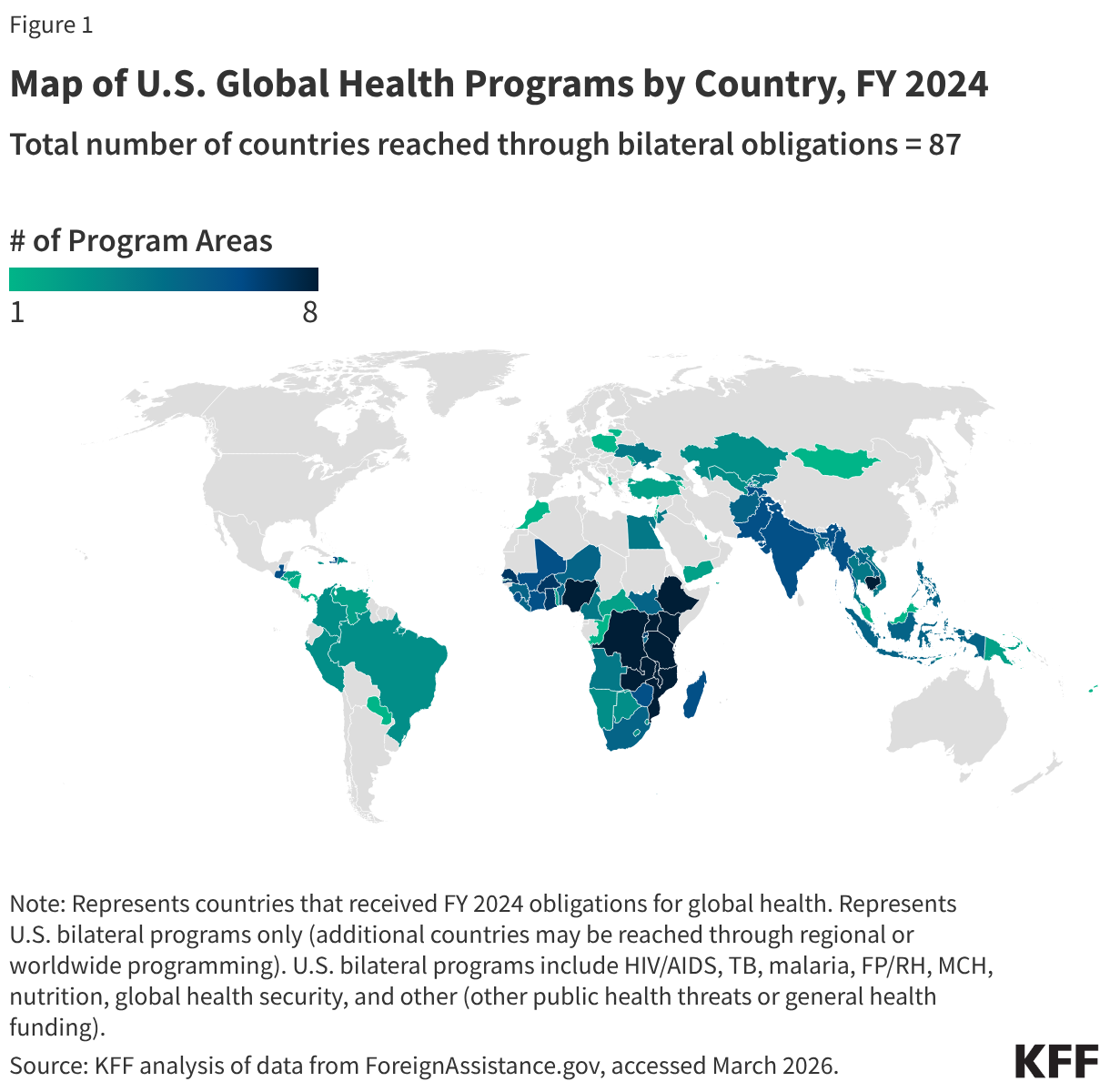
- PEPFAR: Active in over 50 countries/regions.
- Maternal and Child Health: Active in approximately 25-30 "priority" countries with the highest mortality rates.
- Global Health Security: Expanded to over 50 countries to meet the 2024 goal of helping partner nations achieve "demonstrated capacity" in technical areas like immunization and real-time surveillance.
Funding is distributed through several key agencies. USAID manages the largest portion of the budget, focusing on long-term development and health system strengthening. The CDC provides technical expertise and supports surveillance and laboratory capacity. Additionally, the Department of State oversees the diplomatic coordination of PEPFAR, while the Department of Health and Human Services (HHS) engages in high-level multilateral policy.
Official Responses and Stakeholder Perspectives
The continuation of these programs in FY 2024 has drawn praise from international health bodies and domestic policymakers alike, though it is not without debate.
Ambassador Dr. John Nkengasong, the U.S. Global AIDS Coordinator, has frequently emphasized that the mission of PEPFAR is moving toward "sustaining the gains" while closing the gaps in pediatric HIV treatment. In recent statements, he noted that the U.S. commitment is not just about health outcomes, but about "economic productivity and regional security."
On the Congressional front, global health remains one of the few areas of consistent, albeit sometimes precarious, bipartisan support. Proponents argue that health assistance is a "force multiplier" that prevents the collapse of fragile states. However, some lawmakers have called for increased oversight and a greater emphasis on "burden-sharing," urging other wealthy nations and domestic governments in partner countries to increase their own financial contributions.
International partners, such as the World Health Organization (WHO) and the Global Fund to Fight AIDS, Tuberculosis and Malaria, view U.S. bilateral programs as essential complements to their own work. "The U.S. bilateral presence provides the technical backbone upon which many multilateral efforts rely," noted a spokesperson for the Global Fund, highlighting how U.S.-funded supply chains often deliver the medicines purchased by the Fund.

Broader Impact and Future Implications
The implications of U.S. global health programs extend far beyond the clinical setting. By reducing the burden of disease, these initiatives foster economic growth. Healthy populations are better able to participate in the workforce, children are more likely to stay in school, and families are less likely to fall into extreme poverty due to catastrophic health expenditures.
Furthermore, the U.S. uses its health leadership as a tool of "soft power." By being the primary responder to health crises, the U.S. strengthens its diplomatic ties and counteracts the influence of other global actors who may use health aid for more transactional political gains.
However, as we move through 2024, several challenges loom. The "plateauing" of global health funding in the face of domestic fiscal constraints in the U.S. poses a risk to the progress made over the last two decades. There is also the challenge of "transitioning"—shifting the financial and operational responsibility of health programs to host-country governments. This requires significant political will from partner nations, many of whom are facing their own economic headwinds.
Another critical implication for the future is the integration of climate change into health programming. In FY 2024, USAID and other agencies have begun to acknowledge the link between environmental shifts and the spread of vector-borne diseases like malaria and dengue. Future programs will likely need to be "climate-resilient," ensuring that health clinics can operate during extreme weather events and that surveillance systems can track the changing geographic range of pathogens.
The FY 2024 data provided by trackers like those from KFF serves as a vital tool for transparency and accountability. It allows researchers, policymakers, and the public to see exactly where American tax dollars are going and what health outcomes they are buying. As the U.S. continues to navigate a complex post-pandemic world, its role in global health remains a defining feature of its identity on the world stage—a blend of scientific leadership, humanitarian impulse, and strategic necessity.