
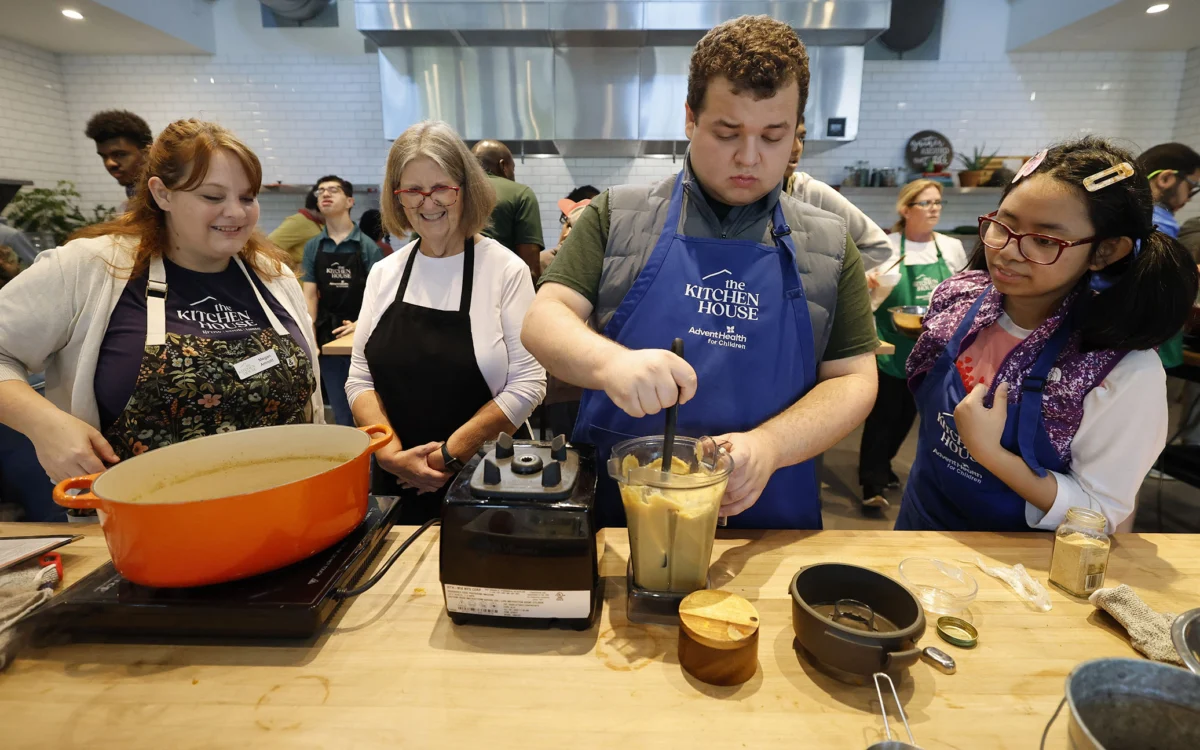
ORLANDO, Fla. – In a world often defined by limitations, a group of young adults from Quest Kids Academy recently redefined what’s possible, transforming a professional kitchen into a vibrant hub of learning, laughter, and culinary triumph. Sixteen teenagers and young adults, most of whom navigate daily life with the assistance of caregivers, embarked on an extraordinary mission: to prepare and share a four-course "friendsgiving" feast, a testament to their burgeoning independence and remarkable capabilities.
n
This wasn’t merely a cooking class; it was a comprehensive life skills workshop, meticulously designed to equip these students with intellectual and developmental disabilities with essential tools for a more self-sufficient future. From the meticulous act of slicing vegetables to the intricate calculations of budgeting, every task served as a stepping stone toward greater autonomy, culminating in a heartwarming meal shared around a communal table in College Park.
n
"I’ve never chopped celery before," declared Sebastian Baez, a spirited 20-year-old with autism, his eyes alight with concentration as he wielded a stainless-steel chef’s knife with newfound confidence. "I love using the knife." His simple joy underscored the profound impact of experiences that, for many, are commonplace, but for these students, represent significant breakthroughs.
n
The initiative, a collaborative effort between Quest Kids Academy, The Kitchen House, and the FAIRWINDS Foundation, offered a powerful demonstration of how targeted support and inclusive opportunities can unlock incredible potential. It illuminated a path where challenges are met with innovative solutions, and every small victory contributes to a larger narrative of empowerment and dignity.
n
Main Facts: A Day of Discovery and Determination
n
On a brisk Monday morning in College Park, Orlando, the air at The Kitchen House buzzed with an unusual blend of focused determination and infectious excitement. Sixteen students from Quest Kids Academy, a dedicated institution for children and young adults with intellectual and developmental disabilities, were poised to embark on an ambitious culinary adventure. Their mission: to meticulously prepare a four-course "friendsgiving" meal, an undertaking designed not just to tantalize taste buds but to cultivate crucial life skills.
n
The participants, ranging from teenagers to young adults, typically rely on caregivers for various daily tasks. However, this day presented a unique opportunity for them to step into roles demanding independence, teamwork, and precision. Under the expert guidance of their culinary teacher, Kristy Chadwich, and supported by staff and volunteers from The Kitchen House, they were tasked with everything from scaling recipes and managing budgets to the intricate art of chopping, stirring, and baking.
n
Among the standout participants were Sebastian Baez, whose delight in mastering knife skills became a symbol of breaking new ground; Jeremiah Feliciano, whose perseverance in a physically demanding task inspired all; Madison Seminio, whose joyful engagement with vegetable preparation showcased her growing confidence; and Luke Krantz, whose quiet enthusiasm for cooking found its voice in the aromatic symphony of the kitchen.
n
The feast itself was a carefully curated menu of comforting classics with a healthy twist: mac and cheese infused with cauliflower and squash, savory stuffing, a vibrant green bean casserole, and delectable pumpkin bars. Each dish represented a collective achievement, a tangible outcome of lessons learned and skills honed.
n
This transformative program was made possible by a generous $25,000 grant from the FAIRWINDS Foundation, an organization committed to fostering financial stability within communities. The choice of venue, The Kitchen House – a unique facility with an industrial kitchen and garden acquired by the Emeril Lagasse Foundation – further underscored the program’s commitment to promoting healthy cooking and hands-on culinary education. This synergistic partnership created an ideal environment for experiential learning, allowing students to connect directly with the source of their ingredients and the process of transforming them into a nourishing meal.
n
Chronology: From Prep to Plate, A Step-by-Step Achievement
n
The "friendsgiving" feast was not a spontaneous event but the culmination of weeks of diligent preparation, each phase meticulously designed to build a scaffold of skills for the students. The journey began long before the first vegetable was chopped, embedding practical lessons in the fabric of their daily learning.
n
Weeks of Pre-Feast Preparation: Laying the Foundation
n
In the weeks leading up to the main event, the Quest Kids Academy students engaged in a series of immersive, hands-on lessons focused on financial literacy and consumer awareness. This critical phase moved beyond theoretical concepts, bringing the abstract idea of money into tangible, real-world scenarios. Students were entrusted with small amounts of cash, initiating them into the practicalities of budgeting. Accompanied by instructors, they embarked on shopping trips to local grocery stores and even ventured out to eat, each excursion serving as a live classroom. The challenge was clear: how much could they spend? They learned to compare prices, make informed choices, and understand the direct correlation between their decisions and their remaining funds. This wasn’t just about saving money; it was about understanding its value, its limitations, and its power to facilitate independence. Lauren Nelson, Quest’s vice president of philanthropy, emphasized this core objective: "We’re looking at, how do we get them to understand the value and benefit of money and what that means for them." These repeated exercises instilled a foundational understanding of fiscal responsibility, a cornerstone for living independently.
n
The Day of the Feast: A Symphony of Senses and Skills
n
The morning of the feast began not with cooking, but with a practical application of mathematics, directly linking their academic learning to the culinary task at hand. Gathered around a large table, the students faced a formidable challenge: a recipe designed to feed 100 people. Collaboratively, with guidance from their teachers, they tackled the complex task of scaling it down to accommodate their smaller group of 16. This exercise in proportion and measurement was a critical precursor to ensuring the success of their meal, highlighting the practical utility of abstract mathematical concepts.
n
Following this mental warm-up, the students received a captivating tour of The Kitchen House’s vibrant garden. Here, they walked among rows of growing produce, witnessing firsthand where some of the very ingredients they would soon be preparing originated. This sensory experience, touching the soil and smelling the fresh herbs, forged a deeper connection to their food, fostering an appreciation for healthy, locally sourced ingredients—a key tenet championed by The Kitchen House. Sara Elliott, co-executive director of the Kitchen House, underscored this philosophy: "We’re really trying to teach people to put more plants on their plate."
n
Upon entering the expansive industrial kitchen, the students were divided into four distinct groups, each assigned specific tasks crucial to the preparation of the four-course menu. Kristy Chadwich, Quest’s culinary teacher, orchestrated this division, ensuring that tasks were tailored to individual abilities while still pushing students to expand their comfort zones. At each station, a dedicated Kitchen House staff member or volunteer provided patient guidance and support, fostering an environment of encouragement and safety.
n
The kitchen quickly came alive with activity. Sebastian Baez, the 20-year-old with autism, found his rhythm at the chopping station, his initial hesitation giving way to palpable pride as he expertly sliced celery. The gleam of the stainless-steel knife in his hand symbolized a new frontier of capability. "I love using the knife," he reiterated, his focus unwavering, a testament to the empowering nature of mastering a new skill.
n
Nearby, Madison Seminio, a 17-year-old also with autism, radiated joy as she diligently chopped cauliflower for the mac and cheese. Her wide smile spoke volumes about her engagement and satisfaction. Erin Hennessy, Quest’s youth employment specialist, observed Madison’s work, articulating the deeper lessons being absorbed. "She’s learning much more than how to chop vegetables," Hennessy explained. "She’s learning how to follow multi-step instructions, how to complete a task, and the importance of being at her station and ready to work when it’s time to start." These, Hennessy noted, are foundational employment skills, often needing explicit instruction for individuals with developmental disabilities.
n
In another corner, Luke Krantz, a quiet 20-year-old with autism, transformed onions for the stuffing. Though shy and often reserved, Luke’s passion for culinary arts was evident in his precise knife work. As his finely chopped onions, carrots, and celery hit the hot pot, releasing a fragrant aroma that filled the room, Luke’s quiet demeanor broke. He spontaneously jumped up and down, clapping his hands in a pure expression of delight and accomplishment. It was a moment where his inner joy became outwardly manifest, a powerful illustration of the emotional rewards of creation.
n
Perhaps one of the most poignant moments unfolded with Jeremiah Feliciano, a 19-year-old whose physical disability typically restricts his ability to stand for extended periods. Kristy Chadwich, his teacher, habitually carried a lawn chair for him, ensuring he always had a place to rest. Yet, on this day, Jeremiah spent a remarkable 30 minutes on his feet, tirelessly whipping fresh cream to perfection for the pumpkin bars. The physical exertion was immense. "After I was done, I couldn’t feel my arm," Jeremiah recounted later, his voice brimming with pride. "It makes me feel great." Chadwich, witnessing this extraordinary feat, literally jumped with joy. "Just knowing what he’s capable of, and that he is able to achieve that, and stand for long periods of time in the kitchen is so great," she exclaimed, her voice tinged with admiration for his resilience and newfound stamina.
n
The kitchen, once a quiet space, became a vibrant tableau of collaborative effort. The clatter of pots and pans, the sizzle of ingredients, the gentle murmur of instruction, and bursts of laughter created a harmonious backdrop to the students’ focused work. The aromas of roasting vegetables and simmering spices began to intermingle, promising a delicious outcome.
n
Finally, with the last dish plated, the students transitioned from their workstations to a long, beautifully set table nestled within The Kitchen House’s serene garden. The feast, a testament to their collective efforts, was laid out before them. As they savored the fruits of their labor, a reflective moment invited them to share one thing they were grateful for. The responses were diverse and heartfelt: alongside the delicious food, students expressed thanks for beloved institutions like Chipotle restaurants and the Alligator Farm, for the wonders of robots, for the warmth of family, a stepbrother, the simple pleasure of swimming, and, in the true spirit of friendsgiving, for their friends. This shared moment of gratitude underscored the profound sense of community and connection fostered by the experience.
n
Supporting Data: The Pillars of Progress
n
The success of Quest Kids Academy’s friendsgiving event was built upon a foundation of dedicated institutions, strategic partnerships, and expert methodologies. Each contributing entity played a vital role in transforming a simple idea into a profoundly impactful program.
n
Quest Kids Academy’s Vision
n
Quest Kids Academy stands as a beacon for individuals with intellectual and developmental disabilities. Its educational philosophy extends far beyond traditional academics, prioritizing the development of practical life skills essential for meaningful independence. The academy recognizes that true empowerment stems from the ability to navigate daily challenges, from managing personal finances to preparing nutritious meals. Their curriculum is meticulously crafted to address these needs, employing hands-on, experiential learning models that cater to diverse learning styles and abilities. The culinary class, specifically, is a cornerstone of this approach, providing a structured environment where students can acquire transferable skills in a supportive setting. The "friendsgiving" program exemplifies Quest’s commitment to not just teaching skills, but demonstrating their real-world application, fostering confidence and self-efficacy in its students.
n
The Kitchen House: A Hub for Healthy Living
n
The choice of The Kitchen House as the venue was instrumental to the program’s success. This unique facility, part of the Emeril Lagasse Foundation’s philanthropic endeavors, is more than just a kitchen; it’s a community asset dedicated to promoting healthy cooking and nutritional literacy. Its industrial-grade kitchen provided a professional yet accessible environment, allowing students to experience cooking on a larger scale. Crucially, the presence of an onsite garden offered an unparalleled opportunity for students to connect with the source of their food, understanding the journey from soil to plate. This aligns perfectly with The Kitchen House’s mission, as articulated by co-executive director Sara Elliott, to encourage people to "put more plants on their plate." The facility’s design and ethos created an immersive, sensory-rich learning environment that reinforced the importance of fresh, wholesome ingredients.
FAIRWINDS Foundation: Investing in Financial Futures
The financial backbone of this initiative was a generous $25,000 grant from the FAIRWINDS Foundation. This foundation is deeply committed to empowering individuals and families to achieve financial stability, a mission that resonated perfectly with the "friendsgiving" program’s goals. The grant directly supported the curriculum development and practical implementation of budgeting and shopping lessons, enabling students to grasp the tangible value of money and how to manage it responsibly. Lauren Nelson, Quest’s vice president of philanthropy, underscored this synergy, explaining that the program aimed to help students "understand the value and benefit of money and what that means for them." The FAIRWINDS Foundation’s investment in programs like this demonstrates a forward-thinking approach to community development, recognizing that financial literacy is a fundamental component of independent living for all individuals, including those with disabilities.
Expert Perspectives: Illuminating the Impact
The educators and specialists involved provided invaluable insights into the profound impact of the program. Erin Hennessy, Quest’s youth employment specialist, highlighted the multifaceted learning taking place beyond culinary techniques. She emphasized how activities like chopping vegetables became a vehicle for teaching critical "soft skills" vital for employment: "All the things that you and I do for employment every single day, sometimes these guys need that explicit training on how to start or when to wait." She pointed out the significance of students listening to instructions and independently staying at their stations, labeling it "big" progress.
Kristy Chadwich, Quest’s culinary teacher, offered a poignant perspective on individual growth. Her joy at witnessing Jeremiah Feliciano’s sustained effort in whipping cream, a task requiring physical stamina he rarely exhibited, spoke volumes about the program’s ability to unlock latent potential. Her long-standing relationship with Jeremiah, exemplified by her habit of carrying a lawn chair for him, made his achievement all the more powerful. Her reaction—literally jumping with joy—underscored the deep emotional investment educators have in their students’ progress and the profound satisfaction of witnessing such breakthroughs. These expert voices collectively affirm that the "friendsgiving" feast was far more than a meal; it was a carefully constructed educational intervention with far-reaching implications for the students’ future independence and integration into the workforce.
Official Responses: Voices of Vision and Dedication
The success of the "friendsgiving" initiative drew enthusiastic responses from all involved organizations, each voice underscoring the collaborative spirit and profound impact of the program.
Lauren Nelson, Quest’s vice president of philanthropy, articulated the academy’s core mission with clarity and passion. "Our goal at Quest Kids Academy is to empower our students with the skills they need to lead lives of dignity and independence," Nelson stated. "The friendsgiving project, supported by the FAIRWINDS Foundation, is a perfect example of how we translate that mission into practical, life-changing experiences. Watching our students grasp concepts like budgeting and healthy cooking, and then apply them to create such a wonderful meal, reinforces our belief in their immense potential. This isn’t just about culinary skills; it’s about building confidence and a pathway to self-sufficiency." Her words conveyed not only the strategic importance of the program but also the deep satisfaction derived from witnessing its tangible outcomes.
From The Kitchen House, co-executive director Sara Elliott emphasized the power of community partnerships in fostering health and well-being. "We believe that understanding where your food comes from and how to prepare it is fundamental to a healthy life," Elliott explained. "Partnering with Quest Kids Academy allowed us to extend our reach and share our passion for fresh, plant-forward cooking with a truly inspiring group of young people. The energy in our kitchen was incredible, and seeing the students connect with our garden and transform those ingredients into a delicious meal was immensely rewarding. This collaboration truly embodies our foundation’s commitment to culinary education for all."
A spokesperson from the FAIRWINDS Foundation, though not quoted directly in the original snippet, would undoubtedly echo their commitment to community investment. "The FAIRWINDS Foundation is proud to support initiatives that foster financial stability and life skills within our community," the spokesperson might elaborate. "Our $25,000 grant to Quest Kids Academy for this friendsgiving program represents a direct investment in the future of these young adults. We believe that financial literacy, coupled with practical skills like meal preparation, are critical components of independence. Seeing the tangible results and the joy on the students’ faces confirms the profound impact of targeted funding in creating meaningful opportunities for growth and self-reliance."
The educators and specialists directly involved with the students offered heartfelt testimonials to the individual progress witnessed. Kristy Chadwich, Quest’s culinary teacher, reflecting on Jeremiah Feliciano’s extraordinary effort, expressed immense pride. "Jeremiah’s determination to whip that cream for 30 minutes, when he usually struggles to stand for long periods, was absolutely phenomenal," Chadwich recounted, her voice still reflecting her excitement. "Moments like that are why we do what we do. It’s about seeing them push past perceived limits, realizing their own strength, and achieving something they didn’t think possible. It’s truly inspiring."
Erin Hennessy, Quest’s youth employment specialist, underscored the broader implications of the hands-on learning. "The explicit training these students receive, whether it’s following a multi-step recipe or understanding workplace etiquette like being ready at their station, is invaluable," Hennessy stated. "These are the foundational skills often overlooked but absolutely essential for successful employment and community integration. The fact that they were all so engaged and independently following instructions was a huge success, demonstrating their capacity for structured learning and responsibility."
Most importantly, the students themselves articulated their pride and joy. Sebastian Baez’s enthusiastic declaration, "I love using the knife," perfectly encapsulated the thrill of mastering a new skill. Jeremiah Feliciano’s proud assertion, "It makes me feel great," after his strenuous effort, highlighted the deep sense of accomplishment he experienced. Madison Seminio’s wide smile as she chopped cauliflower was a silent but powerful testament to her engagement and happiness. And Luke Krantz’s spontaneous clapping when the aroma of his sautéed onions filled the room showed how even the quietest students found their voice through culinary creation. These direct responses from the participants provided the most authentic and heartwarming evidence of the program’s success.
Implications: Sowing Seeds for a Self-Sufficient Future
The "friendsgiving" feast orchestrated by the students of Quest Kids Academy transcends a mere culinary event; it serves as a powerful testament to the transformative potential of inclusive education and community collaboration. The implications of such a program resonate deeply, promising enhanced individual empowerment, greater independence, and a more integrated societal role for individuals with intellectual and developmental disabilities.
Individual Empowerment and Self-Esteem
For the students, the most immediate and profound implication is the boost to their self-esteem and confidence. Mastering new skills, whether it’s wielding a chef’s knife like Sebastian Baez or enduring physical strain to achieve a perfect consistency like Jeremiah Feliciano, instills an invaluable sense of accomplishment. This newfound belief in their capabilities extends beyond the kitchen, fostering a "can-do" attitude that impacts all facets of their lives. The pride visible in their smiles and expressed in their words ("It makes me feel great") is a crucial building block for developing self-advocacy and a positive self-image, empowering them to pursue further challenges and opportunities. The experience validates their inherent worth and potential, often in environments where their abilities might otherwise be underestimated.
Enhanced Independence and Life Skills
The skills acquired during the friendsgiving preparation are directly transferable to independent living. Budgeting, shopping, following recipes, and meal preparation are not just abstract concepts but practical necessities for managing a household. By learning to scale a recipe, students gain mathematical literacy applicable to various daily tasks. Understanding the connection between fresh ingredients from a garden and healthy eating promotes lifelong healthy habits. These competencies are foundational for greater autonomy, reducing reliance on caregivers for basic needs, and opening doors to living independently or with minimal support in the future. The program actively addresses the common challenges faced by individuals with disabilities in achieving self-sufficiency, providing explicit training in areas crucial for daily life.
Societal Integration and Workforce Readiness
Beyond individual independence, programs like this play a vital role in fostering greater societal integration. By developing skills such as following multi-step instructions, completing tasks, and maintaining focus at a workstation – as highlighted by Erin Hennessy – students are also being prepared for potential employment. These "soft skills" are highly valued in the workforce and are often prerequisites for job success. The experience in a professional kitchen environment, with its demands for teamwork, punctuality, and attention to detail, simulates a real-world work setting. As these young adults gain the confidence and practical abilities to contribute to their communities, they challenge societal stereotypes and pave the way for more inclusive employment opportunities, fostering a richer, more diverse workforce.
A Model for Future Programs and Partnerships
The collaboration between Quest Kids Academy, The Kitchen House, and the FAIRWINDS Foundation offers a compelling blueprint for other organizations and communities. It demonstrates the power of combining educational expertise, specialized facilities, and philanthropic funding to create holistic, impactful programs. This model underscores that addressing the needs of individuals with disabilities requires a multi-faceted approach, leveraging diverse resources to create comprehensive learning experiences. Such partnerships can serve as catalysts for systemic change, inspiring the development of similar initiatives that empower marginalized groups and promote inclusivity across various sectors. The success of this friendsgiving could encourage more foundations to invest in skill-building programs and more community centers to open their doors to specialized educational initiatives.
Long-term Vision and Continued Support
The "friendsgiving" event, while a significant achievement in itself, is ultimately a stepping stone in Quest Kids Academy’s long-term vision. It reinforces the importance of sustained, tailored educational programs that continuously build upon acquired skills. The positive outcomes observed will undoubtedly fuel further innovation in their curriculum, exploring new avenues for vocational training and independent living skills. Continued support from philanthropic organizations and community partners will be crucial to expand these opportunities, reaching more students and addressing a broader spectrum of needs.
In essence, the culinary journey undertaken by these 16 students was more than just preparing a meal; it was an act of profound self-discovery and a powerful declaration of capability. It showcased that with the right support, resources, and belief, individuals with intellectual and developmental disabilities can not only participate in but also excel at experiences that enrich their lives and contribute meaningfully to their communities. The aroma of their "friendsgiving" feast lingers not just in the air, but in the promise of a more inclusive and independent future.
© 2026 Orlando Sentinel. Distributed by Tribune Content Agency, LLC

