
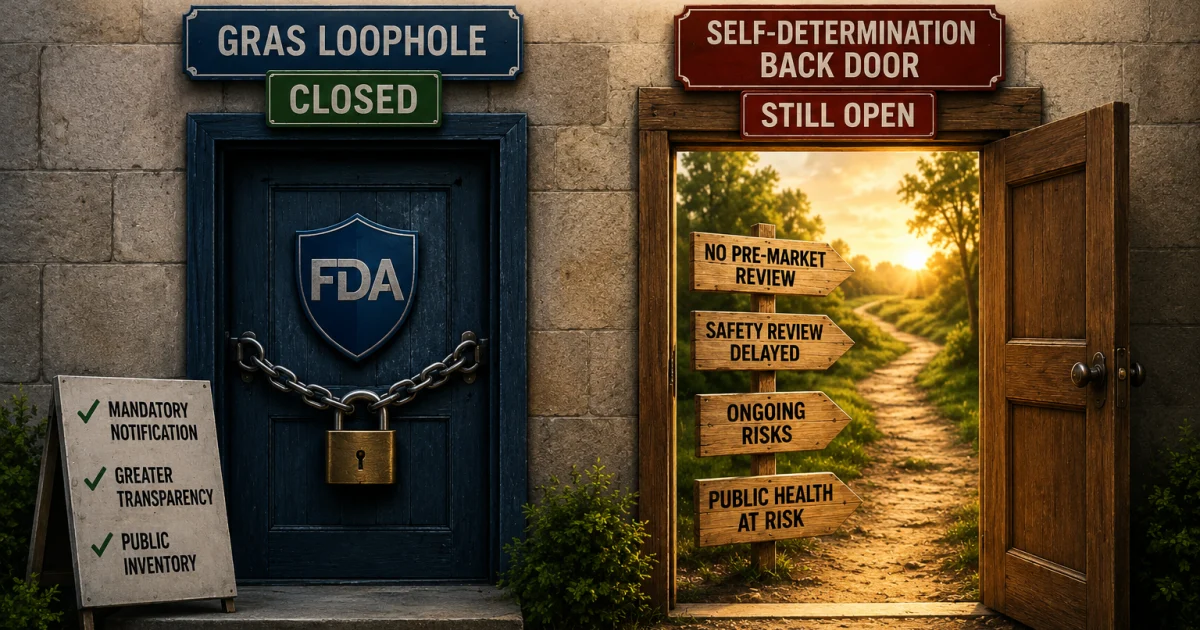
Washington D.C. – In a move heralded by some as a landmark victory for consumer protection, Secretary Kennedy has announced significant proposed reforms to the Generally Recognized As Safe (GRAS) loophole, a long-standing regulatory mechanism that has allowed numerous ingredients to enter the food supply without rigorous FDA pre-market review. The fanfare surrounding this announcement, however, masks a complex regulatory landscape. While the proposed changes promise greater transparency and a more informed FDA, questions remain about whether this represents a true overhaul or merely a superficial adjustment to a system still rife with potential vulnerabilities. The critical distinction between mandatory notification and pre-market approval, particularly when viewed through the lens of the controversial dietary supplement industry, leaves many to ponder if the glass is indeed half full or half empty.
n
The GRAS Loophole: A Brief History and the Proposed Overhaul
n
For decades, the GRAS designation has served as a pathway for food ingredients to be deemed safe for consumption without undergoing the stringent pre-market approval process required for "food additives." This system, established by the Federal Food, Drug, and Cosmetic Act of 1958, allows for ingredients to be considered GRAS based on either a history of safe use prior to 1958 or through scientific procedures and expert consensus. The inherent challenge has always been the subjective nature of "scientific procedures" and the potential for self-determination by manufacturers, leading to a lack of robust oversight.
n
Secretary Kennedy’s proposed regulation aims to address this by fundamentally altering the GRAS notification process. The core of the proposed change, stripped of its rhetorical flourish, mandates that manufacturers must notify the FDA when they conclude that a substance added to human or animal food is GRAS. This notification requirement is the linchpin of the proposed reform, aiming to dismantle the practice of "secret self-determination" and establish a public inventory of ingredients deemed safe by manufacturers. The FDA, for its part, has indicated that these notifications will allow for better prioritization of post-market safety evaluations.
n
The history of GRAS is replete with instances where this self-declaration mechanism has been exploited, leading to concerns about the safety of ingredients that have entered the food supply without independent, government-mandated scrutiny. Critics have long argued that the lack of a mandatory notification system created an opaque process, making it difficult for both regulators and consumers to ascertain the safety profile of many common food ingredients. The proposed regulation, therefore, represents a significant step towards shedding light on this previously shadowy corner of food safety regulation.
n
A Deeper Dive into the Proposed Regulation: The Nuances of "Radical Transparency"
n
The proposed regulation, while ostensibly a victory for transparency, operates within a framework that maintains a critical distinction: mandatory notification is not pre-market approval. This is the crux of the quandary.
n
The Cup Half Full: Exposing the Loophole Through Mandatory Notification
n
On the optimistic side, the proposed regulation effectively closes the GRAS self-determination loophole by introducing a mandatory notification system. Manufacturers can no longer unilaterally declare an ingredient GRAS without informing the FDA. Furthermore, a "streamlined time-limited pathway" is being established for additives already in use to notify the FDA of their current status. This mechanism is designed to bring a substantial number of existing GRAS ingredients into the public purview.
n
This newfound visibility is significant. It means that the FDA will have a clearer picture of what ingredients are being used in our food supply. The creation of an expanded public inventory of GRAS conclusions is a tangible benefit, allowing researchers, consumer advocacy groups, and the public to access information that was previously difficult, if not impossible, to obtain. This increased transparency is a necessary precursor to any meaningful safety evaluation.
n
The Cup Half Empty: Mandatory Notification is Not Pre-Market Approval
n
However, the enthusiasm for "radical transparency" must be tempered by a sober understanding of what the regulation does not do. Crucially, it does not mandate pre-market approval for GRAS substances. Pre-market approval, as exemplified by the Food Additive Petition process, requires manufacturers to submit comprehensive safety data for FDA review before an ingredient enters the marketplace. This rigorous process ensures that potential risks are identified and mitigated prior to consumer exposure.
n
Under the proposed GRAS reforms, the FDA’s involvement begins after an ingredient has already been introduced into the food supply. While the FDA will be made aware of manufacturers’ GRAS conclusions, this notification does not equate to an endorsement or validation of safety. The agency’s review, if it occurs, is discretionary and happens post-market. This distinction is paramount. It means that while companies will be compelled to disclose their GRAS determinations, they are not obligated to undergo the more robust safety vetting that characterizes the Food Additive Petition pathway.

n
The Prevagen Precedent: A Troubling Interplay Between Supplements and GRAS
n
The complexities and potential shortcomings of the proposed GRAS reforms become starkly apparent when examining the regulatory landscape of dietary supplements, and the highly publicized case of Prevagen serves as a potent illustration. Dietary supplements, unlike conventional foods, are regulated under a different framework established by the Dietary Supplement Health and Education Act of 1994 (DSHEA). Under DSHEA, manufacturers introducing "new dietary ingredients" (NDIs) are generally required to notify the FDA at least 75 days before marketing, providing the basis for their safety conclusion. However, this notification is not synonymous with formal FDA approval.
n
The critical issue arises from the interaction between supplement law and GRAS. Ingredients that are GRAS for food use can potentially sidestep the NDI notification requirements when incorporated into dietary supplements. This is precisely the strategy employed by Quincy Bioscience, the manufacturer of Prevagen.
n
The story of Prevagen is instructive. Quincy Bioscience initially sought FDA clearance for apoaequorin, the key ingredient in Prevagen, as an NDI for a dietary supplement. The FDA reportedly declined to approve the NDI twice, citing safety concerns. Undeterred, Quincy Bioscience pivoted, introducing apoaequorin into a "drink" and subsequently declaring it GRAS for food use through a voluntary notification process. Even then, the FDA expressed safety concerns, and Quincy withdrew the notification. The company then opted for self-determined GRAS status for its pill and capsule formulations.
n
This maneuver allowed Prevagen to bypass the mandatory pre-market FDA review it had previously failed to secure as an NDI. Under existing supplement law, a GRAS ingredient, regardless of how it achieved that status, is exempt from further review. This loophole effectively allowed a product with previously flagged safety concerns to enter the market without the rigorous oversight afforded to food additives.
n
The proposed GRAS reforms, while bringing manufacturers’ GRAS conclusions into the public record, do not fundamentally alter this dynamic for supplements. Prevagen, under the new proposed regulations, could continue to be sold while regulators embark on the lengthy process of re-evaluating its safety filings. This highlights the inherent limitation of mandatory notification: it provides information but does not guarantee prompt regulatory action. The FDA’s capacity to conduct post-market safety evaluations is constrained by its resources and funding, often dependent on congressional appropriations, unlike the user-fee funded pharmaceutical review process.
n
The Political Blind Spot: Equal Scrutiny for "Big Supplement"?
n
The Prevagen case, and the broader implications of GRAS reform for the supplement industry, expose a significant political blind spot. Advocates for greater food and supplement oversight often criticize conventional food and pharmaceutical companies for issues such as conflicts of interest, inadequate transparency, and regulatory capture. These are valid concerns that warrant continuous scrutiny. However, the same critical lens must be applied to the supplement industry, which operates under a distinctly less stringent regulatory framework.
n
If conflicts of interest and insufficient oversight are problematic when they involve large food conglomerates or pharmaceutical giants, they should remain equally problematic when they involve companies aligned with the burgeoning wellness movement. The scientific principles governing biological effects do not discriminate based on whether a substance is classified as a food ingredient or a dietary supplement. Therefore, it is arguable that substances presenting comparable risks should be subjected to comparable standards of pre-market scientific evidence, irrespective of their market classification.
n
The current fragmented statutory approach allows for substances with similar safety profiles to navigate vastly different regulatory pathways. This creates an uneven playing field and potentially compromises consumer protection. Until "Big Food" and "Big Supplement" are held to a unified, proactive standard of safety demonstration, the promise of "radical transparency" may illuminate the marketplace without adequately safeguarding its entrance.
n
Conclusion: A Spotlight Without a Gatekeeper
n
Secretary Kennedy’s proposed GRAS reforms represent a meaningful structural change in how food ingredients are regulated. The shift from undisclosed self-determination to mandatory notification and the establishment of a public record are undeniably positive developments. Companies will now be required to demonstrate their GRAS conclusions to regulators, fostering a level of transparency previously absent.
n
However, it is crucial to recognize that filing a notice in an FDA database is not the same as securing pre-market authorization. The proposed regulations shine a spotlight on what is entering the food supply, but they do not install a robust gatekeeper to ensure safety before consumption. The continued ability of certain ingredients to bypass rigorous pre-market review, particularly when they intersect with the less demanding regulatory framework of dietary supplements, underscores the limitations of the current proposal.
n
For genuine consumer protection to be fully realized, a more comprehensive approach is needed. This would involve harmonizing regulatory standards for substances with comparable risks, regardless of whether they are marketed as food ingredients or dietary supplements. Until such time as both conventional food and supplement industries are held to a single, proactive standard of scientific evidence demonstrating safety, the promise of "radical transparency" will continue to illuminate the marketplace, but the gates of consumer protection may not be fully secured. The journey towards truly comprehensive food safety is ongoing, and the proposed GRAS reforms, while a step forward, leave critical questions unanswered and significant challenges ahead.
nnn

