
WASHINGTON, D.C. — In the high-stakes environment of labor and delivery, clinical guidelines serve as the "North Star" for practitioners. However, a significant controversy has emerged following the publication of a recent study in Obstetrics & Gynecology, colloquially known as the "Green Journal." The study, titled “Professional Guideline Discrepancies as a Barrier to Labor Progress and Teamwork,” authored by Donelan, E.A., et al. (2026), purported to identify critical misalignments between the Association of Women’s Health, Obstetric and Neonatal Nurses (AWHONN) and other major medical bodies.
n
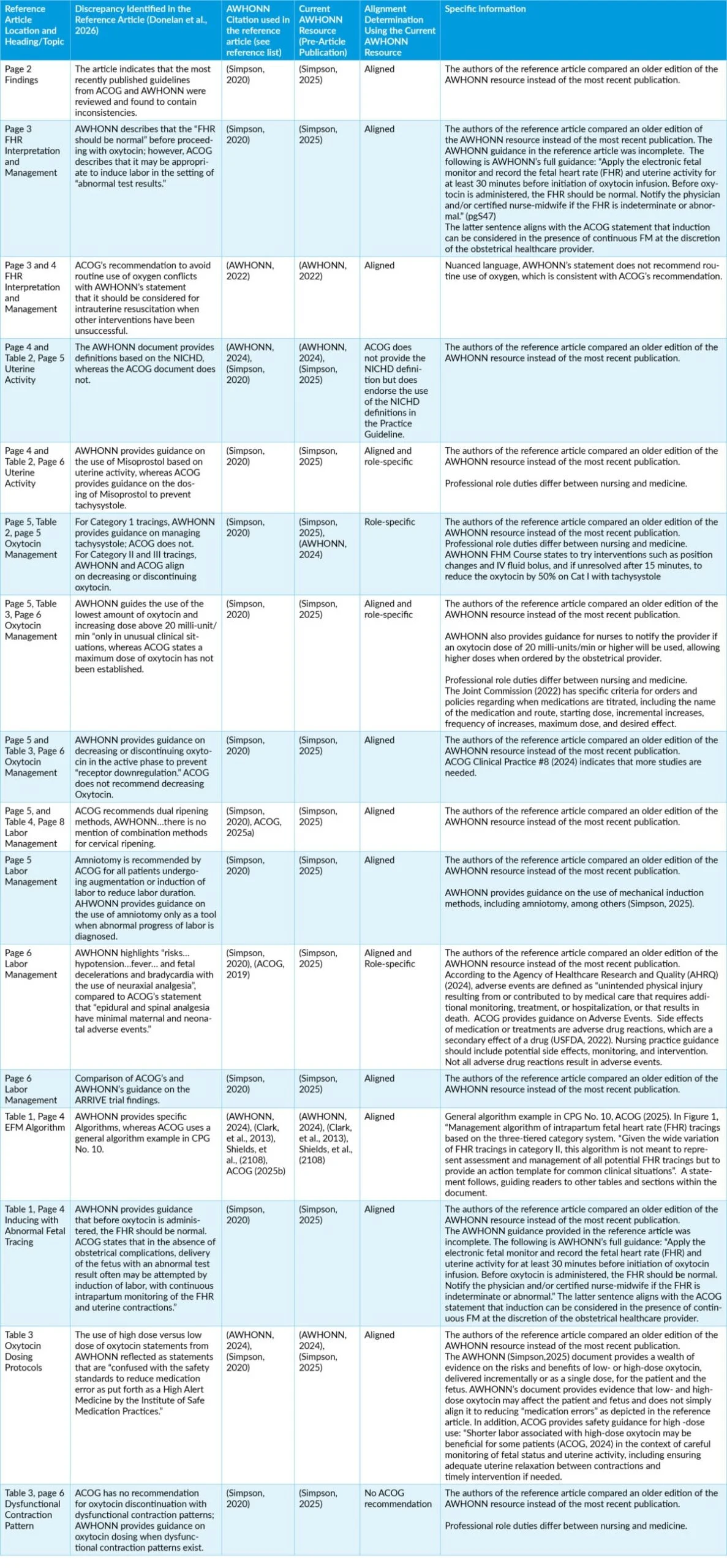
In a swift response, AWHONN has released a comprehensive "Crosswalk Table" to address what it characterizes as fundamental inaccuracies in the article. The core of the dispute rests on a chronological oversight: the study’s findings were based on an expired version of AWHONN’s clinical monographs, potentially creating unnecessary confusion for bedside clinicians and undermining the interdisciplinary teamwork essential for maternal safety.
n
Main Facts: The Anatomy of a Clinical Misunderstanding
n
The Donelan et al. (2026) article arrived at a time when the healthcare industry is hyper-focused on reducing maternal morbidity and mortality through standardized protocols. The researchers aimed to highlight how differing recommendations between AWHONN and the American College of Obstetricians and Gynecologists (ACOG) could create "barriers" to labor progress and disrupt the synergy of the obstetric team.
n
However, AWHONN’s subsequent analysis revealed a critical flaw in the research methodology: the authors utilized the 5th Edition (2020) of AWHONN’s Cervical Ripening and Labor Induction and Augmentation Monograph. By the time the article was published in March 2026, this edition had been superseded by the 6th Edition, which was released in August 2025.
n
The "Crosswalk Table" issued by AWHONN serves as a corrective roadmap. It identifies specific page numbers, topic headings, and citations where the Donelan article cited outdated information. More importantly, it provides the current evidence-based references that should have been used, effectively neutralizing the "discrepancies" the original authors claimed to have found.
n
The dispute highlights a growing tension in medical publishing: the speed of clinical evolution versus the slower cycles of academic peer review. When researchers fail to account for the most recent updates from professional organizations, the resulting "evidence" can inadvertently cause the very discord it seeks to resolve.
n
Chronology: A Timeline of Overlapping Publications
n
To understand how this discrepancy occurred, one must look at the timeline of both the AWHONN revisions and the Obstetrics & Gynecology publication process.
n
- n
- 2020: AWHONN publishes the 5th Edition of the Cervical Ripening and Labor Induction and Augmentation Monograph. This becomes the standard for nursing practice for the next five years.
- August 2025: Adhering to its commitment to a five-year revision cycle, AWHONN releases the 6th Edition of the monograph. This update incorporates the latest evidence-based research and aligns nursing practice with modern obstetric standards.
- January 2026: As the Donelan et al. article moved through the final stages of the pre-release phase at the "Green Journal," the editorial team was reportedly notified that the AWHONN references used in the study were expired.
- March 2026: Despite the notification, the Donelan et al. article is published in Obstetrics & Gynecology, 147(3), 313-327, citing the 2020 monograph rather than the 2025 edition.
- Post-Publication 2026: AWHONN issues its formal response and the Crosswalk Table to "alleviate any confusion at the bedside" and to correct the record regarding nursing standards.
n
n
n
n
n
n
This timeline suggests a breakdown in the "rigorous tracking of resources" that AWHONN insists is vital for academic integrity. The fact that the article was accepted and published after the 6th edition was already commercially available and in use at hospitals across the country created a period of clinical ambiguity.
n
Supporting Data: Why the 6th Edition Matters
n
The transition from the 5th to the 6th Edition of the AWHONN monograph was not merely a cosmetic update; it reflected five years of evolving data in maternal-fetal medicine. The Cervical Ripening and Labor Induction and Augmentation Monograph is a cornerstone document that guides how nurses monitor patients, manage oxytocin titration, and collaborate with physicians during some of the most critical windows of labor.
n
The Donelan article specifically compared ACOG guidelines with AWHONN monographs, treating them as potentially conflicting directives. However, AWHONN clarifies that these resources are intended to be utilized differently. While ACOG provides broad clinical guidelines for medical management, AWHONN monographs provide specific nursing interventions and assessment frameworks.
n
The data presented in the Crosswalk Table highlights several key areas where the 2020 and 2025 editions differ:
n
- n
- Oxytocin Protocols: Updated evidence on titration rates to minimize tachysystole while ensuring labor progress.
- Fetal Monitoring: Refined standards for interpreting fetal heart rate patterns in the context of induction.
- Patient Safety Bundles: Integration of the latest AIM (Alliance for Innovation on Maternal Health) safety bundles, which were updated between 2020 and 2025.
n
n
n
n
By citing the 5th Edition, the Donelan study identified "discrepancies" that had already been resolved by the 6th Edition. In essence, the researchers were critiquing a version of nursing practice that the profession had already moved past.
n
Official Responses: A Call for Editorial Rigor
n
In its preface to the Crosswalk Table, AWHONN did not mince words regarding the responsibilities of researchers and editorial boards. The organization emphasized that authors must follow "rigorous tracking of resources all the way through publication."
n
"It is best practice to communicate with professional organizations to assess revision cycles of published resources," the AWHONN statement read. This suggests that a simple inquiry to the organization during the manuscript’s drafting phase could have prevented the error.
Furthermore, AWHONN’s response pointed a finger at the editorial process of the "Green Journal." The organization noted that editorial teams should establish a process for reevaluating articles brought to their attention during the pre-release phase. The fact that the journal was notified of the inaccuracies in January 2026—two months before the official publication—yet proceeded without updating the references, has raised questions about the peer-review safeguards in place for interdisciplinary research.
AWHONN’s stance is clear: Nursing practice is inherently collaborative, and the tools used to teach and guide that practice must be beyond reproach. When academic journals publish outdated information, they risk "silencing" the open dialogue necessary for patient safety.
Implications: Teamwork, Safety, and the Bedside Reality
The implications of this discrepancy extend far beyond the pages of a medical journal. At the bedside, nurses and physicians must work in a "psychologically safe environment" where they can share expertise without the friction of conflicting guidelines.
1. Mitigation of Healthcare Discord
When a physician cites an ACOG guideline and a nurse cites an (outdated) AWHONN guideline, the result is often a breakdown in communication. The Donelan article, by incorrectly suggesting that these organizations remain at odds, may have inadvertently validated "us vs. them" mentalities in the labor suite. The Crosswalk Table is designed to mitigate this by showing that, when the most current versions are used, AWHONN and ACOG are largely in sync, supporting a unified approach to care.
2. Shared Decision-Making
Optimal maternal outcomes depend on shared decision-making. This process requires a mutual recognition of each discipline’s expertise. AWHONN’s response underscores that their monographs are meant to support—not silence—dialogue. If a nurse is empowered with the most current 6th Edition data, they can engage in a more informed, patient-centered discussion with the rest of the healthcare team.
3. The Future of Interdisciplinary Research
This incident serves as a cautionary tale for future researchers. As professional organizations move toward more frequent, evidence-based update cycles (such as AWHONN’s five-year rule), the "shelf life" of research becomes shorter. Researchers must ensure their work reflects the current clinical reality, or they risk publishing "ghost discrepancies" that exist only on paper and not in practice.
4. Psychological Safety
The concept of "psychological safety"—the belief that one can speak up with questions or concerns without fear of retribution—is cited by AWHONN as a casualty of guideline confusion. When guidelines are perceived as being in conflict, clinicians may feel hesitant to voice concerns, fearing they are "out of step" with their colleagues. By clarifying that AWHONN and ACOG are working from a similar evidence base, AWHONN aims to restore the confidence of clinicians at the bedside.
Conclusion
The release of the Crosswalk Table is more than just a technical correction; it is a defense of the nursing profession’s commitment to current, evidence-based care. While the Donelan et al. (2026) article may have intended to highlight barriers to teamwork, its reliance on the 5th Edition of AWHONN’s monograph created a barrier of its own.
As the healthcare community moves forward, the lesson is clear: in the rapidly evolving world of maternal health, the most valuable tool a clinician has is not just a guideline, but the current guideline. Through rigorous tracking, interdisciplinary respect, and a commitment to shared decision-making, the healthcare team can ensure that the only thing progressing in the labor room is the patient.

