
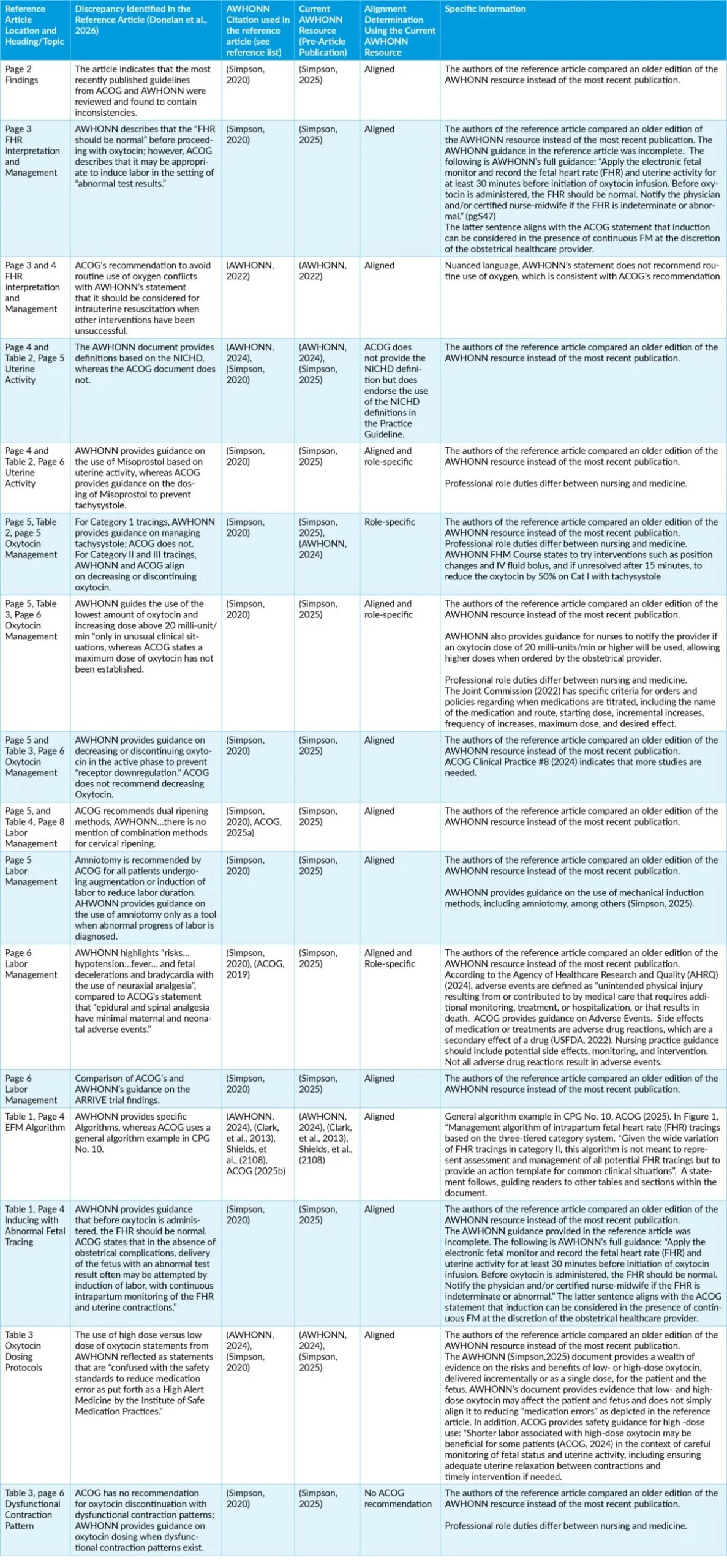
In the complex ecosystem of obstetric care, the alignment of clinical guidelines between nursing and medical organizations is paramount to patient safety. However, a recent high-profile publication in the journal Obstetrics & Gynecology (commonly known as the "Green Journal") has sparked significant debate and necessitated a formal intervention by the Association of Women’s Health, Obstetric and Neonatal Nurses (AWHONN).
n
The article in question, "Professional Guideline Discrepancies as a Barrier to Labor Progress and Teamwork," authored by E.A. Donelan et al. (2026), sought to highlight inconsistencies between various professional standards. Instead, it inadvertently became a case study in the challenges of academic publishing timelines and the critical importance of utilizing current clinical resources. In response, AWHONN has released a comprehensive "Crosswalk Table" to rectify inaccuracies stemming from the authors’ use of an outdated monograph, ensuring that bedside clinicians have the most accurate, evidence-based information available.
n
Main Facts: The Core of the Contention
n
The central issue revolves around the source material used by Donelan et al. to represent AWHONN’s clinical positions. The researchers cited the 5th Edition (2020) of AWHONN’s Cervical Ripening and Labor Induction and Augmentation Monograph. However, by the time the article reached its final publication phase in March 2026, this edition had been superseded by the 6th Edition, which was released in August 2025.
n
The reliance on the 5th Edition led the researchers to identify "discrepancies" between AWHONN’s nursing guidelines and the American College of Obstetricians and Gynecologists (ACOG) recommendations that, in many instances, no longer existed in the updated 6th Edition. These perceived gaps, according to the article, were framed as barriers to labor progress and interdisciplinary teamwork.
n
AWHONN’s newly released Crosswalk Table serves as a corrective roadmap. It identifies specific page numbers and topic headings within the Donelan article, highlights the inaccuracies, and provides the current references from the 6th Edition. The goal is to alleviate confusion among labor and delivery (L&D) staff and to restore the collaborative spirit essential for high-functioning obstetric teams.
n
Chronology: A Breakdown of the Publication Timeline
n
To understand how this discrepancy occurred, it is necessary to examine the timeline of both the AWHONN resource updates and the journal’s editorial process.
n
- n
- 2020: AWHONN publishes the 5th Edition of the Cervical Ripening and Labor Induction and Augmentation Monograph. This becomes the standard reference for several years.
- August 2025: Following its standard five-year revision cycle, AWHONN releases the 6th Edition of the monograph. This version incorporates the latest evidence-based practices and aligns more closely with contemporary interdisciplinary standards.
- Late 2025: The Donelan et al. manuscript is in the peer-review and editorial phase at Obstetrics & Gynecology. Despite the availability of the 6th Edition, the manuscript continues to reference the 2020 version.
- January 2026: The Green Journal editorial team is formally notified of the inaccuracies within the pending Donelan article. The notification specifically points out that the authors are utilizing an expired AWHONN publication.
- March 2026: Obstetrics & Gynecology publishes the article in Volume 147, Issue 3. The published version still contains the references to the 5th Edition, leading to the public identification of "discrepancies" that AWHONN argues are no longer valid.
- Post-Publication 2026: AWHONN issues the "Crosswalk Table" and a formal preface to mitigate bedside confusion and address the procedural failures in the publication process.
n
n
n
n
n
n
n
Supporting Data: The Impact of Outdated Information
n
The technical nature of labor induction and augmentation means that even minor discrepancies in guidelines can lead to significant variations in practice. AWHONN’s monographs are not merely suggestions; they are comprehensive resources that guide nursing assessments, titration of medications like oxytocin, and the monitoring of maternal-fetal well-being.
n
The Role of the Monograph
n
The AWHONN monograph provides specific nursing interventions that complement medical management. When an academic article suggests that nursing guidelines (AWHONN) are at odds with physician guidelines (ACOG), it can create a "double standard" at the bedside. For example, if a nurse follows an outdated AWHONN protocol cited in a new study while a physician follows current ACOG guidelines, the result is often friction, delayed care, or compromised patient safety.
n
The Five-Year Revision Cycle
n
AWHONN, like most major healthcare organizations, adheres to a strict five-year revision cycle. This ensures that nursing practice evolves alongside emerging clinical data. The transition from the 5th to the 6th Edition included updates reflecting the latest findings on labor dystocia, fetal heart rate monitoring, and patient-centered induction techniques. By citing the 2020 version in 2026, the Donelan article ignored nearly a year of updated clinical standards.
n
Official Responses: A Call for Editorial Rigor
n
AWHONN’s response to the Donelan article is two-fold: a technical correction of the clinical data and a critique of the academic publishing process.
n
AWHONN’s Stance on Editorial Responsibility
n
AWHONN has emphasized that authors and editorial teams have a professional obligation to ensure that the resources they cite are current at the time of publication. "Authors of articles must follow rigorous tracking of resources all the way through publication," the organization stated in its preface. Furthermore, AWHONN suggested that it is "best practice" for researchers to communicate directly with professional organizations to verify revision cycles before going to print.
n
The organization expressed disappointment that the Green Journal’s editorial team proceeded with the publication in March 2026 despite being alerted to the inaccuracies two months prior. This highlights a systemic issue in medical journalism where the speed of publication or the rigidity of the "accepted" manuscript version can sometimes override the need for real-time clinical accuracy.
n
The Concept of Psychological Safety
n
Central to AWHONN’s response is the impact of such articles on the healthcare environment. The organization argues that varied resources should "support—not silence—open dialogue." When research highlights discrepancies that don’t actually exist, it can undermine the "psychologically safe environments" where clinicians share expertise. AWHONN maintains that nursing practice is inherently collaborative and that misinformation serves as a wedge between disciplines.
n
Implications: Protecting the Bedside and the Team
The fallout from the Donelan et al. article extends beyond the pages of a medical journal. It has real-world implications for how labor and delivery units function.
Mitigating Bedside Confusion
The primary implication is the potential for "practice drift." If a hospital’s policy-making committee reads the Donelan article and concludes that AWHONN and ACOG are in conflict, they may implement confusing or contradictory protocols. The Crosswalk Table is designed to be a tool for these committees and for individual clinicians to ensure their hospital policies reflect the actual current standards of the 6th Edition, rather than the "perceived" discrepancies of the 5th Edition.
Strengthening Interdisciplinary Teamwork
The article’s title identified discrepancies as a "barrier to teamwork." Ironically, by publishing outdated information, the article itself became a barrier. High-functioning teams rely on mutual recognition of each discipline’s expertise. AWHONN’s response reinforces that while ACOG and AWHONN resources have different focuses—one on medical management and the other on nursing care—they are intended to be utilized in tandem. Shared decision-making is only possible when all parties are working from the same, most recent set of facts.
Future Academic Standards
This incident serves as a warning for the academic community. It underscores the necessity for:
- Pre-release Reevaluation: Editorial teams should have a formal process for reevaluating articles when new editions of cited guidelines are released during the publication lag.
- Dynamic Citation Management: Authors must be proactive in updating their manuscripts to reflect the most current "Gold Standard" documents, even after a paper has been accepted for publication.
- Collaborative Verification: Journals should consider a verification step with the professional organizations whose guidelines are being analyzed, particularly in comparative studies.
Conclusion: A Path Forward
The correction of the Donelan et al. (2026) article is more than a simple clerical update; it is an assertion of the importance of clinical currency in the pursuit of maternal health. AWHONN’s proactive release of the Crosswalk Table ensures that the nursing profession remains grounded in the most recent evidence-based practice.
As the healthcare community moves forward, the focus remains on the patient. Optimal outcomes in labor and delivery depend on a commitment to high-functioning teamwork, respectful communication, and, perhaps most importantly, an unwavering dedication to the most current clinical standards. The 6th Edition of the AWHONN monograph stands as the definitive guide for nursing care in labor induction and augmentation, and it is this standard—not the discrepancies of the past—that must guide the future of obstetric care.

