The 2025 reconciliation law requires states to condition Medicaid eligibility for adults in the Affordable Care Act (ACA) Medicaid expansion group and enrollees in partial expansion waiver programs on meeting work requirements starting January 1, 2027, with the option for states to implement requirements earlier. This federal mandate marks one of the most significant shifts in Medicaid policy since the expansion of the program under the ACA, creating a complex administrative and operational roadmap for state agencies. As states prepare for this transition, they are looking toward the recent "Medicaid unwinding" period—the massive redetermination process that followed the COVID-19 pandemic—as a primary source of operational intelligence and a cautionary tale regarding the risks of procedural disenrollment.
The Legislative Context and Implementation Timeline
The introduction of mandatory work requirements via the 2025 reconciliation law represents a pivot in federal healthcare strategy, aiming to link social safety net benefits with labor participation. The law specifically targets the ACA expansion population—primarily low-income adults who do not qualify based on disability or age—as well as participants in unique state-level partial expansion programs in Georgia and Wisconsin.
While the federal deadline is set for the start of 2027, the legislative framework allows for early adoption, a path several states with existing conservative policy goals may pursue. However, the timeline remains aggressive given the scale of the required changes. States must not only redefine eligibility criteria but also overhaul IT systems, hire and train thousands of eligibility workers, and establish new verification protocols for employment, education, and volunteer hours.
The historical context of such requirements is fraught with administrative hurdles. Previous attempts at state-level work requirements, most notably in Arkansas before being halted by court challenges, resulted in thousands of individuals losing coverage not necessarily because they were employed or ineligible, but because of the "paperwork burden" associated with reporting hours. The 2025 law attempts to standardize these requirements while placing the burden of implementation on state infrastructures that are still recovering from the pandemic-era workload.
Lessons from the Medicaid Unwinding Period
In April 2023, states began the monumental task of "unwinding" the Medicaid continuous enrollment provision. This pandemic-era policy had prevented states from disenrolling members in exchange for increased federal funding. During the three-year hiatus of redeterminations, Medicaid enrollment swelled to record highs. When the unwinding began, states were forced to re-verify the eligibility of every single person on their rolls—roughly 90 million people nationwide.
Data from the Kaiser Family Foundation (KFF) and state reports indicate that the unwinding was a period of high volatility. Millions of Americans were disenrolled, with a staggering percentage occurring due to "procedural reasons" rather than a confirmed loss of eligibility. Procedural disenrollments happen when a beneficiary fails to return paperwork, the state has an incorrect address, or the system fails to process a renewal correctly.
From this experience, state officials have identified several critical takeaways that will inform the 2027 work requirement rollout:
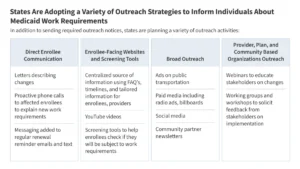
- Multi-Modal Communication is Essential: The unwinding proved that traditional mail is no longer sufficient. Successful states used a combination of text messaging, email, automated phone calls, and community-based outreach to reach transient populations.
- The Role of Managed Care Organizations (MCOs): Private insurers that manage Medicaid benefits proved to be vital partners. Because MCOs have frequent contact with members through health services, they often possessed more up-to-date contact information than the state’s own databases.
- The "Ex Parte" Necessity: States that successfully minimized coverage losses relied heavily on ex parte renewals—automated processes where the state verifies eligibility using existing data sources (like tax records or SNAP data) without requiring the member to submit a form.
Technical and Staffing Challenges
The transition to work requirements is expected to be even more technically demanding than the unwinding. While the unwinding was a check of existing income rules, the new law requires the collection and verification of entirely new data points. States will need to track monthly work hours, verify exemptions (such as for caregivers or those with medical frailty), and integrate data from external sources like student enrollment databases and gig-economy platforms.
State Medicaid directors have expressed concern regarding the "administrative churn" this could create. According to the 23rd annual budget survey of Medicaid officials, staffing remains a primary bottleneck. High turnover among eligibility workers and the need for specialized training on the nuances of work requirement exemptions could lead to significant backlogs.
Furthermore, many states still operate on legacy IT systems that are not easily integrated with other social service programs. While integrated systems (those that combine Medicaid, SNAP, and TANF) offer the benefit of shared data, they are also more difficult to update. A change in Medicaid work policy might require a complete overhaul of the logic used across all three programs, leading to long lead times for software development and testing.
Impact on Beneficiaries and Community Partnerships
The 2025 law affects a specific subset of the Medicaid population, which presents a unique communication challenge. Unlike the unwinding, which applied to everyone, the work requirements apply only to expansion adults. States must carefully target their messaging to avoid confusing seniors, children, and people with disabilities who remain exempt.
Community-based organizations (CBOs), including health centers and faith-based groups, are expected to play a frontline role. During the unwinding, these groups provided "feedback loops" to state governments, alerting them when specific populations were being unfairly disenrolled. For the 2027 rollout, states will likely need to re-engage these partners to help beneficiaries navigate the complexities of documenting their work hours or filing for exemptions.
The role of MCOs will be more restricted under the new law. While they can assist with outreach and education, the 2025 reconciliation law explicitly prohibits MCOs from making the final determination on whether a beneficiary has complied with work requirements. This ensures that the legal authority remains with the state but places the full administrative weight on government agencies.
Broader Economic and Health Implications
The implementation of work requirements carries significant implications for both state budgets and public health. Proponents of the policy argue that it encourages labor force participation and ensures that Medicaid remains a temporary safety net for those capable of working. However, healthcare advocates and analysts warn of the "chilling effect" on enrollment.
Research into previous work requirement models suggests that the administrative complexity often acts as a barrier to care. If a significant portion of the expansion population loses coverage due to reporting errors, the resulting increase in uninsured rates could lead to higher uncompensated care costs for hospitals and poorer management of chronic conditions like diabetes and hypertension.
Financially, states face a dual-edged sword. While reduced enrollment could lower the state’s share of Medicaid spending, the administrative costs of monitoring work hours are substantial. Hiring new staff, upgrading IT infrastructure, and managing the inevitable appeals process require significant upfront investment.
Chronology of Medicaid Policy Shifts (2010–2027)
- 2010: The Affordable Care Act is signed into law, creating the Medicaid expansion category for adults up to 138% of the Federal Poverty Level.
- March 2020: The COVID-19 Public Health Emergency begins; the Families First Coronavirus Response Act mandates continuous enrollment in exchange for enhanced federal funding.
- January 2023: Congress passes the Consolidated Appropriations Act, 2023, decoupling the continuous enrollment provision from the Public Health Emergency.
- April 2023: The "Unwinding" begins; states start redetermining eligibility for all Medicaid enrollees for the first time in three years.
- 2025: The federal reconciliation law is passed, establishing the framework for mandatory work requirements for expansion adults.
- July 2024 – December 2025: States finalize "Unwinding" and begin planning for the 2027 transition, including system upgrades and staffing reallocations.
- January 1, 2027: The federal deadline for states to implement Medicaid work requirements for the expansion group.
Conclusion and Outlook
As the 2027 deadline approaches, the success of the Medicaid work requirement mandate will depend largely on how well states have internalized the lessons of the 2023 unwinding. The move toward automation, the use of diverse communication channels, and the strengthening of community partnerships will be the deciding factors in whether the policy achieves its stated goals or results in a wave of procedural coverage losses.
State officials are now in a race against time to modernize their systems and train their workforces. While the 2025 reconciliation law provides the mandate, the operational reality remains a state-level challenge. With the experience of the unwinding fresh in their minds, administrators are acutely aware that in the world of Medicaid, policy is only as effective as the system that implements it. The coming years will test the resilience of state infrastructures as they attempt to balance federal compliance with the health and stability of their most vulnerable populations.