
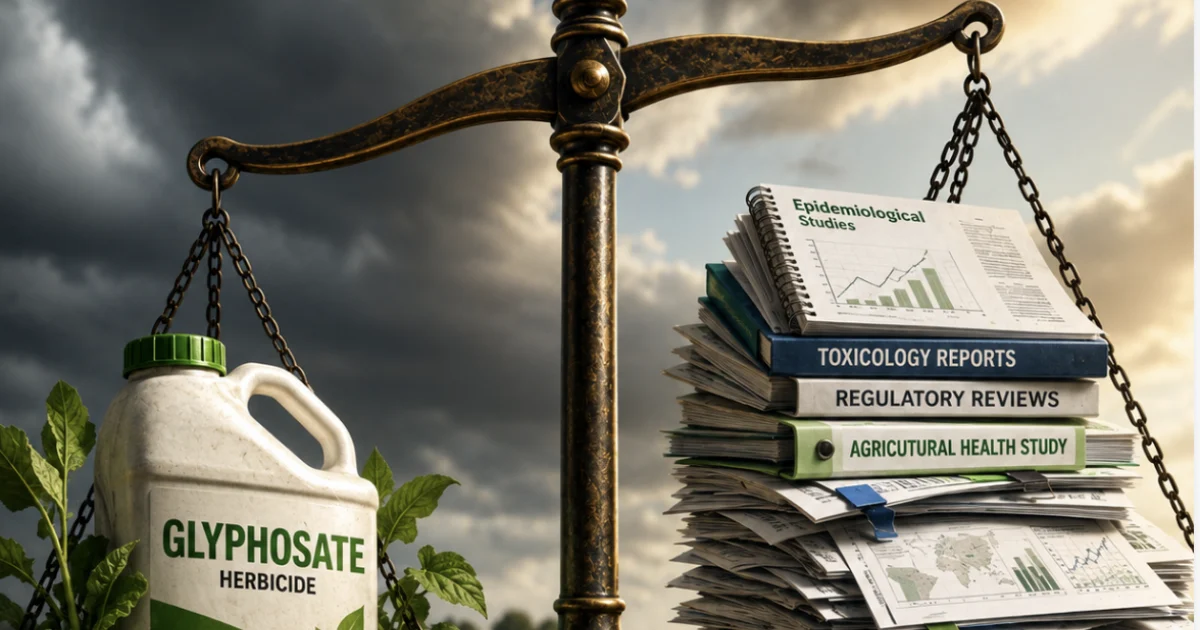
The recent U.S. Supreme Court decision in Monsanto v. Durnell has once again placed glyphosate, the active ingredient in the widely used herbicide Roundup, under intense public scrutiny. While the ruling has been widely reported, its nuances have been frequently misinterpreted, leading to a surge of public confusion about the scientific consensus on glyphosate’s safety. A critical examination of prominent science communication efforts, such as that by Yale neurologist Steven Novella, reveals how even well-intentioned analyses can inadvertently perpetuate misunderstandings by overlooking crucial scientific evidence and context.
n
The Supreme Court’s Decision: A Ruling on Federal Authority, Not Absolute Safety
n
In a 7-2 decision, the Supreme Court ruled that federal law, as represented by the U.S. Environmental Protection Agency’s (EPA) 2020 determination that glyphosate is not carcinogenic at typical exposure levels, supersedes a state’s authority to mandate specific warning labels about potential cancer risks. This landmark ruling, Monsanto v. Durnell, has been misconstrued by many as a definitive scientific declaration that glyphosate is safe.
n
It is crucial to understand that the Supreme Court did not independently assess the scientific evidence for glyphosate’s carcinogenicity. Instead, their decision hinged on the principle of federal preemption and the weight given to the EPA’s established regulatory assessments. The Court relied on the EPA’s conclusion that glyphosate does not pose a carcinogenic threat at ordinary exposure levels, thereby limiting the ability of individual states to impose their own warning requirements. This distinction between a legal ruling on regulatory authority and a scientific verdict on chemical safety is a critical point often lost in public discourse.
n
Navigating the Glyphosate Controversy: An Examination of Science Communication
n
The ongoing debate surrounding glyphosate’s safety is complex, fueled by a deluge of scientific studies, regulatory reviews, and public advocacy. In this environment, clear and accurate communication of scientific findings is paramount. Steven Novella, a neurologist at Yale University and a respected voice in science communication, recently updated his analysis of glyphosate safety, aiming to provide an even-handed overview. Novella’s work, particularly his article "Glyphosate remains controversial," warrants close examination due to his standing and his stated commitment to impartial scientific discourse.
n
Novella, also the host of the popular podcast "The Skeptics’ Guide to the Universe," largely aligns with the scientific consensus that glyphosate appears to be safe at typical exposure levels. He acknowledges the vast scale of its use and the economic importance of effective herbicides. However, his attempt to present a balanced perspective, by "bending over backward to consider the possibility that glyphosate poses a threat," inadvertently highlights the challenges of dissecting complex scientific literature and the potential for even expert analyses to fall short.
n
The Hazard vs. Risk Dichotomy: A Flawed Framework for IARC’s Determination?
n
A central point of contention in the glyphosate debate revolves around the distinction between "hazard" and "risk." Novella posits that the scientific controversy often stems from differing approaches to this distinction. Hazard, in this context, refers to the inherent capacity of a substance to cause harm, while risk quantifies the probability of that harm occurring under specific exposure conditions.
n
However, Novella’s reliance on this dichotomy as a primary explanation for the International Agency for Research on Cancer’s (IARC) 2015 classification of glyphosate as a "probable carcinogen" overlooks significant criticisms of IARC’s methodology and the specific circumstances surrounding their assessment. As previously explored in scholarly discussions, IARC’s determination has been challenged on several fronts:
n
- n
- Erroneous interpretation of rodent studies: Critics argue that the IARC Working Group misinterpreted or selectively focused on rodent studies, drawing conclusions about carcinogenicity that were not robustly supported by the data. Independent analyses have suggested flaws in the interpretation of these studies.
- Conflict of interest concerns: The involvement of Christopher Portier, a key figure in the IARC glyphosate assessment, has also been a point of contention. Reports indicate that Portier entered into agreements to assist in lawsuits against Monsanto within a short timeframe following IARC’s classification, raising questions about potential conflicts of interest and their influence on the agency’s findings.
n
n
n
Furthermore, the fact that other regulatory bodies, such as the European Chemicals Agency (ECHA) in conjunction with the European Food Safety Authority (EFSA), have conducted their own comprehensive evaluations of glyphosate and concluded it is not carcinogenic, despite also considering hazard, underscores the complexity of the issue and the potential for differing interpretations of scientific evidence. These agencies, like the EPA, focus on the totality of scientific evidence, including exposure assessments, to determine risk.
n
Examining the Evidence: A Closer Look at Meta-Analyses and Study Limitations
n
Novella’s article highlights the ongoing scientific debate, particularly concerning the potential association between glyphosate exposure and non-Hodgkin lymphoma (NHL), especially in occupationally exposed individuals. He cites two "reviews" that suggest a "persistent signal" of such an association.
n
The first of these, a 2019 meta-analysis by Zhang et al., garnered significant media attention for its claim of a 41% increased risk of NHL in workers with heavy glyphosate exposure. However, this meta-analysis has faced substantial criticism for its methodological limitations. Key concerns include:
n
- n
- Inclusion of low-quality studies: The Zhang et al. paper reportedly combined poorly conducted case-control studies with more robust, larger prospective studies like the Agricultural Health Study (AHS).
- Selective model use: The meta-analysis’s conclusions were based on the selection of one specific model out of five used to analyze the AHS data.
- Lack of dose-response relationship: Independent analyses of the AHS data by the National Cancer Institute (NCI) failed to demonstrate a clear dose-response relationship between glyphosate exposure and NHL risk. In some of the analyses preferred by Zhang et al., the risk estimates for lower exposure quartiles were actually higher than for the highest quartile, contradicting the hypothesized increase with greater exposure.
n
n
n
n
The author of the present article, Geoffrey Kabat, a cancer epidemiologist, has extensively critiqued the Zhang et al. meta-analysis in previous publications, highlighting its perceived data manipulation or analytical flaws.
n
A critical omission in Novella’s analysis is the failure to mention the potential for bias among the cited authors. Both Zhang and Weisenburger, whose review is also cited by Novella, have reportedly served as paid experts for plaintiffs in glyphosate litigation. While Novella mentions that Acquavella, another cited reviewer, once worked for Monsanto, he does not explore the potential implications of these affiliations on the authors’ findings.
n
Moreover, Novella neglects to cite two other significant meta-analyses by Paolo Boffetta and Geoffrey Kabat. These comprehensive reviews, which considered a broader range of studies and employed different analytical approaches, found no statistically significant evidence of an association between glyphosate exposure and an increased risk of non-Hodgkin lymphoma.
n
The Importance of Comprehensive Review and Context
n
If Novella had incorporated these additional meta-analyses and given greater weight to the findings of the extensive Agricultural Health Study, his conclusion might have more closely aligned with his own initial assessment of glyphosate’s relative safety. The AHS, a large-scale, long-term study of pesticide applicators, has been a cornerstone in the scientific understanding of the health effects of pesticide exposure, including glyphosate. Its findings, alongside those of Boffetta and Kabat, provide a more balanced perspective that challenges the notion of a "persistent signal" of increased NHL risk solely attributable to glyphosate.
n
This situation serves as a potent reminder of how easily even highly accomplished scholars can arrive at poorly founded conclusions when their engagement with the relevant evidence is uncritical or incomplete. The scientific understanding of glyphosate’s safety is not a static, monolithic entity. It is the product of ongoing research, rigorous peer review, and diverse interpretations of complex datasets. Navigating this landscape requires meticulous attention to detail, a critical assessment of methodologies, and a comprehensive consideration of all available scientific literature, including studies that may challenge prevailing narratives.
n
Official Responses and Regulatory Stance
The scientific and regulatory landscape surrounding glyphosate has been shaped by numerous official bodies. The U.S. EPA has repeatedly reviewed glyphosate and concluded that it is not carcinogenic to humans at levels typically encountered. Their 2020 determination, which played a pivotal role in the Supreme Court’s recent decision, affirmed this stance.
Similarly, the European Food Safety Authority (EFSA) and the European Chemicals Agency (ECHA), in their joint reassessment of glyphosate, concluded that the substance is unlikely to pose a carcinogenic risk to humans. These conclusions are based on extensive reviews of scientific literature, including epidemiological studies, toxicology data, and exposure assessments.
These consistent findings from major regulatory bodies contrast with the conclusions of certain scientific bodies and some litigation-driven research. This divergence highlights the ongoing scientific debate and the varying interpretations of the available evidence.
Implications for Public Understanding and Future Research
The persistent confusion surrounding glyphosate’s safety, exacerbated by misinterpretations of legal rulings and selective engagement with scientific literature, has significant implications. It underscores the critical need for science communicators to present information with precision, to acknowledge scientific uncertainties transparently, and to avoid oversimplification of complex issues.
The Supreme Court’s decision, while addressing a legal matter, has inadvertently amplified the public’s desire for definitive scientific answers. However, the scientific process is rarely about definitive "proof" but rather about building consensus through the accumulation and evaluation of evidence.
Future research in this area should continue to focus on robust epidemiological studies with well-defined exposure assessments and appropriate statistical methodologies. Moreover, greater emphasis on clear, unbiased science communication is essential to help the public navigate the complexities of scientific research and regulatory assessments, ensuring that informed decisions can be made about the use of widely deployed agricultural chemicals like glyphosate. The goal must be to foster understanding based on the totality of the scientific evidence, rather than on isolated findings or misconstrued legal pronouncements.

