
WASHINGTON, D.C. — In an era defined by the rapid democratization of information and the simultaneous erosion of institutional authority, the American healthcare landscape is facing a dual threat: the politicization of pharmaceutical safety and the technological weaponization of medical expertise.
n
As of August 13, 2026, new data from the KFF Health Tracking Poll reveals a public deeply divided and fundamentally confused about the safety of mifepristone, the primary medication used in U.S. abortions. This uncertainty is being compounded by a sophisticated misinformation campaign targeting the drug’s environmental impact. Simultaneously, a separate but equally troubling trend has emerged on social media, where networks of AI-generated "doctors" are exploiting the public’s trust to sell unproven and potentially dangerous health supplements.
n
Together, these developments paint a picture of a nation struggling to navigate a "post-truth" medical environment, where scientific consensus is frequently overshadowed by ideological narratives and synthetic deceptions.
n
n
I. Main Facts: A Landscape of Uncertainty and Deception
n
The intersection of public opinion, environmental science, and artificial intelligence has created three primary fronts in the current battle for health information integrity:
n
- n
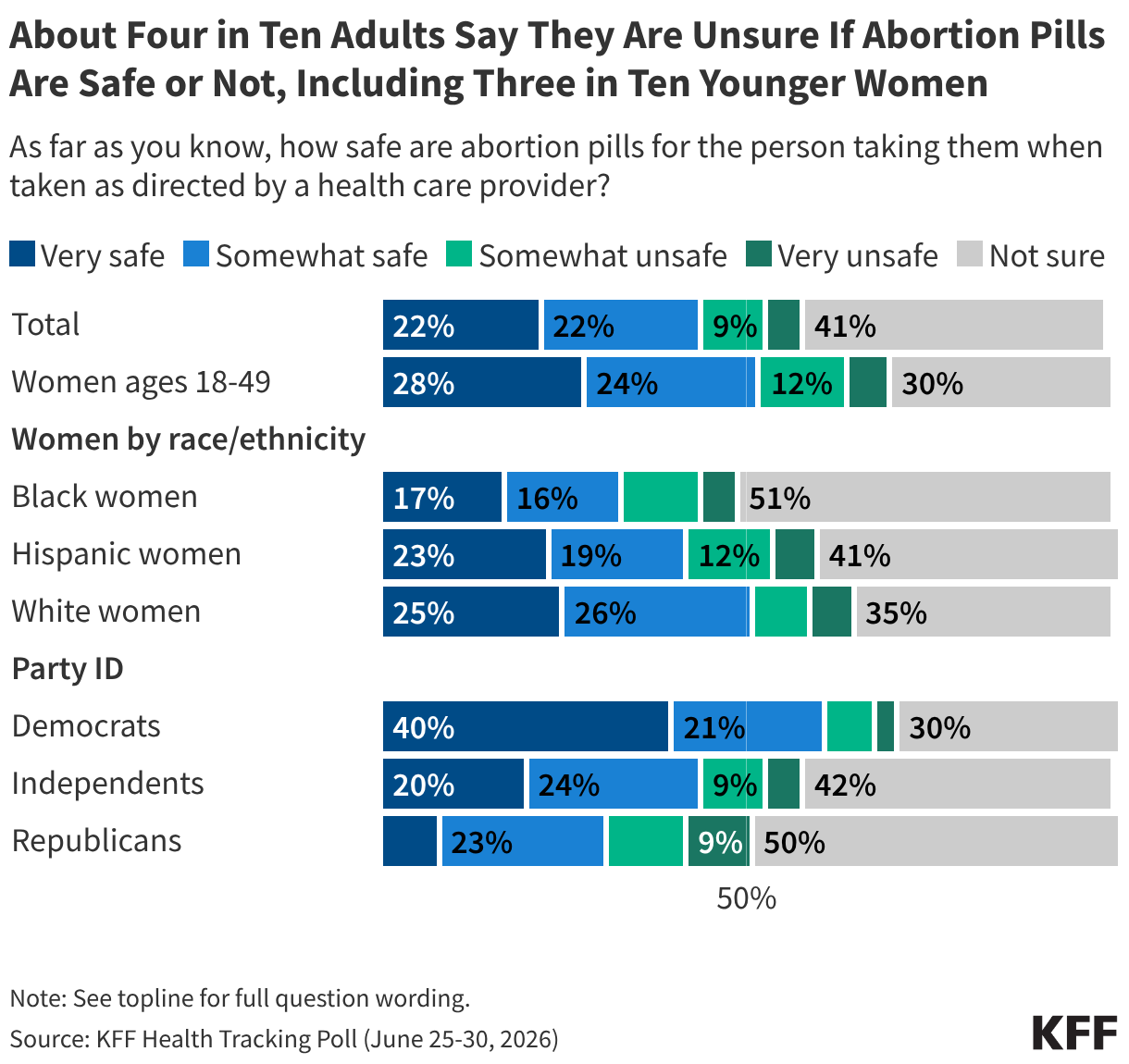
- The Mifepristone Knowledge Gap: Despite a decades-long safety record, 41% of U.S. adults remain unsure whether mifepristone is safe when used as directed. Furthermore, nearly half the population (48%) is unaware that medication abortion is now the most common method of pregnancy termination in the United States.
- The "Wastewater" Strategy: Anti-abortion activists are pivoting toward environmental law, citing a methodologically flawed preprint paper to argue that mifepristone is a water contaminant. This effort aims to bypass traditional medical debates by framing the drug as an ecological hazard, despite a lack of empirical evidence supporting such claims.
- The Rise of Synthetic Medical Experts: Investigations by The New York Times and international fact-checkers have uncovered vast networks of AI-generated influencers. These digital personas—complete with fabricated credentials and simulated clinical environments—are aggressively marketing "miracle cures" to vulnerable populations, leading to real-world health consequences, including salmonella outbreaks.
n
n
n
n
n
II. Chronology: The Evolution of Medical Misinformation (2000–2026)
n
To understand the current state of public confusion, one must trace the parallel trajectories of mifepristone’s legal journey and the advancement of generative AI.
n
- n
- 2000: The FDA approves mifepristone (Mifeprex) for the medical termination of early pregnancy, backed by an environmental assessment that estimated its concentration in water at less than one part per billion—a level deemed negligible for standard test organisms.
- 2016–2021: The FDA relaxes several restrictions on mifepristone, including allowing it to be sent by mail. These changes coincide with a surge in its use, eventually making it the method used in over 60% of U.S. abortions.
- 2022–2024: Following the overturning of Roe v. Wade, mifepristone becomes the primary target of anti-abortion litigation. A series of high-profile court cases challenge the FDA’s original approval process, leading to a climate of heightened public scrutiny and partisan divide.
- 2025: Generative AI technology reaches a tipping point. "Deepfake" technology becomes accessible to low-level scammers, allowing for the creation of hyper-realistic videos of physicians.
- July 2026: KFF releases its July Health Tracking Poll, quantifying the extent of public doubt. Simultaneously, a preprint paper alleging wastewater contamination is published in a journal run by physicians opposed to abortion, providing a new legal avenue for activists.
- August 2026: The FDA enters a critical phase of a court-mandated re-evaluation of mifepristone’s safety, while the AMA and other medical bodies begin a legislative push to curb AI-generated medical impersonation.
n
n
n
n
n
n
n
n
III. Supporting Data: Quantifying the Crisis
n
The KFF July Health Tracking Poll provides a granular look at how misinformation and political polarization have shaped public perception.
n
The Perception of Safety
n
While 44% of adults view medication abortion as safe, the 41% who are "unsure" represent a significant vulnerability in public health literacy. This uncertainty is not evenly distributed:
n
- n
- Black Women: 51% report being unsure of the drug’s safety, a figure that experts attribute to a combination of historical medical mistrust and targeted information campaigns.
- Women of Reproductive Age (18–49): While 52% believe the medication is safe, 30% remain unsure, and 18% believe it is unsafe.
- Partisan Divide: 61% of Democrats view the drug as safe, compared to only 30% of Republicans. Half of all Republicans (50%) say they are "unsure."
n
Lack of Awareness Regarding Abortion Trends
Public knowledge of how abortions are actually performed is equally fragmented. Only 26% of the public correctly identified that most abortions in the U.S. are now performed via medication. An equal share (26%) incorrectly believes most are surgical procedures, while 48% admit they simply do not know. This lack of awareness persists even among "pro-choice" individuals, where roughly half remain uncertain about the primary method of abortion access in the country.
Institutional Distrust
Perhaps the most alarming data point is the lack of confidence in the FDA itself. Over half of the public (54%) expresses "little to no confidence" in the FDA’s ability to make decisions based on science rather than politics when reviewing mifepristone. This distrust is bipartisan, shared by 47% of Democrats and 53% of Republicans, reflecting a post-pandemic decline in the perceived neutrality of federal health agencies.
The Environmental Claims
The "wastewater contamination" claims rest on a testing method that critics say is fundamentally flawed. Environmental health scientists note that the tests used in the controversial preprint do not distinguish between mifepristone and other progesterone-receptor-interacting compounds, such as Bisphenol A (BPA), which is ubiquitous in plastics. The FDA’s original 2000 assessment remains the gold standard, suggesting that mifepristone levels are far too low to impact the environment or human health through water systems.
IV. Official Responses: Regulatory and Professional Pushback
The rise of these threats has triggered a multi-front response from government agencies and professional organizations.
The FDA and EPA
The FDA has stood by its extensive safety record for mifepristone, noting that serious adverse events occur in fewer than 0.5% of patients. In response to the wastewater claims, the agency has pointed to its existing environmental assessments, which label the drug as a "low-risk" substance for the ecosystem. The EPA has not yet moved to classify mifepristone as a contaminant, despite pressure from activist groups, citing a lack of peer-reviewed, scientifically sound evidence.
The American Medical Association (AMA)
The AMA has taken a firm stance against the use of AI to impersonate medical professionals. The organization recently endorsed federal legislation that would hold both individuals and social media platforms liable for distributing unauthorized digital replicas of a person’s likeness or voice. "The sanctity of the patient-physician relationship relies on trust," the AMA stated. "AI deepfakes that hijack a physician’s credibility to sell unproven supplements are a direct threat to public health."
California Medical Association (CMA)
At the state level, the CMA is backing California Senate Bill 1146. This legislation would require any advertisement using an AI-generated likeness of a real person to include a prominent disclosure. This move aims to prevent the "doctor-washing" of supplement ads, where synthetic personas are used to lend an air of unearned clinical authority to unregulated products.
Social Media Platforms
Meta (Facebook/Instagram) and TikTok have both implemented policies to label AI-generated content and remove misleading health claims. However, enforcement remains "uneven." An audit by Maldita.es found that some AI-generated "doctor" accounts even carried blue verification badges, which are intended to confirm identity. TikTok’s labeling system was found to catch only about one-third of synthetic images, highlighting the massive scale of the enforcement challenge.
V. Implications: The Future of Health Information
The convergence of political agendas and synthetic technology has profound implications for the future of public health and democracy.
1. The Erosion of Objective Truth
When 41% of the public is "unsure" about a drug that has been on the market for 26 years, it suggests that the volume of conflicting information has reached a level where many citizens have simply stopped trying to discern the truth. This "information fatigue" makes the public more susceptible to fear-based narratives, such as the environmental contamination claims, which do not require scientific literacy to trigger a visceral reaction.
2. Physical Harm and the Supplement Wild West
The AI-generated influencer phenomenon is not a victimless crime. The New York Times report of a 71-year-old woman contracting salmonella from an AI-promoted supplement is a harbinger of a new era of consumer risk. As scammers use AI to target specific demographics—such as older women or those with chronic illnesses—the potential for mass poisoning or the abandonment of life-saving medical treatments increases exponentially.
3. The Burden on the Healthcare System
The KFF data shows that only 36% of social media users follow up with a doctor to verify health information they see online. This places an immense burden on the 36% of physicians who must now spend clinical time debunking deepfakes and political myths. For the other 64% of users who do not verify information, the risk of self-diagnosis and improper treatment remains high.
4. Regulatory Cat-and-Mouse
The speed of AI development is currently outstripping the speed of legislation. While bills like SB 1146 are a start, the global nature of social media means that "doctor-scammers" can operate from jurisdictions far beyond the reach of the AMA or the California legislature. This suggests that the future of health information will rely less on regulation and more on a radical shift in digital literacy education.
Conclusion
The findings of the July 2026 KFF poll and the emergence of synthetic medical deception represent a critical inflection point. If federal agencies like the FDA cannot regain the public’s trust, and if social media platforms cannot effectively police synthetic personas, the very foundation of evidence-based medicine is at risk. In this new landscape, the most potent tool for public health may no longer be the clinical trial, but the battle for the narrative in the digital town square.

