
Special Report
nUpdated: July 24, 2026
n
The landscape of reproductive healthcare in the United States has undergone a seismic shift over the last half-century, evolving from a federally protected right to a fragmented "postcode lottery" of access. As of mid-2026, the ability of an individual to obtain insurance coverage for abortion services depends almost entirely on their state of residence and the type of insurance plan they hold. This divide has created two distinct Americas: one where abortion is integrated into comprehensive healthcare and another where it is legally and financially inaccessible.
n
Main Facts: The State of Play in 2026
n
The current regulatory environment for abortion coverage is defined by extreme polarization. Following the 2022 Supreme Court decision in Dobbs v. Jackson Women’s Health Organization, states have exercised their regained authority to either mandate or prohibit abortion coverage with unprecedented vigor.
n
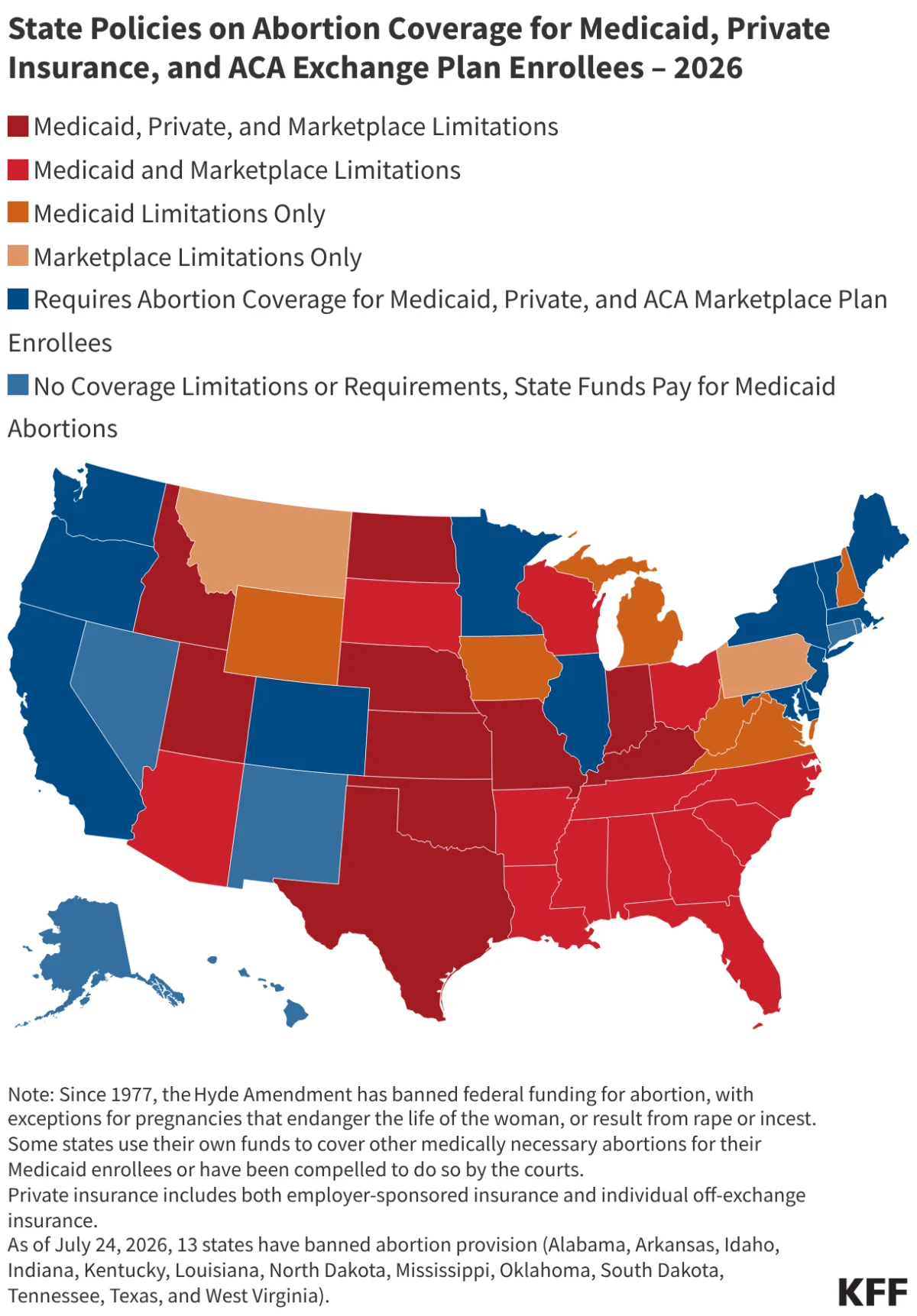
As of January 2026, 13 states have enacted total bans on abortion, effectively rendering the question of insurance coverage moot within their borders. These states include Alabama, Arkansas, Idaho, Indiana, Kentucky, Louisiana, North Dakota, Mississippi, Oklahoma, South Dakota, Tennessee, Texas, and West Virginia. In these jurisdictions, the procedure is illegal regardless of insurance status, except in the narrowest of life-saving circumstances.
n
In states where the procedure remains legal, the insurance landscape is split into three primary categories:
n
- n
- Restrictive States: 29 states and the District of Columbia limit Medicaid coverage to the "Hyde Amendment" minimums—meaning coverage is only provided in cases of rape, incest, or to save the life of the pregnant person. Furthermore, 10 states have passed laws prohibiting private insurance companies from including abortion coverage in their standard policies, and 25 states ban such coverage within their Affordable Care Act (ACA) Marketplaces.
- Neutral/Limited States: Six states maintain a "no limitation" policy, meaning they neither mandate coverage nor prohibit it. In these states, the market dictates whether a plan includes abortion services.
- Mandatory Coverage States: 13 states now require all fully insured group and individual plans to include abortion coverage. These states also use state funds (non-federal) to cover abortions for Medicaid enrollees. Notably, 10 of these states prohibit any cost-sharing (such as co-pays or deductibles) for the procedure, ensuring that financial barriers do not impede access.
n
n
n
n
Chronology: From Roe to the Present Day
n
The journey toward this fragmented reality began shortly after the 1973 Roe v. Wade decision. The timeline of abortion coverage is marked by federal restrictions that paved the way for state-level divergence.
n
1976–1977: The Hyde Amendment
n
Just three years after Roe, Representative Henry Hyde successfully introduced a legislative rider to the annual federal appropriations bill. The Hyde Amendment banned the use of federal funds (specifically Medicaid) for abortion. While initially a total ban, it was later amended to include exceptions for life endangerment, rape, and incest. This created the first major hurdle for low-income individuals seeking reproductive care.
n
2010: The Affordable Care Act (ACA)
n
The passage of the ACA was a landmark for healthcare, but it also became a vehicle for further abortion restrictions. To secure the necessary votes for passage, the Obama administration maintained the Hyde Amendment’s limits. Crucially, the ACA allowed states to opt out of allowing abortion coverage in their state-run or federal Marketplaces. This led to a wave of state-level legislation throughout the 2010s aimed at stripping abortion coverage from private insurance markets.
n
2022: The Overturning of Roe
n
On June 24, 2022, the Supreme Court’s decision in Dobbs ended the federal constitutional right to abortion. This triggered "trigger laws" in several states and emboldened legislatures to move beyond simple funding bans to total criminalization.
n
2024–2026: The Expansion of Mandates
n
In response to the Dobbs decision, a counter-movement emerged in "Blue" states. Between 2024 and 2026, states like Minnesota, Illinois, and Delaware strengthened their protections. Pennsylvania, most recently updated in July 2026, has seen ongoing legislative and judicial battles to expand Medicaid access, reflecting a broader national trend of states using their own tax revenue to bypass federal Hyde restrictions.
n
Supporting Data: The Mechanics of Coverage
n
Understanding the impact of these policies requires a look at the specific insurance mechanisms involved. Coverage is generally divided into three buckets: Medicaid, Marketplace plans, and Private/Employer-sponsored insurance.
n
Medicaid and State Funding
n
Because Medicaid is a joint federal-state program, the Hyde Amendment prevents federal dollars from being used for most abortions. However, states have the option to use their own funds to provide broader coverage.
n
- n
- The 13-State Mandate: States like California, New York, and Oregon require Medicaid to cover abortion as a medically necessary service.
- The Cost-Sharing Divide: Cost-sharing acts as a secondary barrier. While Illinois and Minnesota allow for cost-sharing if it mirrors other services, Delaware has taken a middle-ground approach, prohibiting cost-sharing for abortions up to a $750 cap.
n
n
The Marketplace and Private Restrictions
The ACA Marketplace is where many self-employed or small-business employees receive coverage.
- Marketplace Prohibitions: In 25 states, even if a consumer is willing to pay for a plan that covers abortion, they cannot find one on the state exchange.
- The "Rider" Workaround: In the 10 states that prohibit private insurance coverage, some allow for the purchase of an "abortion rider"—an additional insurance premium paid separately. However, data suggests these riders are rarely offered by insurers and even more rarely purchased by consumers, as the need for an abortion is often an unpredictable event.
Official Responses and Judicial Perspectives
The divergence in state policies has sparked a litany of official responses from both sides of the aisle, alongside significant judicial intervention.
Pro-Access Advocates:
Advocates in states like Illinois and New York argue that abortion coverage is a matter of "health equity." State officials in these jurisdictions have stated that without insurance coverage, the right to an abortion is "purely theoretical" for low-income individuals. The Illinois Department of Insurance has emphasized that by eliminating cost-sharing, they are treating reproductive healthcare as a fundamental right rather than a luxury service.
Pro-Life and Fiscal Conservatives:
Conversely, officials in states like Texas and Mississippi have framed the prohibition of coverage as a "conscience protection" for taxpayers and policyholders. They argue that individuals who morally object to abortion should not have their premiums or tax dollars subsidizing the procedure. This "conscience-based" argument was a primary driver for the 25 states that banned coverage in ACA Marketplaces.
Judicial Challenges:
The courts continue to play a pivotal role. In Pennsylvania, recent 2026 updates reflect ongoing litigation regarding the state’s Equal Rights Amendment. Proponents argue that restricting Medicaid coverage for abortion while covering all other pregnancy-related care constitutes sex discrimination. Similar arguments have been used in state supreme courts to strike down coverage bans, even in states where the legislature is hostile to abortion rights.
Implications: The Human and Economic Cost
The implications of these varying policies extend far beyond the courtroom, impacting the economic stability and health outcomes of millions of Americans.
The Financial Burden
For individuals in the 29 states that limit Medicaid coverage, the out-of-pocket cost of an abortion—which can range from $600 to over $2,000 depending on the gestational age and type of procedure—is often insurmountable. Studies have shown that when insurance does not cover abortion, many patients are forced to delay the procedure while they raise funds. This delay often leads to more complex and expensive procedures, or in some cases, the inability to obtain the procedure at all.
Health Equity and the "Postcode Lottery"
The current system exacerbates existing healthcare disparities. Wealthier individuals in restrictive states can often afford to travel to "protective" states or pay out-of-pocket. However, for low-income individuals, particularly those in the 13 states with total bans, the lack of insurance coverage is a definitive barrier. This has led to a rise in "maternal mortality deserts," where the combination of limited reproductive care and poor insurance coverage contributes to worsening health outcomes for marginalized communities.
Economic Impact on States
There is also an emerging economic divide. States that mandate coverage argue that it reduces long-term state spending on public assistance and improves the economic participation of women. Meanwhile, restrictive states face potential workforce challenges, as some corporations have expressed hesitation to expand in regions where reproductive healthcare for their employees is legally restricted or uninsured.
Conclusion
As of July 2026, the United States remains a nation deeply divided. The evolution from the Hyde Amendment to the current state-mandated coverage or total bans represents a complete decentralization of healthcare policy. For the American consumer, the "right to choose" has been replaced by the "right to coverage," a right that currently ends at the state line.

