
WASHINGTON D.C. — As the United States moves toward the close of 2026, the landscape of healthcare for the nation’s 24 million noncitizen immigrants has reached a critical juncture. A combination of sweeping federal legislative changes, shifting state-level fiscal priorities, and the fallout of the 2026 midterm elections has created a disparate "postcode lottery" for health access.
n
According to data updated on November 25, 2026, the implementation of the 2025 federal budget reconciliation law has begun to systematically dismantle decades of coverage progress for lawfully present immigrants, even as a handful of states scramble to mount a self-funded defense of their public health infrastructure.
n
n
Main Facts: The 2025 Reconciliation Law and the New Barriers to Care
n
The primary driver of the current crisis is the 2025 federal budget reconciliation law, a landmark piece of legislation that has fundamentally redefined eligibility for federal health programs. For decades, while undocumented immigrants were largely barred from federal subsidies, many lawfully present immigrants—including green card holders, refugees, and asylees—could eventually access the safety net.
n
The 2025 law has reversed this trajectory in three significant ways:
n
- n
- Restricted Eligibility: Access to Medicaid, the Children’s Health Insurance Program (CHIP), subsidized Affordable Care Act (ACA) Marketplace coverage, and Medicare is now strictly limited to Lawful Permanent Residents (LPRs), certain Cuban and Haitian entrants, and citizens of Freely Associated (COFA) nations.
- The "Five-Year Wait" Re-solidified: The law reinforced the requirement that many LPRs must wait five years before enrolling in Medicaid, removing previous flexibilities.
- The Subsidy Cliff: Effective January 1, 2026, the law eliminated ACA Marketplace coverage for lawfully present immigrants with incomes below 100% of the federal poverty level (FPL), leaving a massive coverage gap for the working poor.
n
n
n
n
The Congressional Budget Office (CBO) issued a stark warning following these changes, estimating that 1.4 million lawfully present immigrants will become uninsured by 2034 due to these restrictions. For the undocumented population, the situation remains even more precarious, as they remain entirely ineligible for federally funded enrollment, relying instead on a shrinking pool of state-funded initiatives and Emergency Medicaid—the latter of which saw its federal matching rate reduced as of October 2026.
n
n
Chronology: A Timeline of Legislative Retraction (2025–2027)
n
To understand the current state of immigrant health, one must look at the rapid-fire succession of policy shifts over the last 24 months:
n
- n
- Early 2025: The federal budget reconciliation law is passed, setting the stage for phased eligibility cuts.
- January 1, 2026: Thousands of lawfully present immigrants with low incomes are purged from the ACA Marketplaces as the <100% FPL subsidy elimination takes effect.
- February 2026: Utah officially closes its state-funded CHIP enrollment for immigrant children, signaling a trend of state-level fiscal tightening.
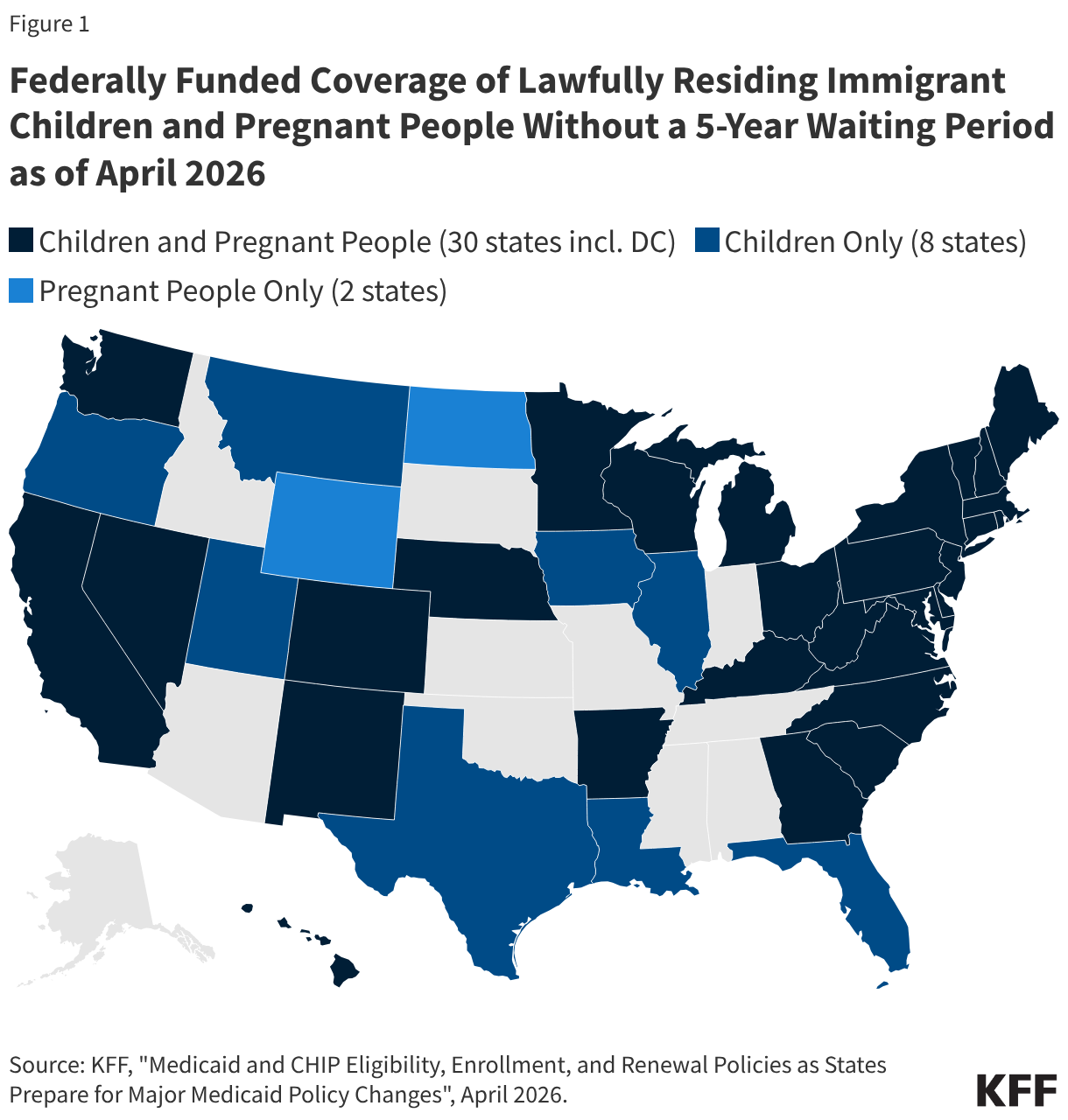
- April 2026: Data shows 38 states have opted to cover immigrant children and 32 cover pregnant people without the five-year wait, attempting to mitigate federal losses.
- July 2026: Colorado begins significant rollbacks, capping enrollment for its state-funded children’s coverage at 25,000 and stripping dental benefits.
- October 1, 2026: Major Medicaid and CHIP restrictions take full effect nationwide. The federal government reduces the matching rate for Emergency Medicaid services provided to expansion-eligible adults.
- November 2026 (Current): Following the midterm elections, Democrats take control of Congress, sparking debates about a potential repeal of the 2025 restrictions. However, 21 states prepare to swear in new governors in January 2027, many of whom have campaigned on further fiscal austerity.
- January 1, 2027 (Projected): Subsidized Marketplace and Medicare restrictions for lawfully present immigrants will take full effect, marking the final phase of the reconciliation law’s health provisions.
n
n
n
n
n
n
n
n
n
n
Supporting Data: A Nation Divided by State Policy
n
The response to federal retrenchment has split the country into two distinct camps: "backfill states" that are using local tax dollars to replace lost federal funds, and "austerity states" that are following the federal lead in cutting benefits.
n
The Proactive Minority
n
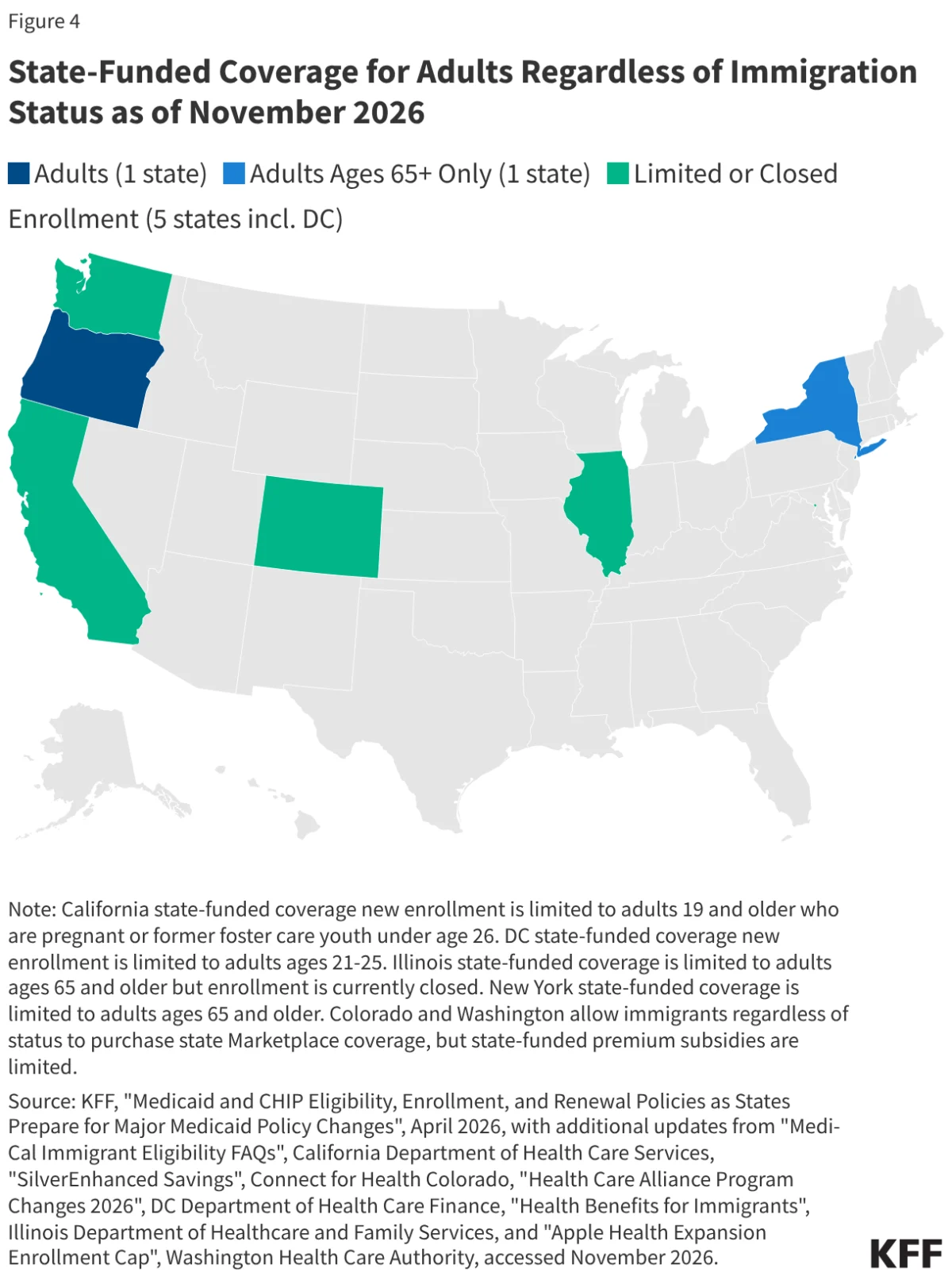
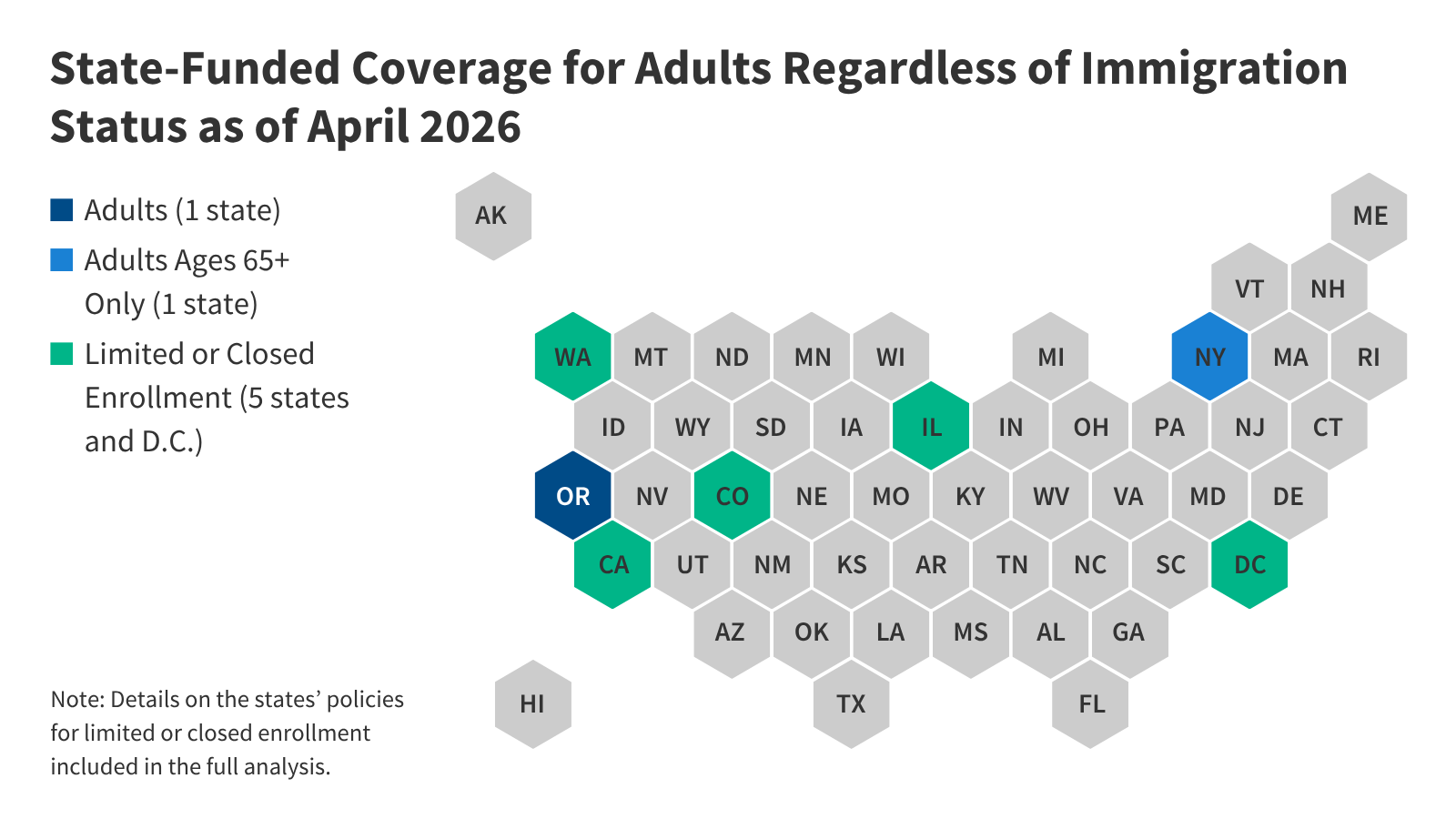
Five states—California, Minnesota, New Mexico, New York, and Oregon—have emerged as the vanguard of immigrant health.
- California and Oregon are currently using state funds to provide a bridge for those losing Medicaid.
- New York is leveraging its "Essential Plan" trust fund reserves to maintain coverage, though experts warn these funds may be exhausted by December 2028.
- Minnesota has expanded its "MinnesotaCare" Basic Health Program to absorb those displaced by federal cuts.
The Children and Pregnancy Gap
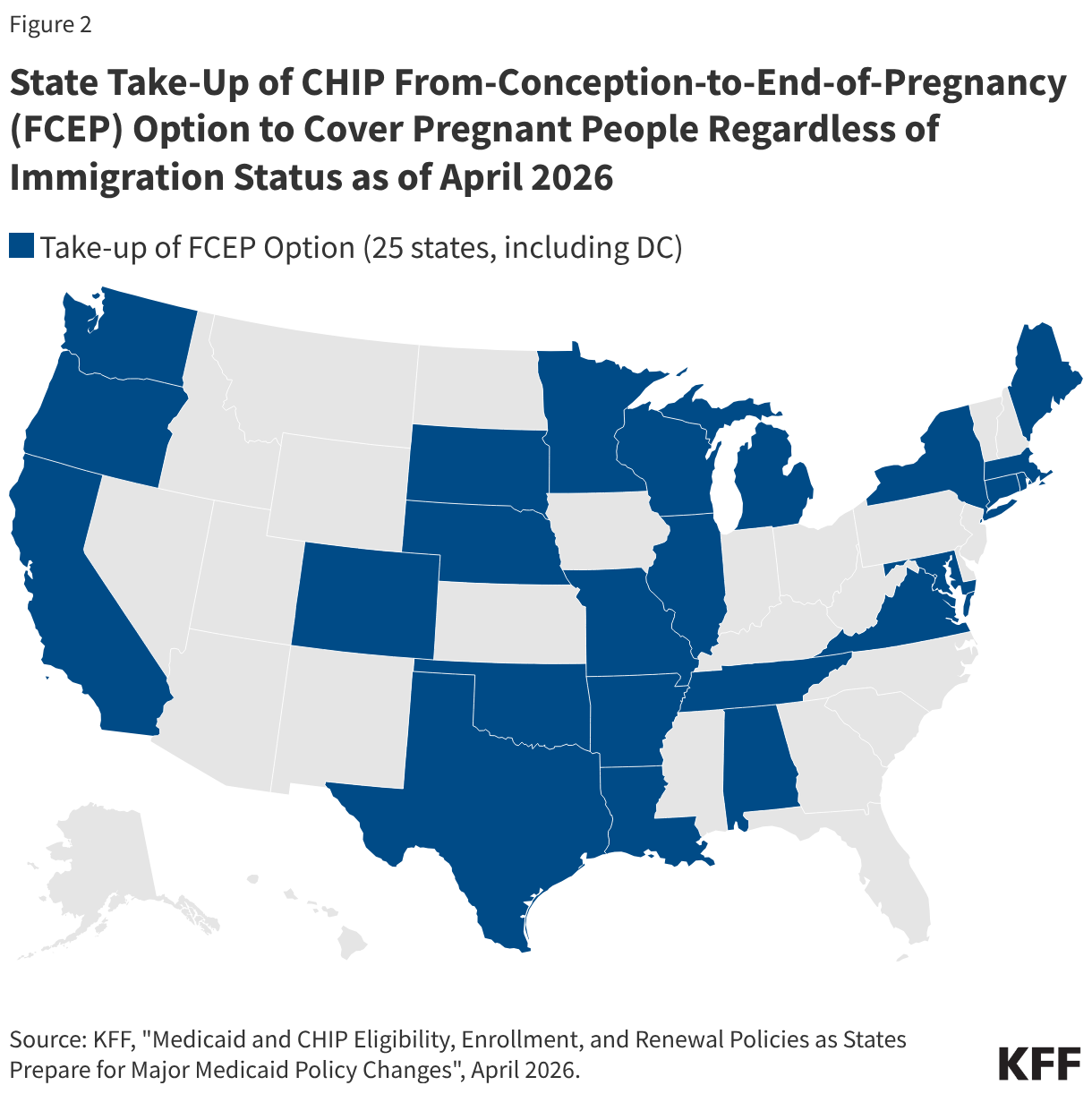
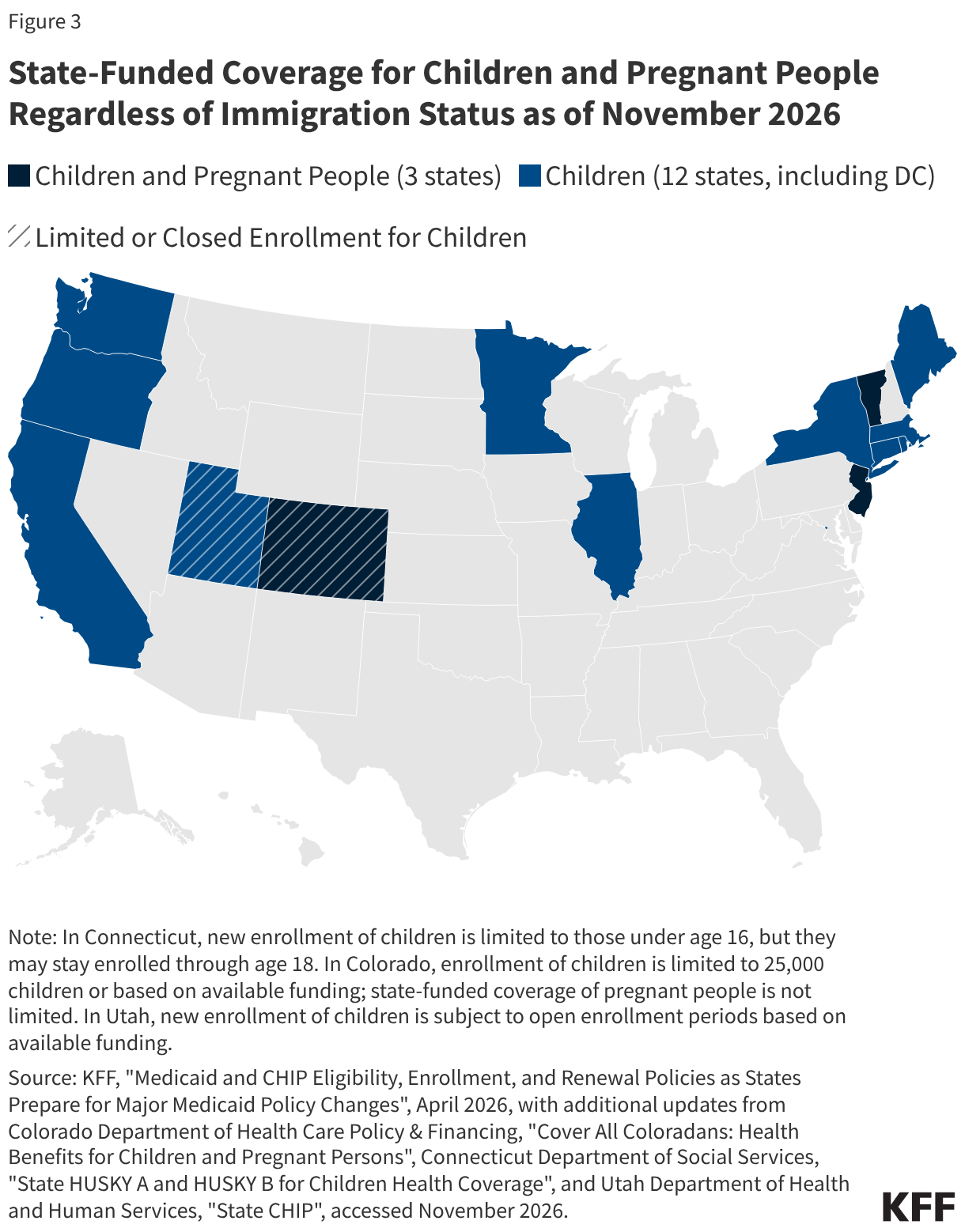
As of late 2026, 15 states and the District of Columbia provide comprehensive, state-funded coverage for children regardless of status. Additionally, 25 states have utilized the "From-Conception-to-End-of-Pregnancy" (FCEP) option under CHIP. While this provides vital prenatal care, it often fails to cover the mother after birth. Only 11 states have stepped in to extend postpartum coverage to a full 12 months using state-only funds.
The Budgetary Backlash
Conversely, states like Illinois, Colorado, and the District of Columbia have recently scaled back adult coverage. In Colorado, the Governor’s proposed fiscal year 2028 budget includes the total elimination of state-funded coverage for all immigrant children by January 2028. Maryland, citing the administrative burden of the 2025 reconciliation law, has delayed its plans to allow undocumented residents to buy into the state marketplace until at least 2028.
Official Responses and Policy Perspectives
The policy shift has drawn sharp criticism from public health advocates and varying defenses from state executives.
The Economic Argument:
Fiscal analysts point to the contributions of the immigrant workforce as a reason for concern. According to the Institute on Taxation and Economic Policy (ITEP), undocumented immigrants contribute billions in taxes annually. Advocates argue that stripping health coverage from this workforce is "economically short-sighted."
"Immigrant families are the backbone of our agricultural and service sectors," said a spokesperson for a leading health policy non-profit. "When we deny them preventive care, we aren’t saving money; we are simply shifting the cost to emergency rooms and risking the stability of our labor force."
State Executive Constraints:
Governors in states like Colorado have defended rollbacks as a matter of mathematical necessity. "We are facing unprecedented budget pressures," a spokesperson for the Colorado Governor’s office noted regarding the July 2026 caps. "Without federal partnership, the state cannot single-handedly fund a comprehensive health system for every resident without jeopardizing other essential services like education and infrastructure."
The Federal Outlook:
With the 2026 midterm results shifting control of Congress to the Democrats, there is a burgeoning movement in Washington to revisit the reconciliation law. However, policy experts at KFF suggest that legislative gridlock and the upcoming transition of 21 governorships in 2027 make a swift federal reversal unlikely.
Implications: The Long-Term Cost of Uninsurance
The repercussions of these policy shifts extend far beyond individual health. Research consistently shows that when immigrants have access to coverage, the entire community benefits.
- Public Health Outcomes: A KFF/New York Times 2025 survey revealed that immigrant adults in "expansive" states are half as likely to be uninsured (11%) compared to those in restrictive states (23%). Studies in California showed that expanding coverage to children led to a 34% decline in uninsurance and a corresponding rise in preventive health visits.
- Economic Productivity: Uninsured workers are more likely to suffer from untreated chronic conditions, leading to higher rates of absenteeism and lower economic output.
- Hospital Stability: As federal matching for Emergency Medicaid decreases, safety-net hospitals—particularly in border states and urban centers—face an increase in uncompensated care costs. This could lead to service reductions that affect all patients, regardless of citizenship status.
- Maternal and Infant Health: The restriction of postpartum care is expected to have a measurable impact on infant mortality and maternal morbidity. States that provide 12-month postpartum care see significantly improved birth outcomes compared to those that terminate coverage 60 days after delivery.
As 2027 approaches, the United States faces a "wait-and-see" period. The divergence between state and federal policy has created a patchwork system where an immigrant’s survival may depend entirely on the state line they happen to reside behind. While some states are proving that a state-funded safety net is possible, the looming exhaustion of trust funds and the persistent pressure of inflation suggest that without a federal course correction, the 1.4 million projected to lose coverage may be just the beginning of a larger public health retreat.

