
Introduction
n
The American healthcare landscape is currently undergoing a seismic shift as the intersection of immigration policy and federal budgeting creates a new reality for millions of residents. At the heart of this transformation is the 2025 tax and budget reconciliation law, a cornerstone of the Trump administration’s legislative agenda. While the law aims to overhaul federal spending, its provisions include significant restrictions on health coverage eligibility that are projected to leave 1.4 million lawfully present immigrants uninsured by 2034.
n
However, a critical "firewall" remains: the Immigrant Children’s Health Improvement Act (ICHIA). This 2009 policy, which allows states to bypass federal waiting periods and eligibility restrictions for children and pregnant individuals, has emerged as the primary mechanism through which states can mitigate the looming coverage losses. As federal protections recede, the disparity between states that adopt ICHIA and those that do not is expected to widen, creating a patchwork of health security across the United States.
n
Main Facts: The 2025 Legislative Overhaul
n
The 2025 reconciliation law introduces a more stringent definition of who qualifies for federally funded health programs. For decades, the system operated under a complex hierarchy of "qualified" statuses, but the new law narrows the gate significantly.
n
1. Restricted EligibilitynUnder the new mandates, federally funded coverage—including Medicaid, the Children’s Health Insurance Program (CHIP), subsidized Affordable Care Act (ACA) Marketplace plans, and Medicare—will be restricted to a specific subset of the immigrant population. This includes Lawful Permanent Residents (LPRs or green card holders), certain Cuban and Haitian entrants, and individuals residing in the U.S. under Compacts of Free Association (COFA).
n
2. The Impacted GroupsnThe most striking aspect of the law is the exclusion of groups previously considered lawfully present. Humanitarian immigrants, such as refugees and asylees, as well as holders of U-visas (victims of crime), T-visas (victims of trafficking), and those with Temporary Protected Status (TPS), will largely lose access to federal subsidies and public programs.
n
3. The Projected FalloutnAccording to analysis by the Congressional Budget Office (CBO) and KFF, the Medicaid and CHIP restrictions alone are expected to result in 100,000 individuals losing coverage. When factoring in the loss of ACA subsidies, the total number of uninsured lawfully present immigrants is expected to climb by 1.4 million over the next decade.
n
4. The ICHIA ExceptionnCrucially, the 2025 law did not repeal the ICHIA option. This allows states to continue providing Medicaid and CHIP coverage to lawfully residing children and pregnant people, regardless of whether they meet the new federal "qualified" definitions. It also allows states to waive the traditional five-year waiting period that usually applies to green card holders.
n
Chronology: From Welfare Reform to the 2025 Shift
n
To understand the gravity of the current changes, one must look at the three-decade evolution of immigrant health policy in the United States.
n
- n
- 1996: The Great Restriction (PRWORA). The Personal Responsibility and Work Opportunity Reconciliation Act fundamentally changed immigrant access to benefits. It created the "qualified status" category and imposed a mandatory five-year waiting period for most lawfully present immigrants before they could access Medicaid or CHIP.
- 2009: The ICHIA Breakthrough. Recognizing the public health risks of leaving immigrant children uninsured, Congress passed the Children’s Health Insurance Program Reauthorization Act (CHIPRA). Section 214 of this act—known as ICHIA—gave states the option to provide Medicaid and CHIP to lawfully residing children and pregnant people without the five-year wait.
- 2010: The ACA Buffer. The Affordable Care Act provided a secondary safety net. Lawfully present immigrants who were ineligible for Medicaid due to the five-year wait could instead purchase subsidized private insurance through the Marketplace.
- 2024-2025: The Trump Administration Pivot. Following the 2024 election, the administration and Congress utilized the reconciliation process to tighten federal spending. The resulting 2025 law effectively dismantled the ACA buffer for many immigrants and narrowed Medicaid eligibility.
- 2026: The Implementation Deadline. The new Medicaid and CHIP eligibility restrictions are scheduled to take effect on October 1, 2026. This gives states a narrow window to decide whether to adopt or maintain ICHIA coverage to protect their populations.
n
n
n
n
n
n
Supporting Data: The "ICHIA Effect" on Noncitizen Children
n
Recent data from the 2024 American Community Survey (ACS) provides a clear picture of why the ICHIA option is so vital. As of 2024, there were approximately 2.6 million noncitizen children residing in the U.S. Their coverage status varies wildly based on their length of residency and, more importantly, the state in which they live.
n
Uninsured Rates by Residency
n
Noncitizen children are significantly more vulnerable than their U.S.-citizen peers:
n
- n
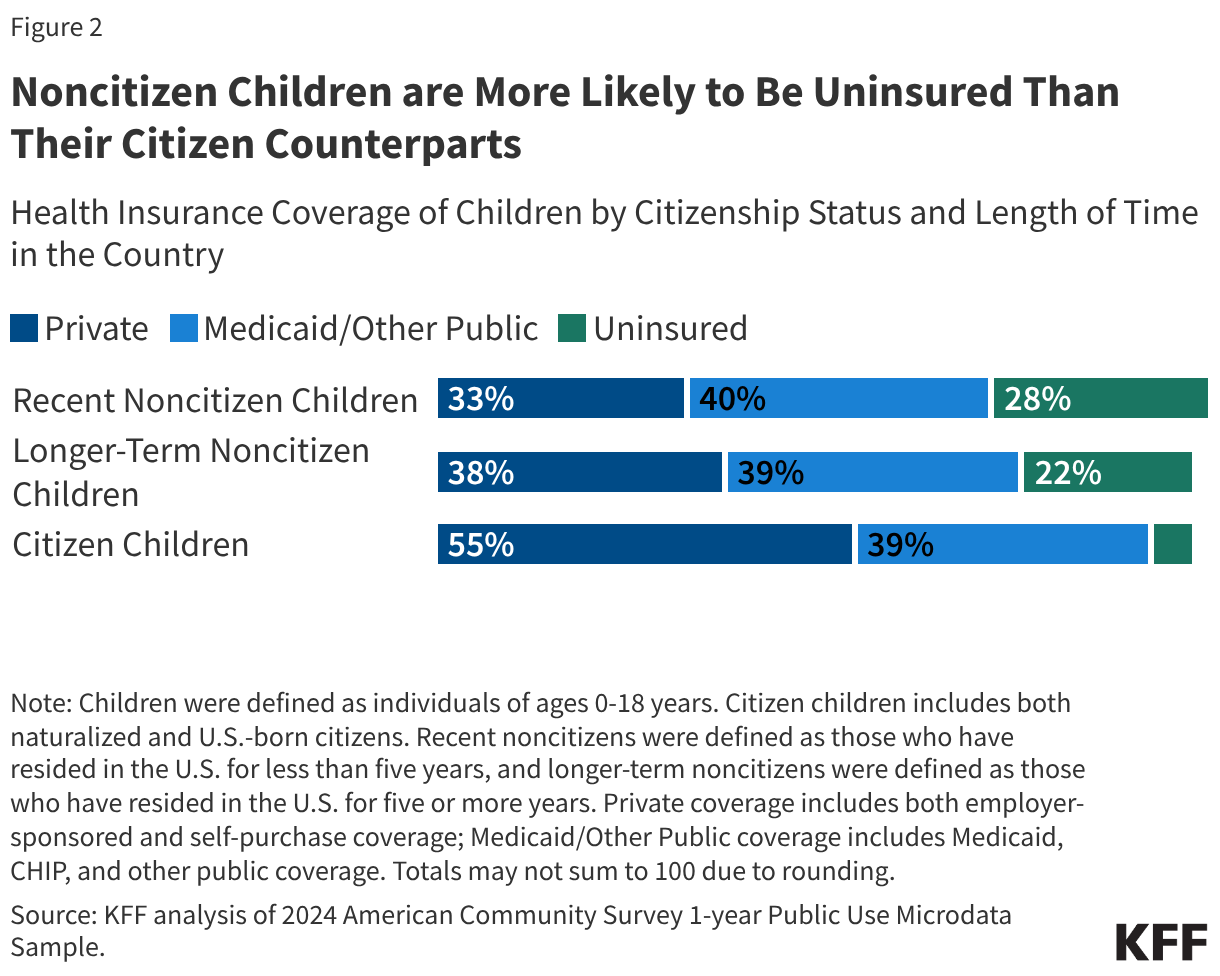
- U.S. Citizen Children: 5% uninsured rate.
- Long-term Noncitizen Children (5+ years in U.S.): 22% uninsured rate.
- Recent Noncitizen Children (less than 5 years in U.S.): 28% uninsured rate.
n
n
The high uninsured rate among recent arrivals is directly linked to the five-year waiting period and the high cost of private insurance for low-income families.
The State-Level Divide
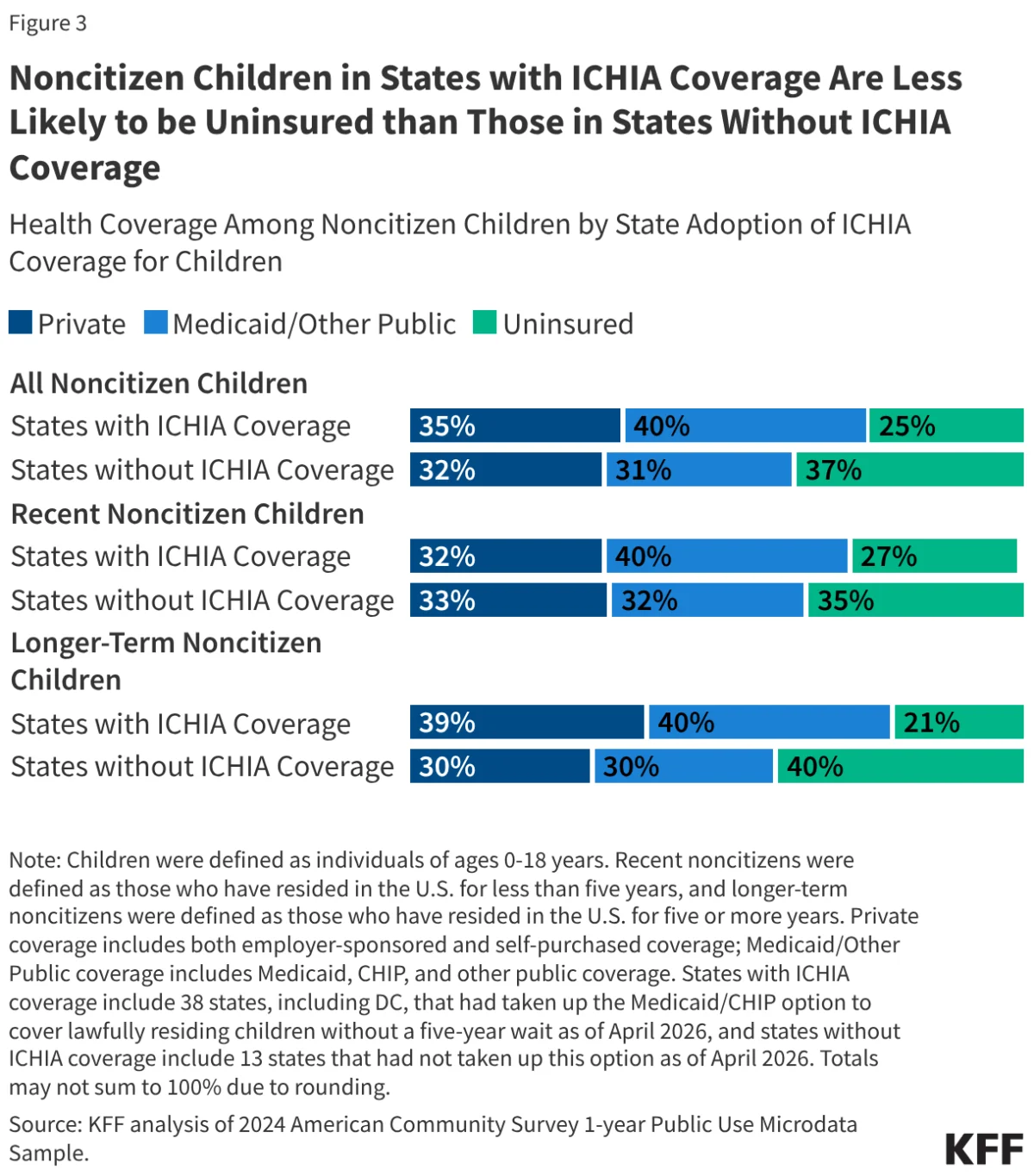
The KFF analysis reveals a stark "ICHIA Effect." In the 38 states (plus D.C.) that have adopted the ICHIA option for children, the uninsured rate for noncitizen children is 25%. In the 11 states that have not adopted the option, the uninsured rate jumps to 37%.
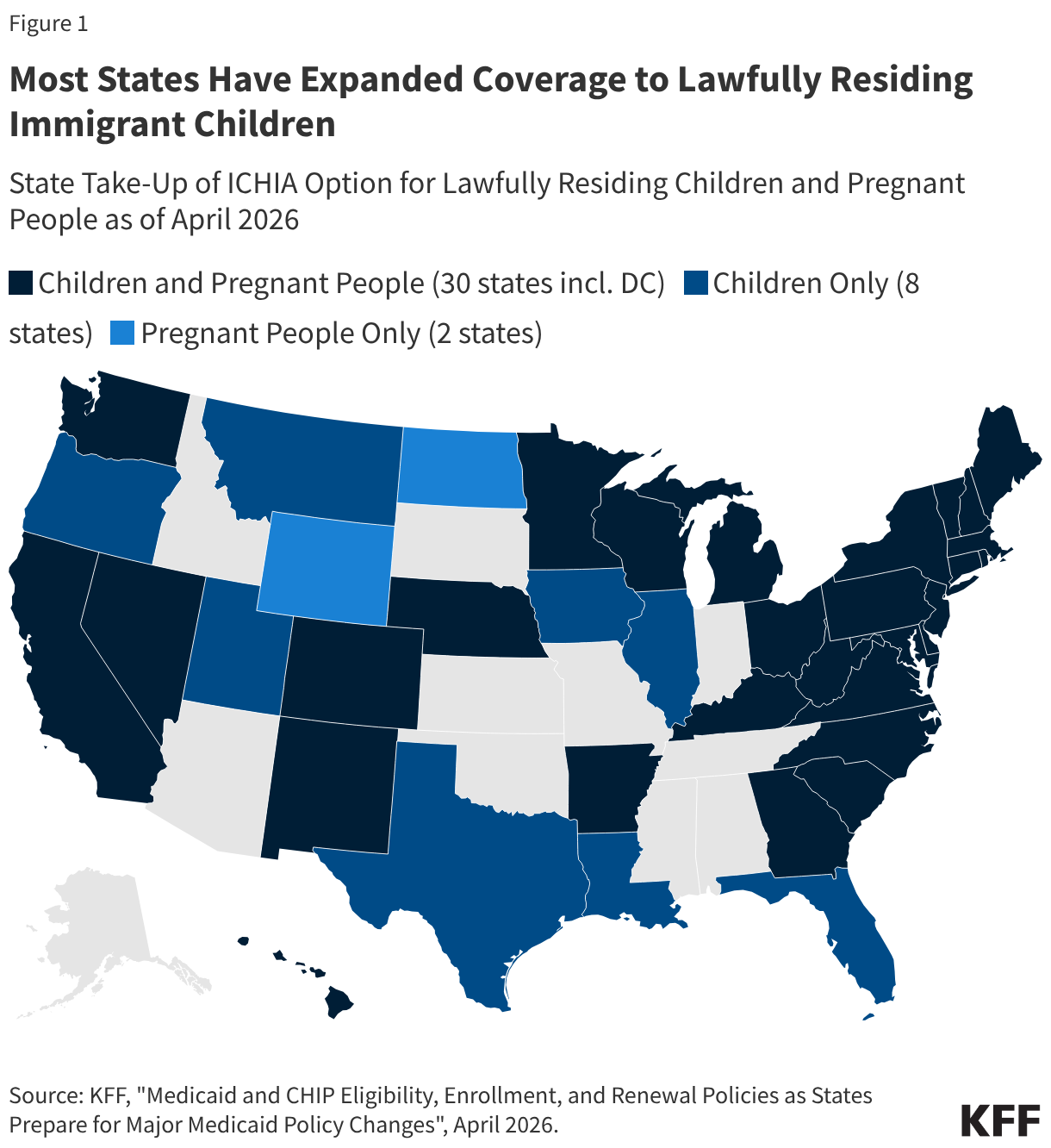
This 12-percentage-point difference is largely attributed to the availability of public coverage. In ICHIA states, public programs like Medicaid and CHIP fill the gap left by the lack of employer-sponsored insurance. Currently, over 92% of noncitizen children in the U.S. live in states that have adopted ICHIA, meaning a rollback of this option at the state level would be catastrophic.
State-Funded Alternatives
Beyond ICHIA, some states have gone further. California, Oregon, Washington, and Illinois provide fully state-funded coverage to children regardless of their immigration status (including undocumented children). These states serve as the most robust examples of local intervention against federal tightening.
Official Responses and Political Perspectives
The reaction to the 2025 reconciliation law has been sharply divided along partisan and ideological lines.
The Trump Administration’s Stance
The administration has framed the restrictions as a matter of fiscal responsibility and national sovereignty. Officials argue that federal resources should be prioritized for U.S. citizens and that the expansion of "welfare-style" benefits to noncitizens creates a "magnet effect" for illegal immigration. By narrowing eligibility to LPRs and specific humanitarian groups like COFA migrants, the administration claims it is returning to the original intent of the 1996 welfare reforms.
Healthcare Advocacy and Public Health Experts
Groups such as KFF, the American Academy of Pediatrics, and various immigrant rights organizations have expressed deep concern. They point to the "chilling effect" of these policies, where even families who remain eligible for coverage may withdraw from programs due to fear or confusion regarding "public charge" rules.
"Health is not a partisan issue; it is a developmental one," noted a KFF analyst. "When children lose coverage, they lose access to preventative care, vaccinations, and chronic disease management. This doesn’t just hurt the families; it increases the long-term costs for the entire healthcare system when these individuals eventually seek care in emergency rooms."
State-Level Reactions
The response from governors has been mixed. In states like North Carolina and Florida, there is a push to align state policy with federal changes to reduce budget outlays. Conversely, leaders in states like New York and Massachusetts are exploring ways to expand state-funded "wrap-around" services to cover those who will be dropped from federal rolls in 2026.
Implications: The Long-Term Consequences of Uninsurance
The implications of the 2025 reconciliation law extend far beyond simple insurance metrics. The ripple effects will be felt in the economy, the education system, and the public health infrastructure.
1. Economic Stability
Uninsured children are less likely to receive the care they need to stay healthy and succeed in school. Research consistently shows that access to Medicaid in childhood is linked to higher educational attainment and greater economic stability in adulthood. By cutting coverage, the law may inadvertently limit the future productivity of a significant portion of the upcoming workforce.
2. The Burden on Safety Net Providers
As 1.4 million people lose insurance, the burden of care will shift to community health centers and hospital emergency departments. These "safety net" providers are already operating on thin margins. An influx of uninsured patients seeking uncompensated care could lead to longer wait times and reduced services for all community members.
3. Administrative and "Chilling" Effects
One of the most immediate risks is administrative coverage loss. As states re-screen millions of people to meet the new 2026 federal requirements, many eligible individuals—including those protected by ICHIA—may lose coverage due to paperwork errors or a lack of understanding of the new rules. Effective outreach and communication will be essential to prevent a "bureaucratic purge" of eligible children.
4. The Future of ICHIA
While the 2025 law spared ICHIA, the policy is not immune to future pressures. As states face their own budget crunches, the optional nature of ICHIA makes it a potential target for state-level cuts. If a significant number of states were to drop the ICHIA option, the number of uninsured immigrant children could double almost overnight.
Conclusion
The 2025 reconciliation law represents a definitive turn toward more restrictive immigrant health policy at the federal level. By 2034, the landscape of American healthcare will likely be defined by a sharp divide: one where citizenship status is the primary determinant of health security.
For the 2.6 million noncitizen children in the U.S., the ICHIA option remains the most significant protection against this tide. The decisions made by state legislators over the next 18 months—whether to maintain, expand, or eliminate these optional protections—will determine the health and well-being of an entire generation of future Americans. As the October 2026 deadline approaches, the focus shifts from the halls of Congress to state capitals, where the real impact of the 2025 law will be decided.

