
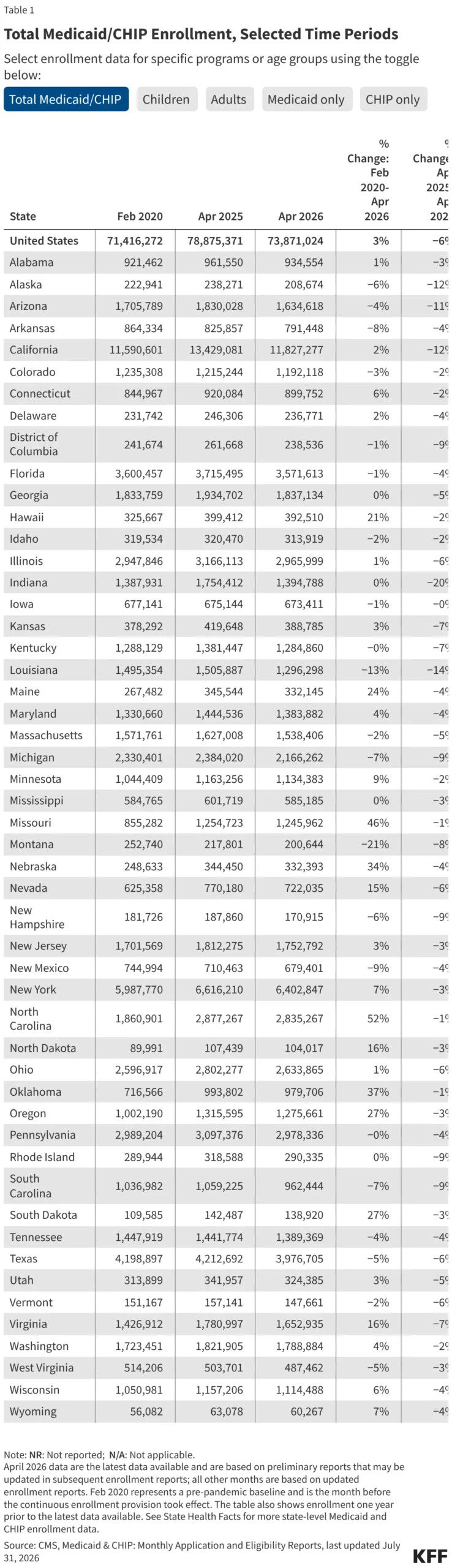
Washington, D.C. — As of April 2026, the United States healthcare system continues to grapple with the aftermath of the most significant administrative overhaul in the history of the Medicaid program. Following the conclusion of the "Great Unwinding" and the passage of the 2025 federal reconciliation law, new data from the Centers for Medicare & Medicaid Services (CMS) and analysis from the Kaiser Family Foundation (KFF) reveal a program in a state of profound transition.
n
With over 25 million individuals disenrolled since the post-pandemic eligibility redeterminations began, and new work requirements looming for 2027, the safety net that covers nearly one in four Americans is being fundamentally reshaped.
n
Main Facts: A Program Under Pressure
n
The latest figures, updated through April 2026, underscore a stark contraction in Medicaid and Children’s Health Insurance Program (CHIP) enrollment. The data, primarily sourced from the CMS Performance Indicator Project, highlights several critical metrics that define the current state of public health coverage:
n
- n
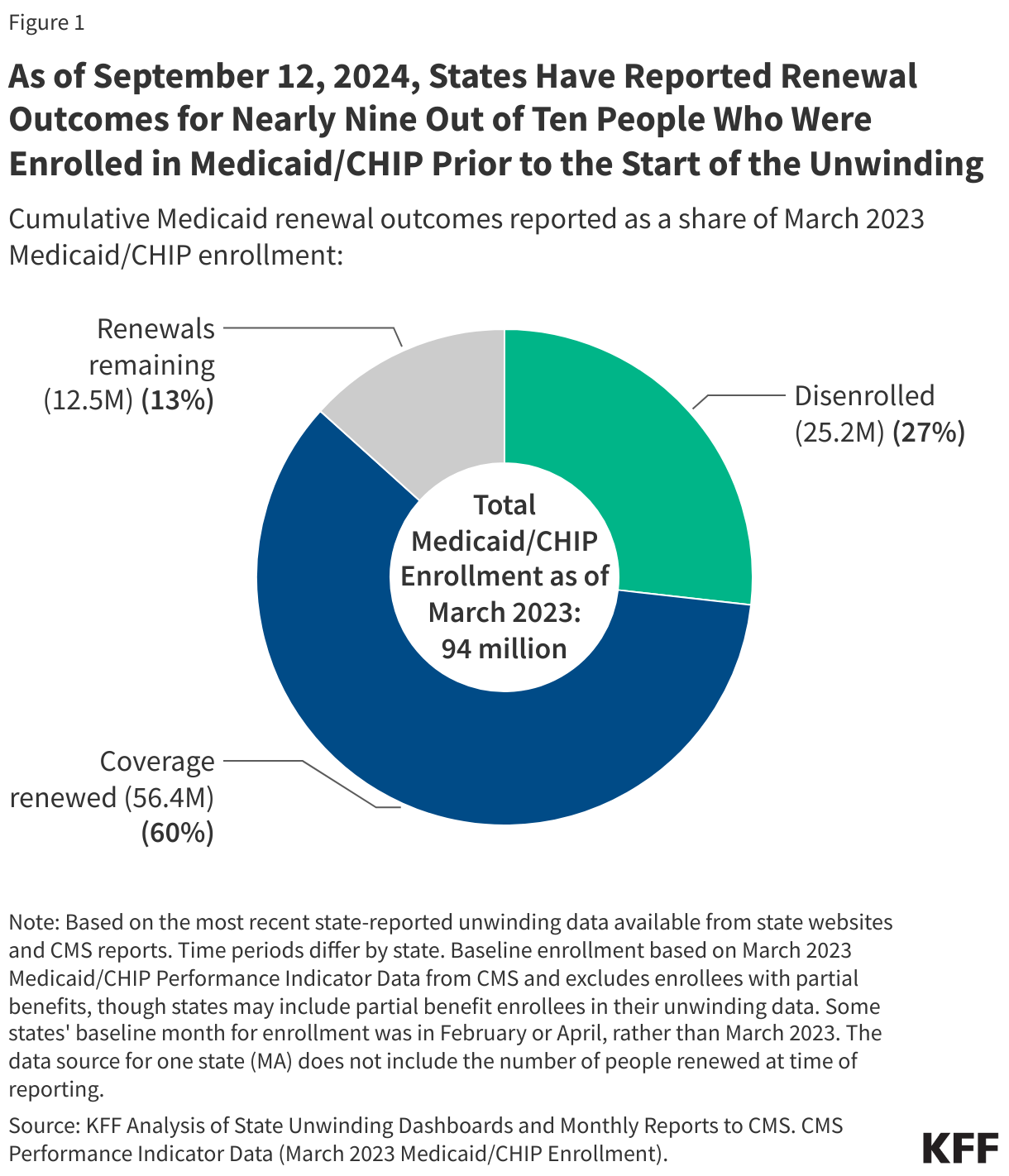
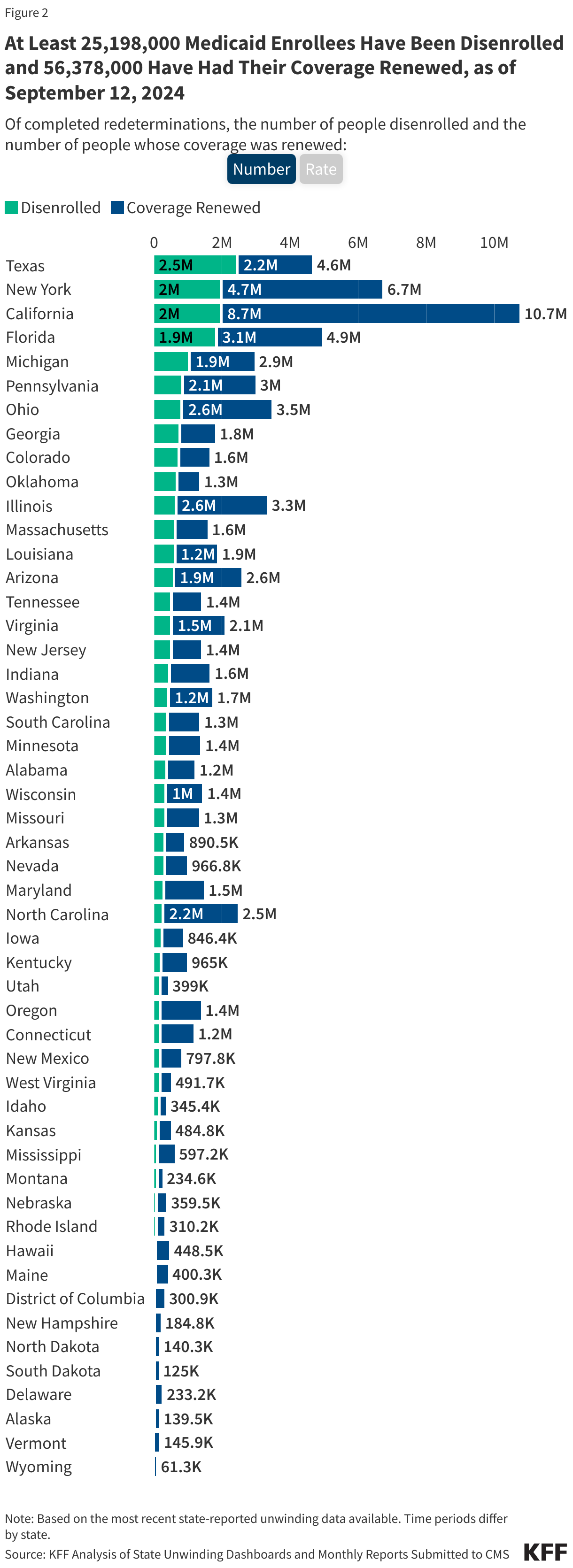
- Mass Disenrollment: Since the end of the pandemic-era continuous enrollment provision, at least 25,198,000 individuals have been removed from Medicaid and CHIP rolls.
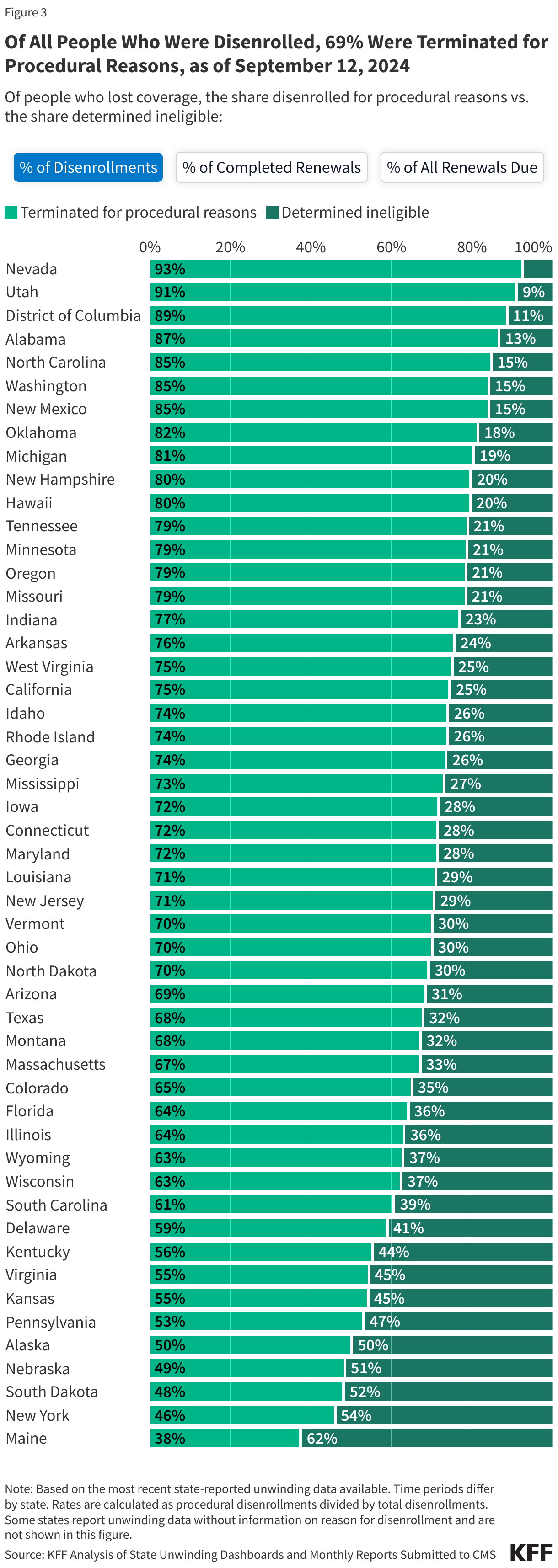
- The Procedural Barrier: A staggering 69% of all disenrollments were categorized as "procedural." These individuals lost coverage not because they were determined to be financially ineligible, but due to administrative hurdles, such as failure to return paperwork, outdated contact information, or system errors.
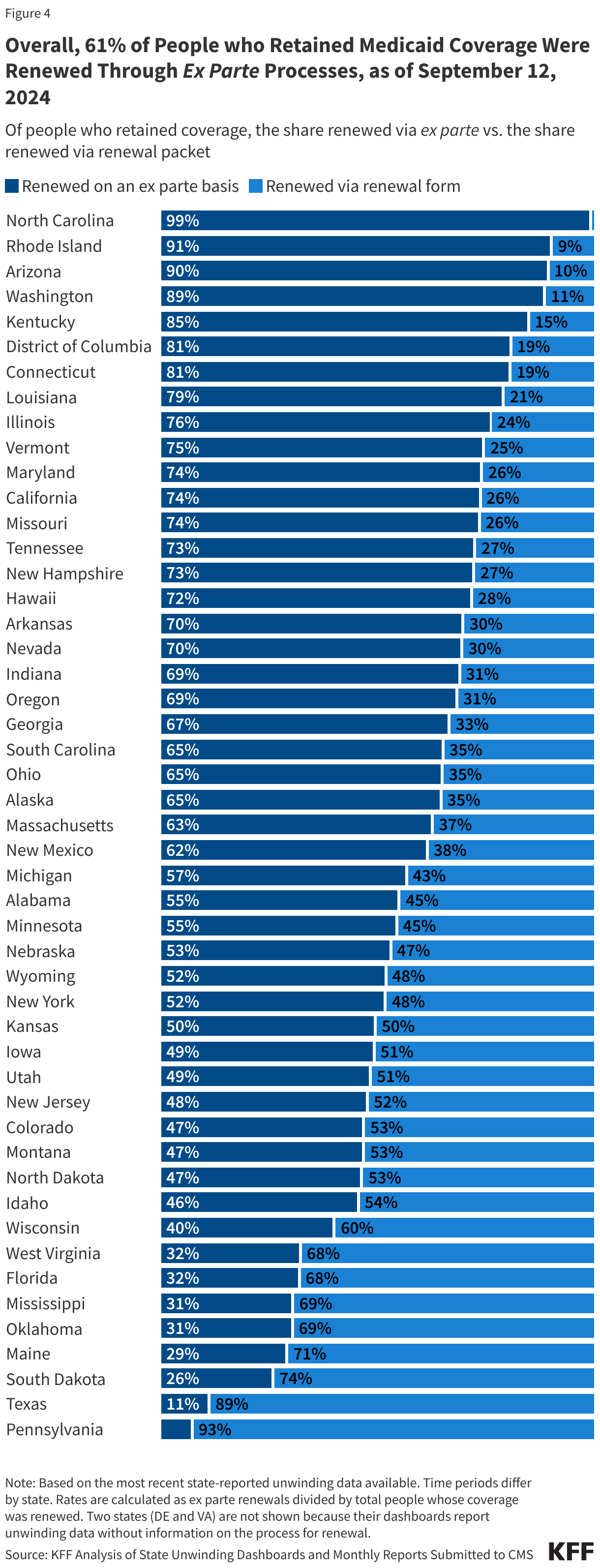
- Renewal Success: Conversely, 56,378,000 enrollees successfully had their coverage renewed. Of those who retained coverage, 61% were processed via "ex parte" renewals—an automated system that uses existing data to verify eligibility without requiring action from the enrollee.
- Legislative Shift: The 2025 reconciliation law has introduced a new era of conditionality. Starting in January 2027, adults in the Medicaid expansion group and those under certain 1115 waivers will be required to meet work and reporting requirements to maintain their health benefits.
- Demographic Impact: While both adults and children have seen enrollment declines, the impact on children is particularly scrutinized by public health advocates, as many children remain eligible for CHIP even when their parents lose Medicaid eligibility.
n
n
n
n
n
n
Chronology: From Pandemic Protection to Fiscal Tightening
n
To understand the current enrollment volatility, one must look back at the policy shifts that began in early 2020.
n
The Pandemic Baseline (February 2020 – March 2023)
n
In February 2020, before the COVID-19 pandemic reshaped the global economy, Medicaid enrollment stood at a stable baseline. To prevent a spike in the uninsured rate during the public health emergency, Congress enacted the Families First Coronavirus Response Act. This included a "continuous enrollment provision," which barred states from disenrolling anyone from Medicaid in exchange for enhanced federal funding. As a result, enrollment swelled to record highs, providing a critical buffer during the economic downturn.
n
The Unwinding Period (April 2023 – September 2024)
n
The "unwinding" began in April 2023, as states were once again permitted to conduct eligibility redeterminations and disenroll those who no longer qualified or failed to complete the renewal process. This period, which largely concluded by September 2024, was characterized by massive administrative workloads for state agencies and significant confusion for enrollees.
n
The 2025 Reconciliation Law (January 2025 – Present)
n
Following the completion of the unwinding, the 2025 reconciliation law was passed, introducing the most significant structural changes to Medicaid since the Affordable Care Act (ACA). This law focused on fiscal sustainability and "personal responsibility," setting the stage for the work requirements that are now less than a year away from implementation.
n
The Current Snapshot (April 2026)
n
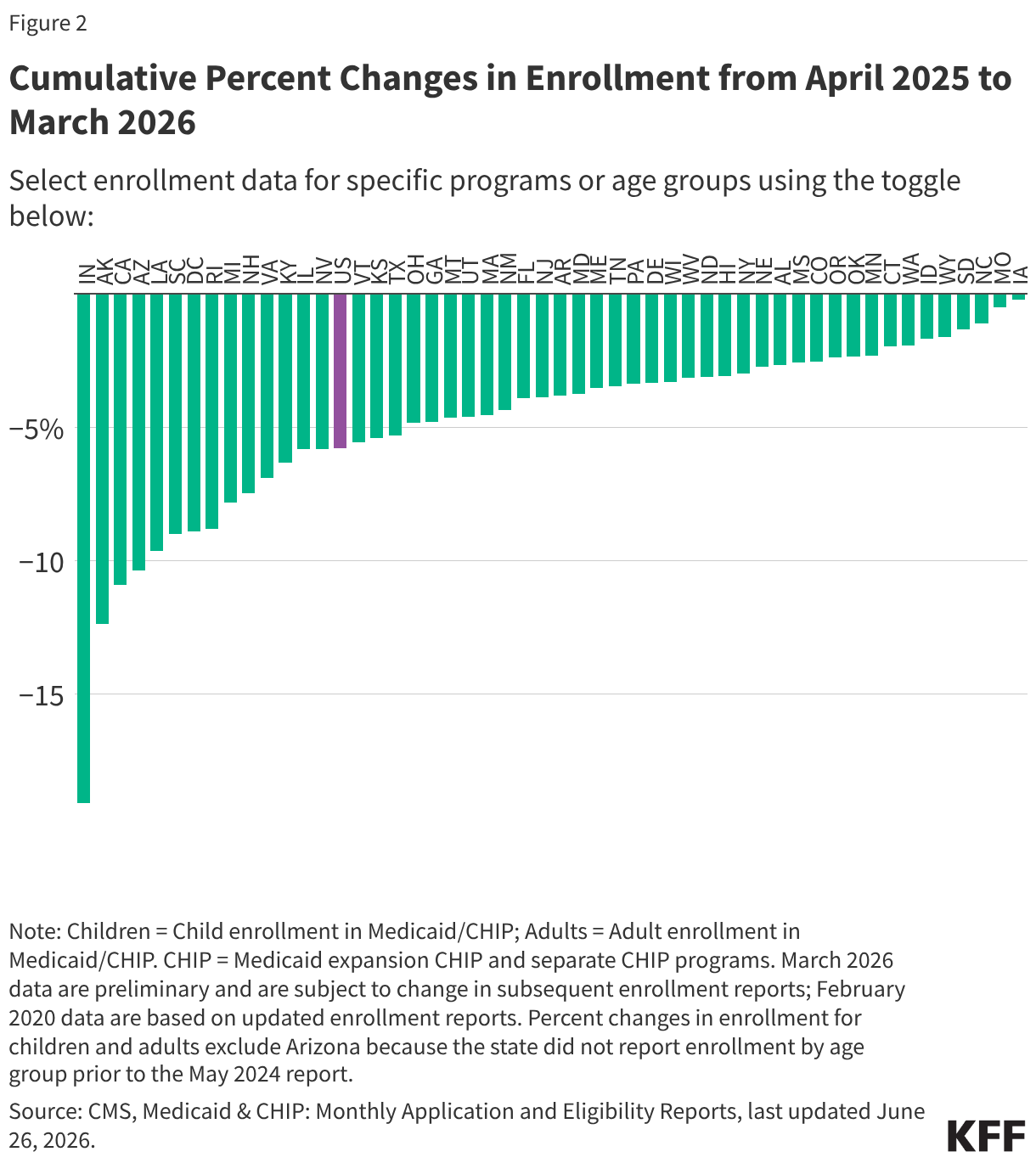
As of the latest reports, the program is experiencing a "new normal." Enrollment levels have stabilized below their pandemic peaks but remain higher than the 2020 baseline in many states. However, the annual percent change in enrollment from April 2025 to April 2026 shows a steady downward trend as states tighten eligibility controls and prepare for the 2027 requirements.
n
Supporting Data: State-Level Variance and Procedural Pitfalls
n
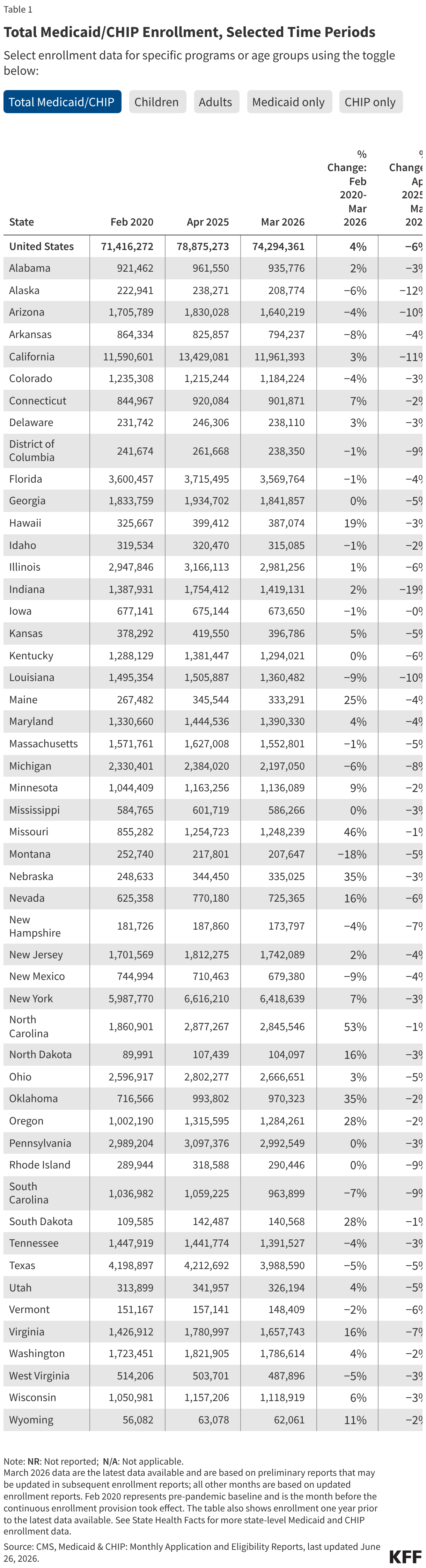
The national data masks a high degree of variation at the state level, reflecting the decentralized nature of Medicaid administration and the divergent political priorities of state governments.
n
Disenrollment Disparities
n
The rate of disenrollment varies dramatically across the country. In Montana, for example, the disenrollment rate reached 57% of completed redeterminations. In contrast, North Carolina, which recently expanded Medicaid, saw a disenrollment rate of only 12%. This 45-percentage-point gap highlights how state-specific policies—such as the investment in outreach, the quality of automated systems, and the length of grace periods—directly dictate coverage outcomes.
n
The Challenge of "Procedural" Losses
n
The fact that 69% of disenrollments were procedural remains the most controversial aspect of the unwinding data. Advocacy groups point to this as evidence of a "broken" renewal system. In many cases, enrollees who were still eligible for coverage lost it because renewal notices were sent to old addresses or because they could not navigate complex, multi-page forms.
n
CMS data suggests that when states prioritize "ex parte" renewals, procedural disenrollments drop. The 61% national average for automated renewals is an improvement over previous years, but it remains uneven. States with modern IT infrastructure have been able to keep more eligible people covered than those relying on legacy paper-based systems.
n
Child vs. Adult Enrollment
n
Data for April 2026 indicates that child enrollment in CHIP has been more resilient than adult enrollment in Medicaid. However, the "churn"—where individuals cycle on and off the program due to minor income fluctuations or administrative errors—remains high for both groups. CMS has urged states to adopt 12-month continuous eligibility for children to mitigate this, a policy that has seen increased adoption in the wake of the 2025 reconciliation law.
Official Responses: Federal Guidance and State Challenges
The Department of Health and Human Services (HHS), through CMS, has maintained a stance of "cautious oversight." Officials have repeatedly emphasized that while states have the right to manage their rolls, they must do so in compliance with federal civil rights and disability laws.
CMS Oversight
"Our goal is to ensure that everyone who is eligible for Medicaid stays covered," a CMS spokesperson noted in a recent update. The agency has utilized "mitigation strategies," at times ordering specific states to pause procedural disenrollments when data suggested that eligible individuals, particularly children, were being erroneously removed from the program.
State Perspectives
State health administrators have often cited "administrative exhaustion" and "workforce shortages" as the primary hurdles during the unwinding and the transition to the 2025 law’s standards. "We are balancing the need for program integrity with the need for access," said a representative from a state health department in the Midwest. "The 2025 law adds a layer of complexity to our systems that requires significant IT investment and staff training."
The 2025 Reconciliation Mandate
The 2025 reconciliation law’s work requirements, scheduled to begin in January 2027, represent a pivot toward a more restrictive model for the Medicaid expansion population. Proponents of the law argue that it encourages economic participation and preserves resources for the "most vulnerable," such as the elderly and those with disabilities. Critics, however, warn that it will lead to a new wave of procedural disenrollments, as even working individuals may struggle to navigate the monthly reporting requirements.
Implications: The Future of the Safety Net
The current trends in Medicaid and CHIP enrollment have profound implications for the broader U.S. healthcare economy and the health outcomes of millions.
Impact on the Uninsured Rate
The 25 million disenrollments since 2023 have already begun to push the national uninsured rate upward. While some of those disenrolled transitioned to employer-sponsored insurance or the ACA Marketplace, KFF analysis suggests that a significant portion—particularly those in the "coverage gap" in non-expansion states—remain without any form of health insurance.
Financial Strain on Providers
Hospitals and community health centers, particularly in rural areas, are reporting a rise in uncompensated care. As Medicaid enrollment drops, the financial burden shifts to providers, who must treat uninsured patients in emergency departments. This strain is expected to intensify as the 2027 work requirements take effect.
The 2027 Horizon: A New Test
The upcoming year will be a litmus test for the 2025 reconciliation law. The implementation of work and reporting requirements will require a massive communication effort to prevent a repeat of the procedural disenrollment crisis seen during the unwinding. If states and the federal government cannot streamline the reporting process, the "2027 Cliff" could result in another several million Americans losing access to primary care, prescription drugs, and mental health services.
Conclusion
As the data from April 2026 shows, the era of "automatic" coverage is over. The Medicaid program has returned to a model defined by rigorous, often cumbersome, eligibility verification. For the 56 million who have successfully renewed their coverage, the system has worked. But for the 25 million who have fallen through the cracks—and for the millions more facing new requirements in 2027—the future of their healthcare access remains precariously tied to their ability to navigate an increasingly complex administrative landscape.
For further information and state-specific data, the KFF Medicaid Enrollment and Unwinding Tracker remains the primary resource for monitoring these ongoing shifts in American health policy.

