
WASHINGTON D.C. — In what marks the most significant reorganization of American foreign policy in over half a century, the landscape of international development has been fundamentally transformed. Following the dissolution of the U.S. Agency for International Development (USAID) and the centralization of foreign assistance within the State Department, the "America First Global Health Strategy" (AFGHS) has emerged as the definitive blueprint for U.S. engagement abroad.
n
As of November 2026, the transition from traditional development models to a state-centric, bilateral framework is well underway. The centerpiece of this transition is the Advancing Global Health Annual Program Statement (AGH/APS), a competitive funding mechanism designed to operationalize billions of dollars in aid through a lens of national interest, government-to-government (G2G) accountability, and strategic co-investment.
n
Main Facts: The $26.7 Billion Pivot
n
The current U.S. global health strategy represents a departure from the multilateral and NGO-heavy approach of previous decades. At its core, the AFGHS is anchored by bilateral Memoranda of Understanding (MOUs) negotiated directly between the State Department and partner nations.
n
To date, the United States has signed 36 such agreements, representing a total financial commitment of $26.7 billion. Under these MOUs, the U.S. has pledged $15.9 billion, while partner countries have committed to co-investing $10.3 billion. This "skin in the game" requirement is a cornerstone of the America First doctrine, intended to ensure that recipient nations transition toward self-reliance and government-led health systems by 2030.
n
To implement these high-level agreements, the State Department launched the AGH/APS in March 2026. This mechanism anticipates providing up to $4.5 billion in funding across four distinct windows. As of late 2026, twelve "addenda"—or specific funding opportunities—have been released, totaling $1.43 billion. These awards, ranging from $500,000 to $250 million, are being directed toward both specific countries and cross-cutting health threats like infectious disease outbreaks and neglected tropical diseases (NTDs).
n
Chronology of the Reorganization
n
The path to the current aid landscape was forged through a series of rapid, systemic changes beginning in early 2025:
n
- n
- Early 2025: The Dissolution of USAID. The administration initiated a sweeping foreign aid review, resulting in the reduction of supported projects and the eventual dissolution of USAID. Responsibility for all global health efforts was transferred to the State Department’s Bureau of Global Health Security and Diplomacy.
- September 2025: The AFGHS Launch. The State Department released the America First Global Health Strategy report. This document codified the shift toward bilateralism and the prioritization of U.S. national security interests within health programming.
- Late 2025 – Early 2026: The MOU Phase. The U.S. aggressively negotiated 36 MOUs with partner countries, establishing the "funding envelopes" that define the financial boundaries of bilateral cooperation.
- March 2026: The APS Framework. The "Advancing Global Health" Annual Program Statement was announced, opening the door for U.S. and foreign for-profit enterprises, faith-based organizations, and governmental institutions to apply for implementation contracts.
- March – October 2026: Funding Windows 1 through 3. The State Department released 12 addenda, soliciting applications for $1.43 billion in projects.
- November 2026: Window 4 Expectation. The final funding window is expected to open, completing the initial cycle of the AFGHS implementation.
n
n
n
n
n
n
n
Supporting Data: A Granular Look at Funding Allocation
n
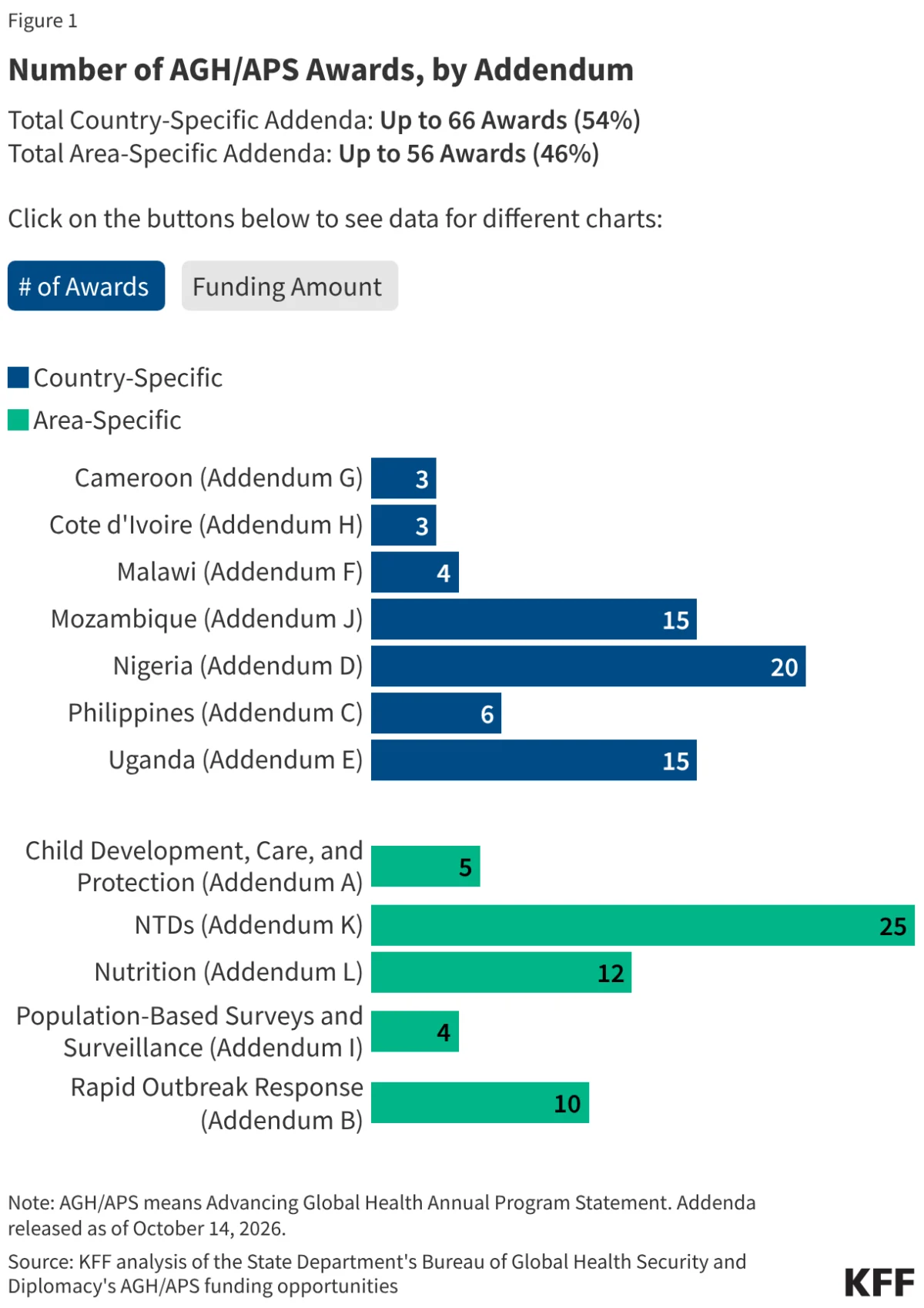
The $1.43 billion committed through the APS so far is split almost evenly between country-specific initiatives (51%) and area-specific health programs (49%).
n
Country-Specific Strategic Investments
n
The State Department has prioritized seven nations for deep-tier integration, with funding totals reflecting their perceived strategic importance:
n
- n
- Nigeria ($200 Million): The largest African allocation, focused on expanding health insurance for women and children and enhancing faith-based integrated service delivery.
- The Philippines ($200 Million): A unique addendum that emphasizes the use of U.S. technologies and standards. It aims to scale up digital health, laboratory, and supply chain innovations through partnerships with U.S. and Philippine firms.
- Mozambique ($180 Million): Aimed at strengthening provincial and subnational systems to deliver integrated care across public and private facilities, with a focus on HIV and maternal health.
- Uganda ($60 Million): Focused on institutionalizing supply chain accountability and scaling community-based health financing.
- Cote d’Ivoire ($50 Million): Directed toward accelerating the transition to a government-led health system by 2030.
- Malawi ($35 Million): Concentrated on digital health coordination and supply chain integration.
- Cameroon ($5.4 Million): A targeted "One Health" approach to strengthen disease surveillance and outbreak preparedness.
n
n
n
n
n
n
n
n
Area-Specific Global Priorities
In addition to country-specific funds, the State Department has identified five "Area-Specific" priorities that transcend borders:
- Rapid Outbreak Response ($290 Million): The largest single area-specific pot, designed for early detection and containment of infectious diseases to limit cross-border spread to the U.S.
- Neglected Tropical Diseases ($162 Million): Targeting 32 countries across Africa, Asia, and the Western Hemisphere to eliminate transmission of priority NTDs.
- Nutrition Progress ($115 Million): Focused on reducing maternal and child mortality in high-burden countries like Ethiopia, Nigeria, and the DRC.
- Population-Based Surveys and Surveillance ($80 Million): Funding the development of self-run health data strategies to reduce risks to the United States.
- Child Development and Protection ($52.65 Million): Aimed at strengthening national child protection systems and preventing child-family separation.
Official Responses and Strategic Intent
The State Department has framed the AFGHS not merely as an aid program, but as a diplomatic tool. Officials have indicated that the transition to Government-to-Government (G2G) funding is the "main mechanism" for long-term sustainability. By moving away from "middleman" NGOs and toward direct agreements with sovereign governments, the administration argues it is fostering true partnership rather than dependency.
In the America First Global Health Strategy report, the administration emphasizes that global health security is synonymous with U.S. national security. The focus on "integrated disease surveillance" and "rapid outbreak response" is explicitly linked to preventing pathogens from reaching American shores.
Furthermore, the inclusion of "U.S. private for-profit enterprises" as eligible applicants for APS awards signals a shift toward using health aid to bolster U.S. economic interests. In the Philippines, for example, the explicit goal of "expanding the use of U.S. technologies and standards" suggests that health assistance is being used to create markets for American digital and medical innovations.
Partner countries have responded with a mixture of cooperation and caution. While the $10.3 billion in co-investment commitments suggests a high level of buy-in, the "limited information" available on the status of the 36 MOUs indicates that the negotiation process remains sensitive and, at times, opaque.
Implications: The Post-USAID Landscape
The transition to the AFGHS and the APS mechanism has profound implications for the future of global health.
1. The End of the "NGO Era": For decades, U.S. global health aid was largely funneled through large international NGOs. Under the new strategy, the emphasis is on G2G agreements and "faith- and community-based organizations." This shift effectively decentralizes implementation, favoring local or religious entities over traditional developmental giants.
2. Accountability and Sovereignty: By requiring partner countries to co-finance health efforts, the U.S. is testing a new model of accountability. If partner countries fail to meet their $10.3 billion commitment, the future of U.S. funding remains uncertain. This "sustainability-first" approach places the burden of proof on the recipient nation.
3. Geopolitical Competition: The focus on "U.S. standards" in regions like the Philippines suggests that global health has become a new frontier in the geopolitical competition for technological and regulatory influence. By embedding U.S. digital health and laboratory standards into national systems, the State Department is ensuring long-term alignment with American infrastructure.
4. Transparency Concerns: As noted by policy analysts, there is currently "limited information" on the implementation plans for the signed MOUs. With no awards publicly announced as of late 2026, the international community is waiting to see how the $1.43 billion in APS solicitations will translate into actual field operations.
5. Health as Security: The heavy weighting of funds toward outbreak response and surveillance ($370 million combined) reinforces the administration’s view of global health as a defensive perimeter. The "America First" moniker is reflected in the prioritization of programs that mitigate direct threats to the U.S. population.
As Window 4 of the APS approaches in late 2026, the global health community remains in a period of watchful transition. The dissolution of USAID was the first tremor; the $26.7 billion bilateral framework is the new foundation. Whether this state-led, "America First" approach can sustain the gains made against HIV, Malaria, and TB while navigating a more nationalist global landscape remains the defining question of this second administration.

