
Introduction: The Intersection of Two Titans
n
In the intricate architecture of the American social safety net, few groups occupy a more complex or costly position than the "dual-eligible" population. These are the approximately 12 million individuals enrolled in both Medicare—the federal program primarily for those aged 65 and older—and Medicaid—the joint state and federal program for low-income individuals.
n
A new analysis of administrative and claims data from 2022 and 2023 reveals a stark reality: while dual-eligible individuals represent a minority of enrollees in both programs, they account for a staggering and disproportionate share of total spending. This fiscal reality is driven not by administrative inefficiency alone, but by a demographic profile characterized by deep poverty, significant disability, and a high prevalence of multiple chronic conditions. As the U.S. healthcare system grapples with rising costs and an aging population, understanding the needs of these 12 million people has become a primary concern for policymakers and taxpayers alike.
n
Main Facts: A Demographic and Fiscal Profile
n
The dual-eligible population is far from monolithic, yet they share a common thread of heightened medical necessity. According to the latest data, this group is significantly more likely than those covered by only one program to report being in fair or poor health. Many require daily assistance with activities of daily living (ADLs), such as bathing, dressing, or eating.
n
The Two Tiers of Coverage
n
The population is divided into two primary categories based on the level of assistance they receive:
n
- n
- Full-Benefit Dual-Eligible Individuals (8.6 Million): These individuals qualify for the full range of Medicaid benefits in addition to their Medicare coverage. This includes "wraparound" services that Medicare does not typically cover, such as long-term services and supports (LTSS), vision care, and dental services.
- Partial-Benefit Dual-Eligible Individuals (3.5 Million): These individuals have slightly higher incomes or assets but still qualify for the Medicare Savings Programs. For this group, Medicaid acts as a financial cushion, paying for Medicare premiums and, in many instances, cost-sharing requirements.
n
n
n
The Spending Disparity
n
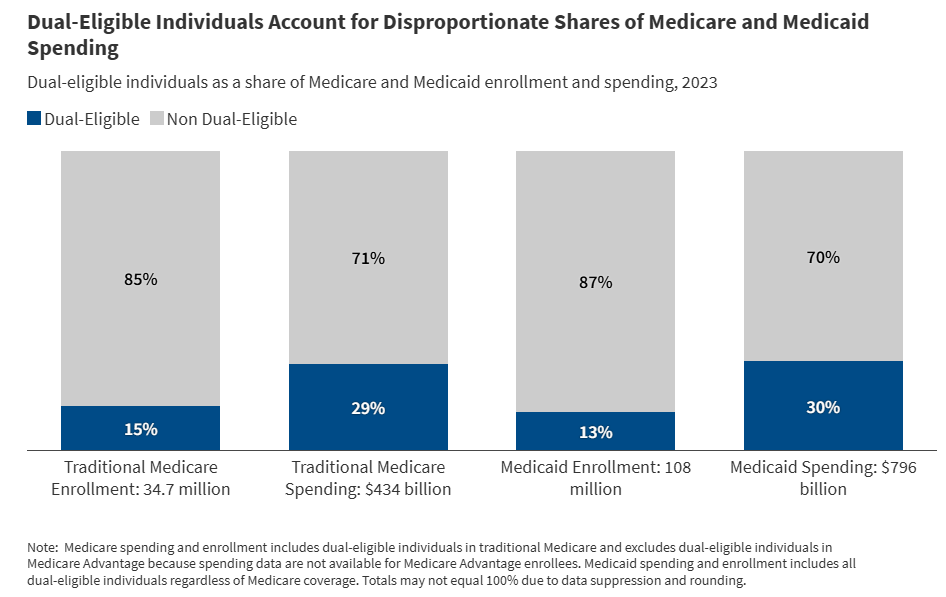
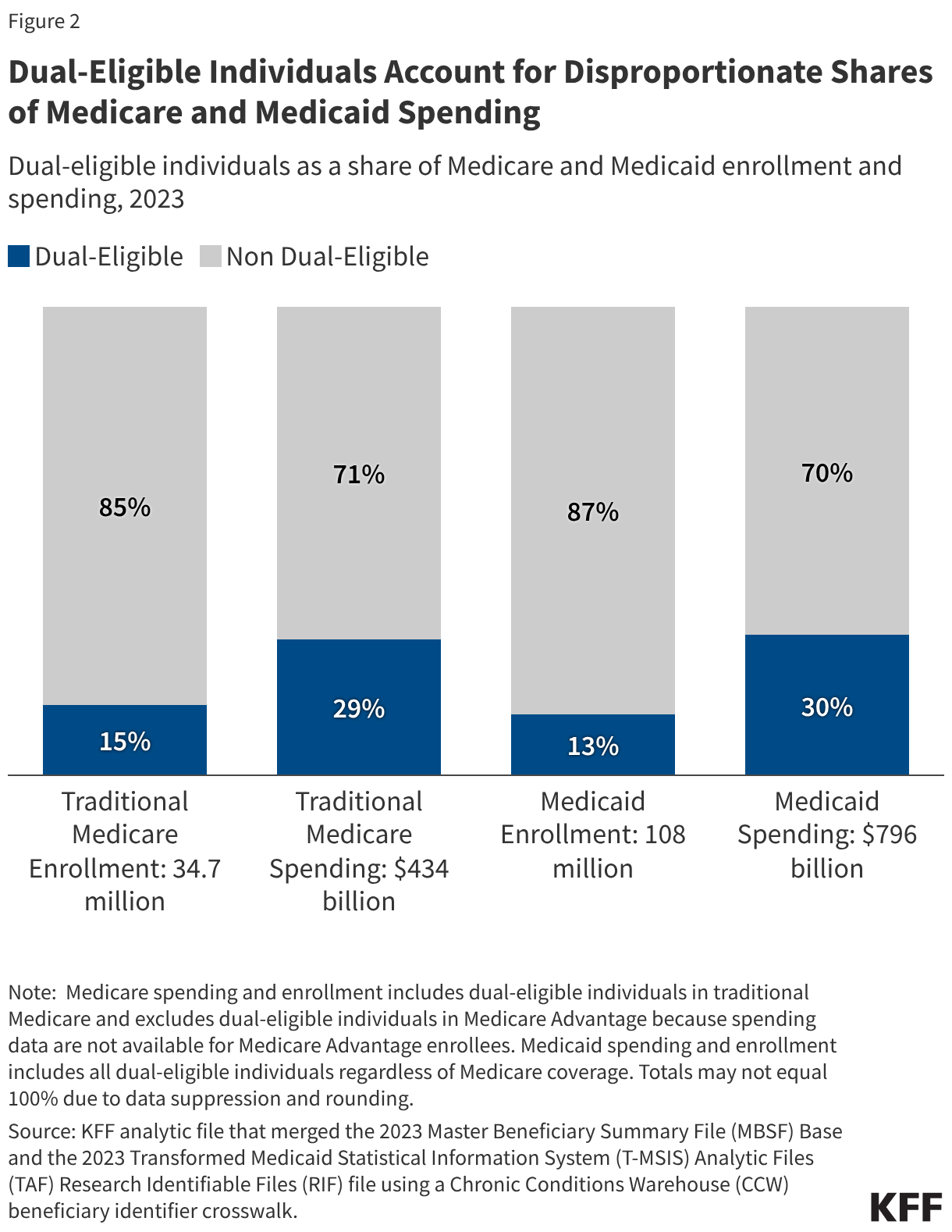
The most striking finding of the recent analysis is the "spending-to-enrollment" gap. Dual-eligible individuals comprise 21% of the total Medicare population but are responsible for 29% of traditional Medicare spending, totaling roughly $127 billion. The trend is even more pronounced in Medicaid, where they represent only 13% of enrollees but consume 30% of total federal and state spending—a massive $241 billion. Collectively, these two programs spend upwards of $368 billion annually on this specific population.
n
Chronology: The Evolution of Fragmented Care
n
To understand why dual-eligible individuals are so expensive to care for, one must look at the historical and structural "fragmentation" of their coverage.
n
The Payer Hierarchy
n
Historically, the relationship between Medicare and Medicaid has been one of "primary" and "secondary" responsibility. Medicare is always the primary payer, covering medical services, hospital stays, and post-acute care. Medicaid is the "payer of last resort," stepping in only after Medicare has fulfilled its obligations.
n
The Fragmentation Problem
n
For decades, health policy experts have warned that having two separate sources of coverage leads to disjointed care. Because Medicare is federal and Medicaid is state-administered, the two programs often have different sets of rules, provider networks, and administrative requirements. This fragmentation often results in:
n
- n
- Duplicate Testing: Lack of data sharing between the two programs can lead to unnecessary repeated procedures.
- Administrative Friction: Patients and providers must navigate two different bureaucracies to authorize treatments.
- Cost Shifting: States may have incentives to shift costs toward the federal Medicare program, while the federal government may try to ensure states maintain their Medicaid obligations.
n
n
n
n
This "siloed" approach has historically made it difficult to manage the care of the most complex patients, who are often shuffled between hospitals (Medicare-funded) and nursing homes or home-based care (Medicaid-funded).
n
Supporting Data: The Correlation Between Chronic Illness and Cost
n
The high per-person costs associated with dual-eligible individuals are not arbitrary; they are directly tied to the clinical complexity of the population.
n
The Per-Person Breakdown
n
The disparity in per-person spending is vast:
n
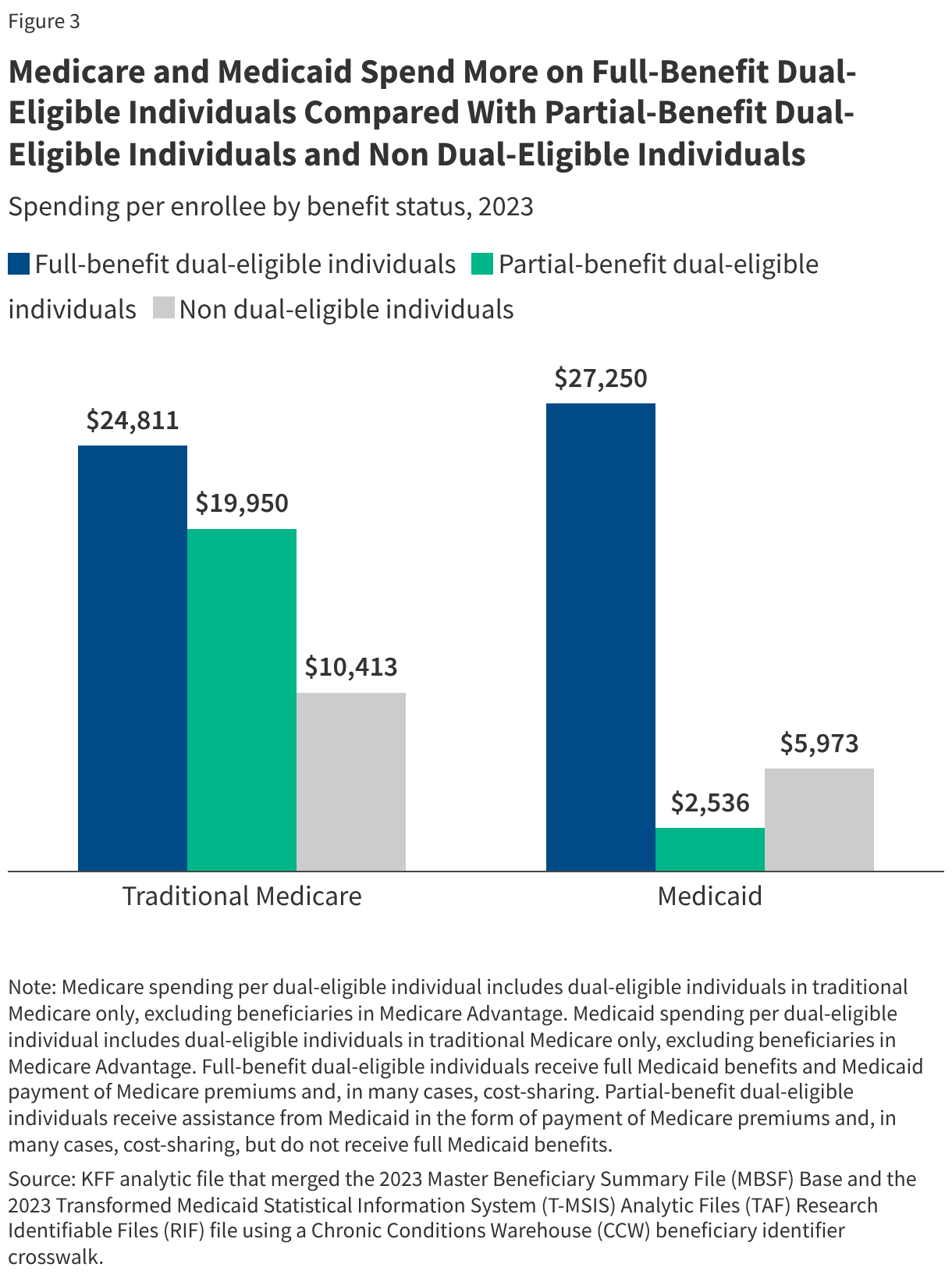
- Medicare Spending: Traditional Medicare spends an average of $24,811 on each full-benefit dual-eligible individual. In contrast, it spends only $10,413 on beneficiaries who do not have Medicaid.
- Medicaid Spending: For full-benefit duals, Medicaid spending averages $27,250 per person. For Medicaid enrollees who are not on Medicare (mostly children and non-disabled adults), that figure drops to just $5,973.
The Burden of Chronic Conditions
The data suggests that the "secret" behind these high costs is the sheer volume of chronic illnesses.
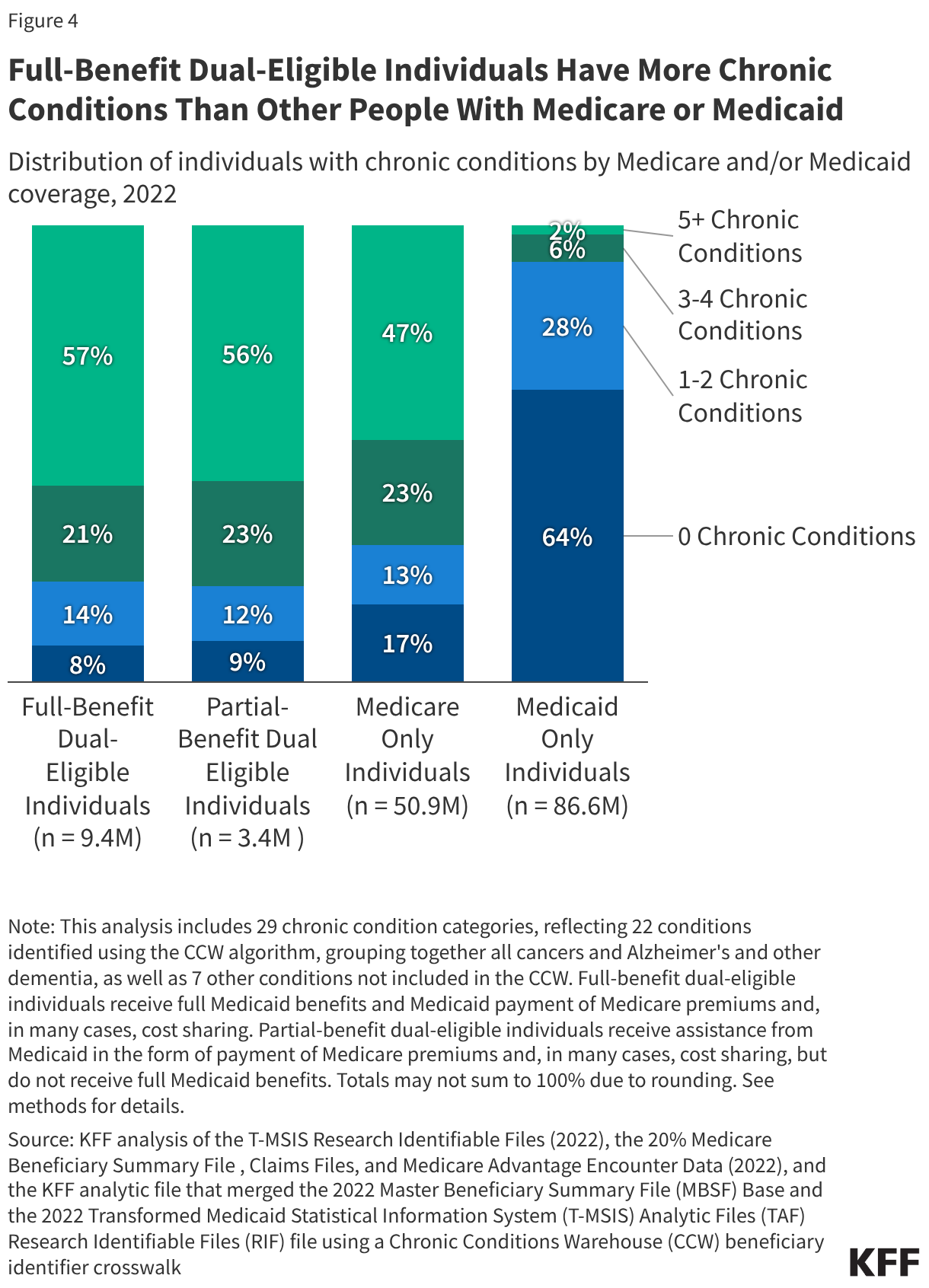
- The 5+ Club: Approximately 57% of full-benefit dual-eligible individuals have five or more chronic conditions. This is significantly higher than the 47% seen in the non-dual Medicare population.
- The Zero-Condition Gap: While 64% of Medicaid-only enrollees have zero chronic conditions, only 8% of full-benefit dual-eligible individuals can say the same.
The financial impact of these conditions is exponential. For a full-benefit dual-eligible individual with no chronic conditions, Medicare spending is a modest $3,955. However, for an individual with five or more conditions, that spending skyrockets to $40,341—a more than tenfold increase. Medicaid spending follows a similar trajectory, jumping from $4,751 to $27,681 as the number of chronic conditions increases.
State-Level Variation
The concentration of dual-eligible individuals varies wildly by geography, reflecting state-specific economic conditions and Medicaid eligibility thresholds:
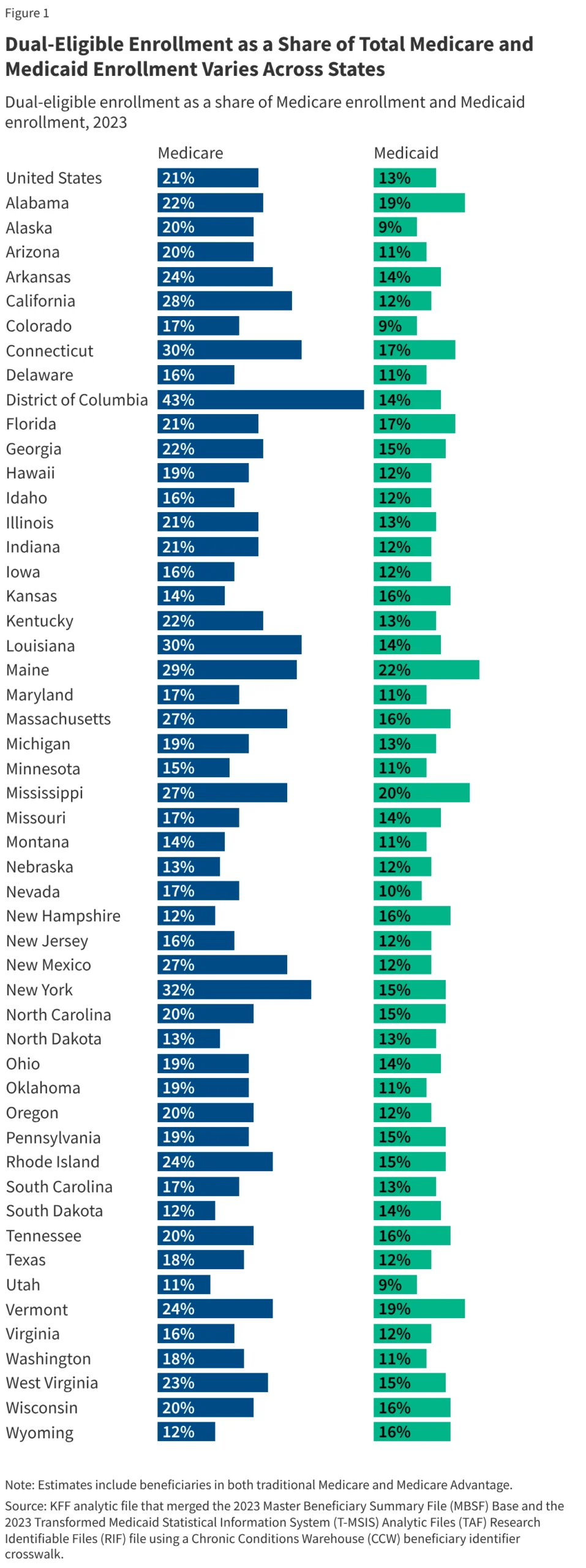
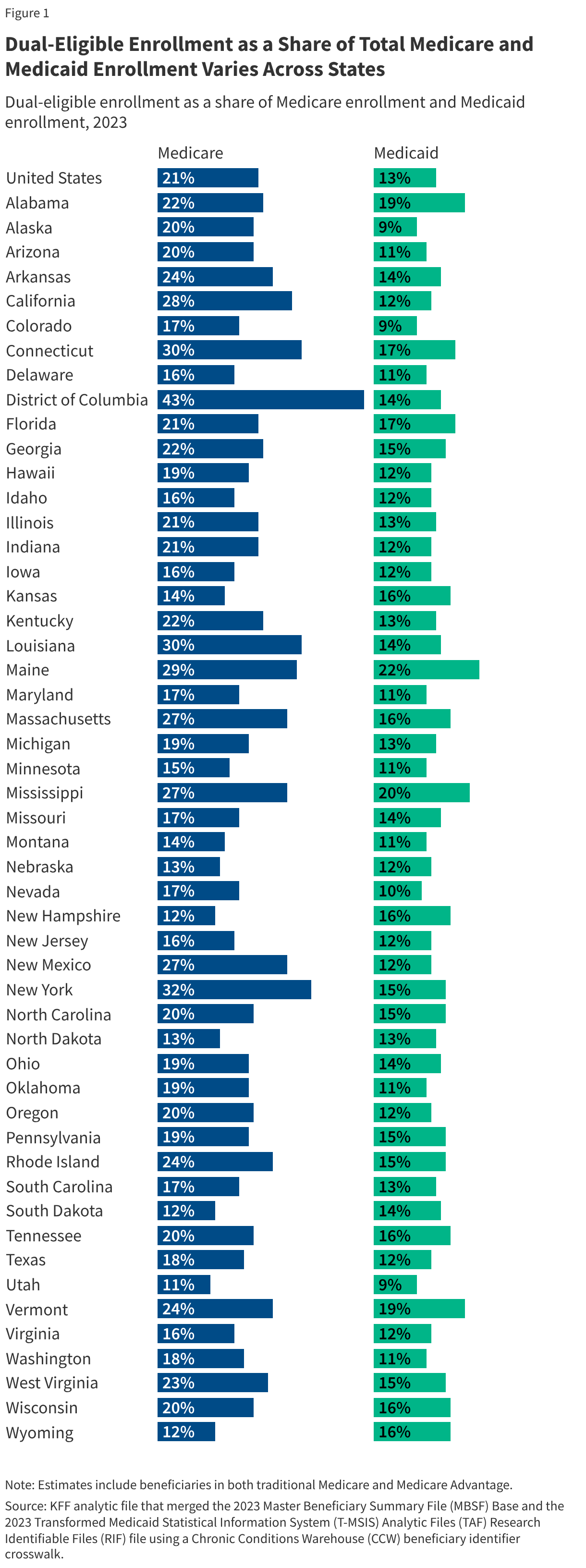
- High-Concentration States: In the District of Columbia, New York, Connecticut, and Louisiana, dual-eligible individuals make up 30% or more of all Medicare beneficiaries.
- Low-Concentration States: In Utah, they represent only 11% of the Medicare population.
These variations suggest that state-level policy decisions regarding Medicaid expansion and income limits play a critical role in determining who gains dual-eligible status.
Official Responses: Navigating the Policy Landscape
The findings of this analysis have sparked renewed calls for "integrated care" models. Organizations like the Kaiser Family Foundation (KFF) and the Medicaid and CHIP Payment and Access Commission (MACPAC) have long advocated for a more unified approach to managing this population.
Focus on Long-Term Services and Supports (LTSS)
Policy experts point out that Medicaid’s high spending on dual-eligible individuals is largely driven by long-term care. Medicare generally does not cover nursing home stays beyond short-term rehabilitation. Consequently, Medicaid becomes the primary financier for long-term institutional care and Home and Community-Based Services (HCBS). Spending on enrollees who use LTSS is eight times higher than on those who do not, and over 60% of all LTSS users are dual-eligible.
The Push for Integration
In response to the fragmented nature of the programs, the Centers for Medicare & Medicaid Services (CMS) has been encouraging the growth of Dual-Eligible Special Needs Plans (D-SNPs). These are specialized Medicare Advantage plans designed to coordinate benefits between the two programs. However, critics argue that while D-SNPs offer better coordination, they also add another layer of private-sector complexity to a system that is already difficult for vulnerable seniors to navigate.
Implications: The Future of the Safety Net
The data presented in this analysis carries profound implications for the future of American healthcare policy.
Fiscal Sustainability
As the "Baby Boomer" generation continues to age, the number of dual-eligible individuals is expected to rise. Given that this group already consumes nearly a third of the budget for both Medicare and Medicaid, the financial pressure on both federal and state coffers will intensify. Without significant reforms in how chronic conditions are managed and how care is coordinated, the current spending trajectory may become unsustainable.
Quality of Care and Equity
The dual-eligible population is not only medically fragile but also economically marginalized. The higher rates of chronic conditions are often linked to social determinants of health, such as lack of access to nutritious food, unstable housing, and the cumulative stress of lifelong poverty. Addressing the high costs of this population requires more than just medical intervention; it requires a holistic approach that addresses the underlying social factors contributing to poor health.
Conclusion: A Call for Systemic Reform
The $368 billion spent on dual-eligible individuals is a testament to the commitment of the American social safety net to its most vulnerable citizens. However, it is also a reminder of the inefficiencies inherent in a "two-master" system. The data is clear: the path to reducing costs and improving lives for the 12 million dual-eligible Americans lies in breaking down the silos between Medicare and Medicaid.
The correlation between chronic disease and spending highlights a massive opportunity for preventative care and intensive case management. If the healthcare system can better manage the "5+ chronic condition" population through integrated, home-based care, it may not only save billions of dollars but also significantly improve the quality of life for millions of Americans who currently navigate the most complex corner of the U.S. medical system.

